Ideas for a Better World newsletter
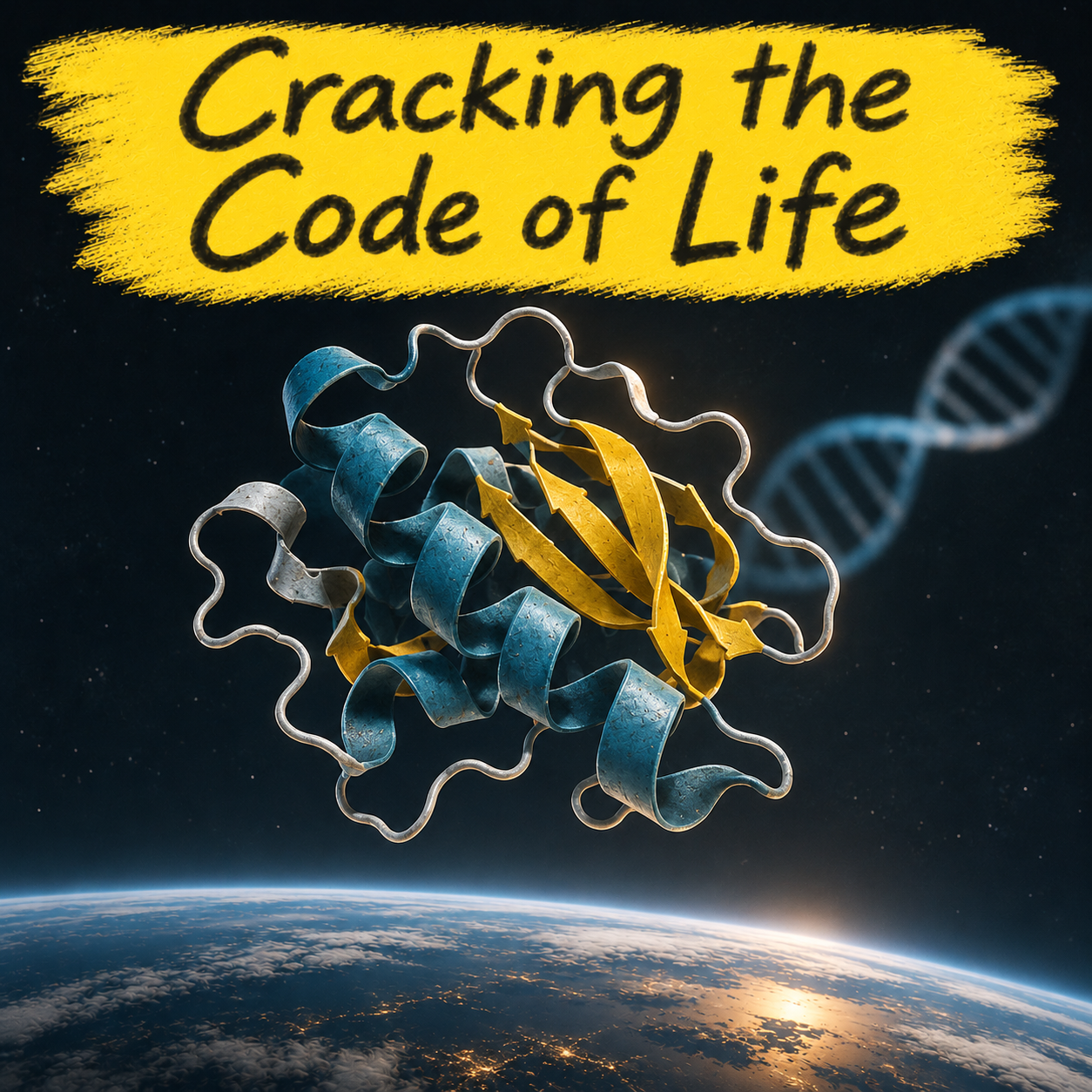
Cracking the Code of Life
The 2024 Nobel Prize in Chemistry rewarded AI that predicts and designs proteins, the machinery of every living thing. Two years on, the code is cracked, but the hard part has moved: from the computer to the clinic, the factory and the funding round. For leaders, that is the real lesson of AI in science.
Tags: AI, Biotechnology, Innovation
In October 2024 the Nobel Prize in Chemistry went to two pieces of work that changed how biology is done. Half went to David Baker of the University of Washington, for designing proteins that do not exist in nature. The other half went jointly to Demis Hassabis and John Jumper of Google DeepMind, for AlphaFold2, an AI model presented in 2020 that predicts the three-dimensional shape of a protein from its sequence of amino acids. The team used it to predict structures for virtually all of the roughly 200 million proteins researchers have identified, and more than two million people in 190 countries have used it. (Utrecht University)
When this newsletter first wrote about the prize, it described a coming revolution in medicine, materials and the environment. Two years is long enough to see what the revolution looks like in practice. The answer is instructive: AI has transformed the first step of turning biology into products, and left the later steps almost untouched.
Lab, trials or market?
Four results that followed the 2024 prize. Decide how far each has travelled from the computer towards the real world, then see the verdict.
Verdict: in the lab. Designed proteins neutralised cobra and mamba toxins, with 80% to 100% of mice surviving lethal doses. Not yet tested in people.
Verdict: in late-stage trials. After an encouraging 71-patient trial, Insilico began a Phase III trial at 47 centres in China in July 2026. It is not yet approved.
Verdict: in the lab. It raised $2.1 billion in May 2026 to move its pipeline towards the clinic. It has given no date for a first human trial.
Verdict: at pilot scale. Carbios has run a demonstration plant since 2021. Its first industrial plant is still waiting for financing.
None of the four has reached the market yet. That is the story below.
Why proteins matter
Proteins are chains of amino acids that fold into precise shapes, and the shape determines what each one does: catalysing reactions, carrying signals, building tissue, fighting infection. Scientists have long known that the sequence dictates the fold, but predicting the fold from the sequence was one of biology's great unsolved problems for around 50 years. Working out a single structure experimentally could take years of laboratory effort. AlphaFold2 made a good prediction a matter of minutes. (University of Cambridge)
Designing new proteins is the mirror image: starting from the shape and function you want, and working back to a sequence that will fold into it. Baker's lab has spent two decades making that routine.
Two years on: how far has it got?
The useful way to judge a breakthrough is to ask how far its results have travelled, from the laboratory to people and markets.
In the lab: designed antivenoms. In January 2025, Baker's team reported in Nature that it had used AI to design small proteins that neutralise some of the deadliest toxins in cobra and mamba venom. In mice, 80% to 100% survived otherwise lethal doses. It is a striking result, achieved far faster than traditional antivenom development, and it has not yet been tested in people. (Institute for Protein Design)
In the clinic: an AI-discovered drug in late-stage trials. Protein structure prediction is one part of a wider push to use AI in drug discovery. In June 2025, Insilico Medicine published the results of a 71-patient trial in Nature Medicine for rentosertib, a drug for the lung-scarring disease idiopathic pulmonary fibrosis, whose target and molecule were both identified with AI. Over 12 weeks, patients on the highest dose saw their lung capacity rise by an average of 98.4 millilitres, against a fall of 20.3 millilitres on placebo. (Peking Union Medical College Hospital) In July 2026 Insilico began a Phase III trial at 47 centres in China. (GeneOnline) The drug is not yet approved.
The trial that moved an AI-discovered drug forward
Change in lung capacity (forced vital capacity) after 12 weeks, phase 2a trial of rentosertib, 71 patients.
| Group | Change in lung capacity |
|---|---|
| Rentosertib, 60 mg once a day | Up 98.4 mL |
| Placebo | Down 20.3 mL |
A small, early trial. Larger trials are needed before the drug could be approved.
Sources
In the funding round: a pipeline heading towards the clinic. Isomorphic Labs, the drug-discovery company spun out of DeepMind to commercialise this work, raised $2.1 billion in May 2026. Its announcement says the money will move its pipeline "towards the clinic". It gives no date for a first human trial. (Isomorphic Labs)
In the factory: still waiting. The original edition of this newsletter imagined enzymes designed to break down plastic. The most advanced example, an enzyme developed by the French company Carbios that recycles PET plastic, already works, and has run in a demonstration plant since 2021. (Textile World) Its first industrial plant does not yet exist. Carbios postponed construction in January 2025 while it sought financing, and in August 2026 said it would miss its latest target for closing the funding. (bioplastics MAGAZINE); (EUWID)
From prize to practice
What has happened since the 2024 Nobel Prize in Chemistry.
| When | What happened | Stage reached |
|---|---|---|
| October 2024 | Nobel Prize for AlphaFold2 and protein design | Recognition |
| January 2025 | AI-designed antivenom proteins protect mice | Lab |
| January 2025 | Carbios postpones its first industrial plastic-recycling plant | Pilot |
| June 2025 | AI-discovered drug shows benefit in a 71-patient trial | Early trial |
| May 2026 | Isomorphic Labs raises $2.1 billion | Lab |
| July 2026 | AI-discovered drug enters Phase III | Late trial |
| August 2026 | Carbios misses its financing target | Pilot |
The bottleneck moved
Put those four together and a pattern emerges. AI has compressed the part of the process that happens in a computer. Finding a structure, designing a binder or nominating a drug candidate now takes months or weeks rather than years. Everything that happens in the physical world takes as long as it always did. Trials still need patients and time to show results. Factories still need capital, permits and customers willing to sign contracts. Regulators still need evidence.
The result is a pile-up. There are more promising candidates than ever, queuing for the same slow, expensive stages. The value of any single discovery falls, and the value of being able to test, manufacture and finance quickly rises.
The same tools raise a harder question. Software that can design a protein to block a toxin could, in principle, help redesign harmful ones. How screening, publication and access should be governed as the tools spread is a question the field is still working out, and it is one that does not wait for the clinic.
AI compresses discovery. It does not compress delivery.
What this means for leaders
The first implication reaches well beyond biology. When AI speeds up one stage of a process, the constraint moves to the next stage. Organisations that use AI to generate more ideas, designs or candidates, without expanding their capacity to test and deliver them, will simply build a longer queue.
The second is that the scarce capabilities are shifting. In drug discovery, the advantage is moving from whoever can find a molecule to whoever can run a trial, build a plant or secure the financing fastest. The same logic applies to any business adopting AI in research and development.
The third is that timelines deserve scepticism. A Nobel-winning breakthrough in 2024 has produced, by late 2026, promising results in mice, a drug in late-stage trials, a well-funded pipeline without a trial date, and an unbuilt factory. That is normal progress, and it is a useful corrective to any business case that assumes AI will collapse the whole journey.
Three questions follow. Where in our own pipeline will AI create a pile-up, and what is the next constraint? Are we investing in delivery capacity at the same pace as discovery? And when we estimate the value of an AI-driven breakthrough, have we priced in the slow stages it does not touch?
The code of life has been cracked. Turning it into medicines and materials is still a matter of patience, capital and execution.
Your turn: where is the bottleneck in your organisation?
If AI doubled the ideas and designs your teams produced tomorrow, where would they queue?
- Testing and validation
- Approvals and governance
- Funding and investment decisions
- Building and delivering
Vote and see current results on the website.
Thanks for reading,
Ideas for a Better World Editor, Simon Hill
About the Editor: Founder of Wazoku including Innocentive, author of the award winning Expected Value, Mapping Value, TEDx speaker and innovation thought leader.
Read next
The 9% Problem
Why plastic recycling has never carried the load it was given.
From the archive
Move 37, revisited
The next revised edition from the Ideas for a Better World archive.
Every edition
Ideas for a Better World
Subscribe for the weekly edition.
How we checked this piece
This edition was first published in October 2024 and has been revised for 2026. Every claim is graded HIGH against a named primary source. Unsourced claims from the original were removed.
| Claim | Grade | Source |
|---|---|---|
| Prize split; AlphaFold2 presented in 2020; about 200 million structures; more than two million people in 190 countries | HIGH | Utrecht University, reporting the Nobel announcement |
| Around 50-year problem; experimental structures took years | HIGH | University of Cambridge |
| AI-designed proteins against cobra and mamba toxins; 80% to 100% mouse survival; Nature, January 2025; not tested in people | HIGH | Institute for Protein Design |
| Rentosertib: 71 patients; 12 weeks; up 98.4 mL against down 20.3 mL on placebo; Nature Medicine, June 2025 | HIGH | PUMCH; EurekAlert |
| Rentosertib Phase III begun July 2026, 47 centres in China | HIGH | GeneOnline |
| Isomorphic Labs $2.1 billion, May 2026; "towards the clinic"; no trial date given | HIGH | Isomorphic Labs |
| Carbios demonstration plant since 2021; industrial plant postponed January 2025; financing target missed August 2026 | HIGH | Textile World; bioplastics MAGAZINE; EUWID |
| The bottleneck has moved from discovery to delivery | ANALYSIS | Editorial judgement from the sources above |
| Removed from the original: AlphaFold2 already enabling drugs against resistant bacteria; AlphaFold2 modelling plastic enzymes; "two million researchers" | CUT | Unsourced or misquoted |