Ideas for a Better World newsletter
On Maxxing
Maxxing: The word travelled from internet subculture to LinkedIn in a decade. The reflex to dismiss it is wrong. So is the reflex to adopt it.
Tags: Innovation, Story Telling, Crowd
The conversation that turned my attention to maxxing was with my good friend John Winsor: founder of Open Assembly, executive in residence at Harvard Business School's Laboratory for Innovation Science, and one of the sharper thinkers I know on open talent and the structure of modern work. John had posted on LinkedIn about a viral neologism he and his friend Ray Foote, a coach at Reboot, had been puzzling over. The word in question is unattractive at root: it borrows a slur, and the borrowing should make most adults flinch. John said so in the post. So does Ray. So do I.
As John said to me..."Ray had written something I haven't been able to dismiss. He read the term as a clumsy name for what he called "the older courage of beginning before we are ready": action inside an imperfect world rather than the perfectly-reasoned wait. He described overthinking as a "beautiful cage", its bars made from doubts. The cage stays beautiful. It also stays closed."
John's worry, applied to the AI moment, was that senior leaders are inside the cage. They are overthinking the strategic moves their organisations need to make while the world outside moves on. I read the post; we talked it through; the conversation set me on a longer thread.
The longer thread is this. The -maxxing suffix is not just one off-putting variant. It is a wave. Looksmaxxing, gymmaxxing, sleepmaxxing, careermaxxing, moneymaxxing, statusmaxxing: a vocabulary that has migrated from internet subculture into mainstream slang in roughly a decade, and is now showing up in the broadsheets and on LinkedIn without quotation marks. The reflex of someone my age, in my job, is to dismiss it. I want to argue against that reflex. A word that travels this fast is doing work. The work it is doing is worth pausing over, because some of it is real and some of it is dangerous, and the people using the word are not always able to tell which is which.
I run a company that has spent the best part of two decades putting crowds to work on hard problems. The maxxing wave looks different from where I sit than it does from the outside, and I want to try to say why.
What the word is doing
"Maxxing" is short for maximising. The suffix originated, as best anyone can trace it, on incel message boards in the mid-2010s, where looksmaxxing referred to the various practices a man might adopt to maximise his physical attractiveness on the assumption that physical attractiveness was the variable that determined his life outcomes. By the early 2020s the suffix had detached from its original context and was being applied to almost anything: sleep, money, careers, comfort, status. The internet linguist Adam Aleksic's recent book Algospeak traces the trajectory in some detail. It is now mainstream slang.
What the word does, underneath, is announce a particular relationship with optimisation. Maxxing is not improving. It is not optimising in the usual sense. It is the deliberate, public, all-in choice to push one variable as far as it will go and to accept whatever happens to the other variables as a consequence. There is no such thing as moderately maxxing something. The point is the corner solution.
This is also, I think, what makes the word interesting. It is unembarrassed. Where a previous generation might have said "I'm working on my fitness" or "I'm focusing on my career", maxxing's user is openly saying: I am pouring everything into this one axis and I do not pretend it is balanced. The honesty is part of the appeal.
It is also, almost inevitably, where the trouble starts.
The Goodhart problem
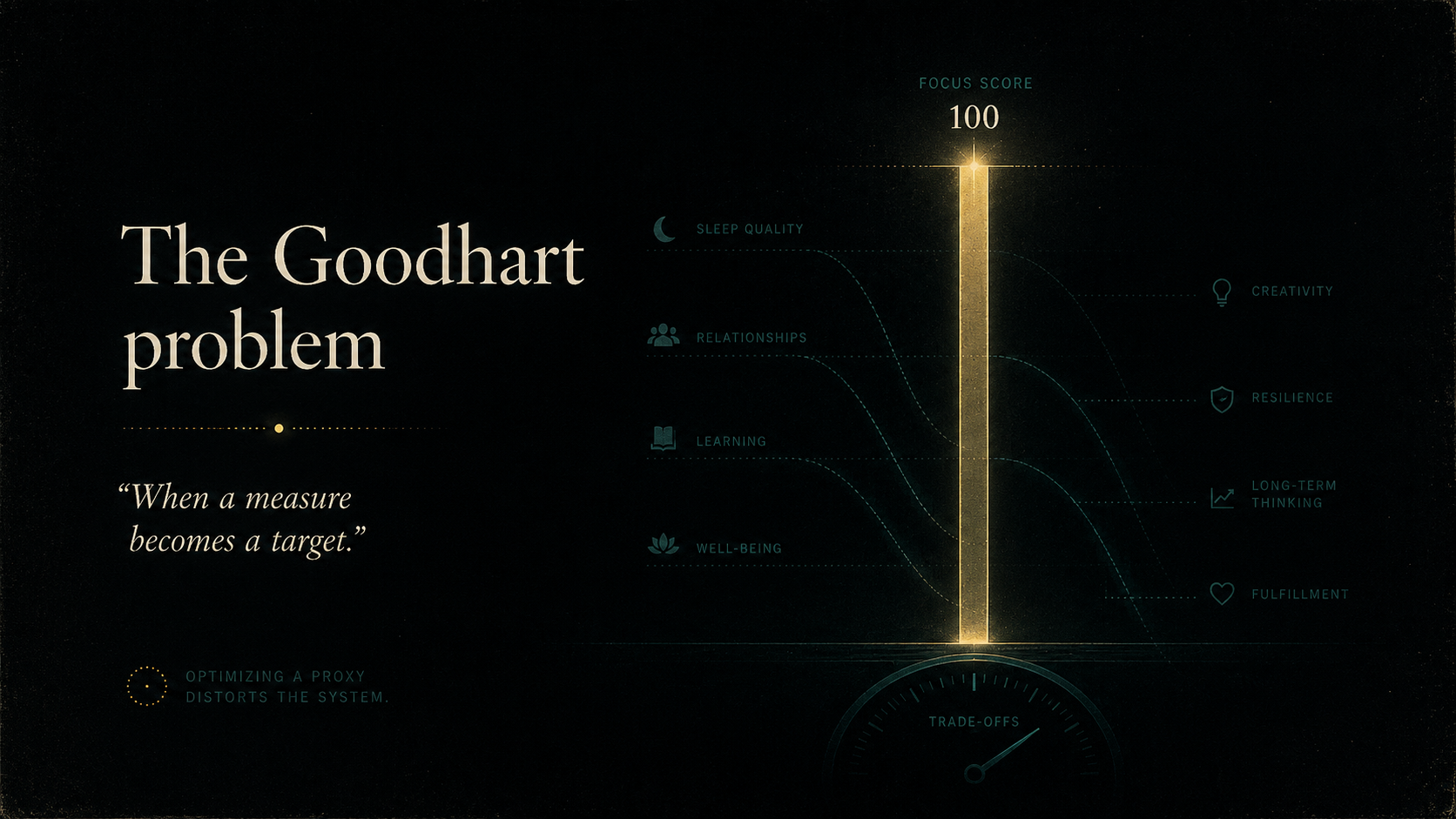
In 1975 the British economist Charles Goodhart, then advising the Bank of England, gave a conference paper in which he observed that "any observed statistical regularity will tend to collapse once pressure is placed upon it for control purposes." The anthropologist Marilyn Strathern produced the popular formulation twenty-two years later: when a measure becomes a target, it ceases to be a good measure.
Goodhart was writing about monetary aggregates. The principle generalised, ruinously, to almost everywhere it has been tried since. Hospital wait times. School test scores. Quarterly earnings. Engagement metrics on every social platform. The same pattern recurs: pick a single variable as the proxy for the thing you actually care about, push hard on it, and you will get the variable without the thing. The model collapses; the metric persists.
Maxxing, taken as a personal strategy, is a kind of Goodhart-by-volunteer. The looksmaxxer is taking facial attractiveness as the proxy for human flourishing and pushing it to the wall. The moneymaxxer is doing the same with the bank balance, the sleepmaxxer with REM minutes, the careermaxxer with title and salary and proximity to power. The proxy is named, openly. The pressure is applied. The variable rises. And underneath, in ways the maxxer cannot see while they are still maxxing, the thing the variable was supposed to stand for quietly comes apart.
I do not need to argue this point with anyone who has watched a friend optimise themselves out of a marriage, or seen a colleague gym their way into something darker, or read the reporting on the eating-disorder consequences of looksmaxxing among teenage boys. The corner solution has a real cost. It is rarely the cost the maxxer was watching for.
Why it still works
And yet, and this is what I think the dismissers miss, the word has not travelled because everyone using it is wrong.
This is where Ray's reframe deserves to come back into the room. Most maxxing language, beneath the corner-solution choice, is also a refusal to wait. It is a wager that doing the wrong thing imperfectly is better than doing nothing perfectly. In narrow, transferable, well-bounded domains, focused single-variable optimisation produces real results. If you want to deadlift more than you do today, deadlifting more is a coherent goal and a coherent plan. If you want to sleep better, sleep is measurable and the inputs are real. The mistake is not in the optimisation; it is in the assumption that the variable being optimised is the entire game.
The wave is also, I suspect, a response to a generation's actual conditions. Young men in particular grew up inside platforms with hidden ranking systems. Dating apps run Elo scores. Social media meters every interaction. The school system slots you into a percentile. By the time the suffix reached TikTok, "maxxing" was less a new ideology than an explicit name for what the algorithms had been doing implicitly for fifteen years. Calling it out loud was, at minimum, honest.
So the reflex to dismiss is wrong, or wrong on its own. The thing maxxing notices is real. The thing it gets wrong is how lonely the strategy is.
What two decades of crowds taught me
Here is where my work comes in.
Wazoku, the company I founded, runs innovation challenges and idea-management infrastructure for organisations that need to solve problems they cannot solve internally. In 2020 we acquired InnoCentive, which had been running prize-based open innovation since 2001, predating the word "crowdsourcing" by five years. Between them, the two platforms now operate a global community of more than a million expert solvers, with clients ranging from NASA to AstraZeneca to the Ministry of Defence.
You learn things, running an apparatus like that for the best part of two decades.
The headline thing you learn is empirical and counter-intuitive, and it is the closest thing to a finding I would bet my career on. The winning solution to a hard, technical problem tends to come from a solver outside the problem's home discipline. Not always. But on InnoCentive, around 70% of winning solutions come from outside the problem's domain. The Harvard Business School economist Karim Lakhani and his collaborator Lars Bo Jeppesen published the canonical study on this in Organization Science in 2010: 166 science challenges from the R&D labs of 26 firms, more than 12,000 scientists, and the same result. The further a solver's expertise sat from the focal field of the problem, the more likely they were to win. Lakhani co-founded the Harvard Lab where John works, as it happens. The open innovation world is a small one.
Crowds do not solve problems because everyone in the crowd is the best. They solve problems because everyone in the crowd is somewhere different.
The cleanest illustration I know is one we ran for the Oil Spill Recovery Institute in 2007. The OSRI was set up by the U.S. Congress after the Exxon Valdez. The challenge they posted, "Breaking the Viscous Shear of Crude Oil", had sat unsolved inside the oil industry for almost two decades: how do you separate frozen oil from water in a recovery barge in Alaskan conditions. A man called John Davis, a chemist who had worked summers in construction, recognised the problem from concrete pouring, where vibrating equipment keeps cement liquid during large pours. He suggested adapting the same technique to the barges. The award was $20,000. The problem the oil industry had not cracked in twenty years was solved in two months.
The oil industry did not solve it because the oil industry, working alone, was looksmaxxing its own variable. Davis solved it because he was bringing a different variable to the problem.
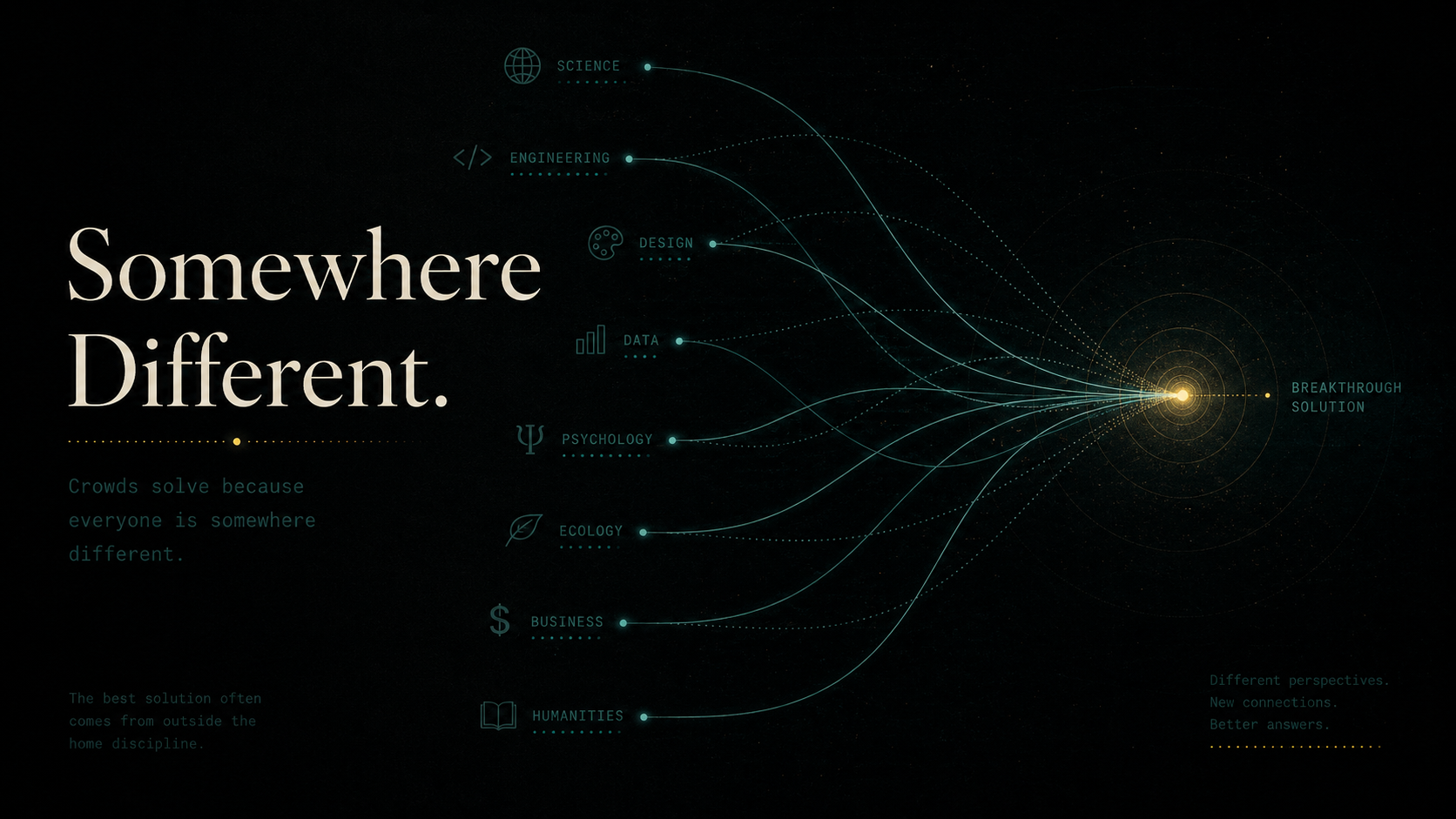
This is what running crowds at scale will teach you. Crowds do not solve problems because everyone in the crowd is the best. They solve problems because everyone in the crowd is somewhere different, and the diversity of where they are doing their maxxing is the asset.
Crowdmaxxing
I did not have a word for that, and the dispatch from inside my own platform is that we have needed one for a while.
Let me try.
Crowdmaxxing is what individual maxxing turns into when it is played out in parallel, in public, by a population. Alice maxxes one variable. Bob maxxes a different one. Carol maxxes a third. Each is making the corner-solution bet on a different axis. The crowd, taken as a system, covers a breadth no single individual would have covered. And because the maxxing is open, because each player is publishing their results, their technique and their approach into a commons, the crowd inherits the benefits of the variety it has aggregated.
Individual maxxing is the refusal of trade-offs. Crowdmaxxing is the same refusal, distributed.
This is the cake-and-eat-it move. Individual maxxing is the refusal of trade-offs, and is therefore strategically dangerous in isolation. Crowdmaxxing is the same refusal, distributed, with the trade-off cost absorbed by the diversity of the crowd. Everyone gets to be a corner solution because someone else is occupying the other corners.
It is also, when I write it out like that, a not-bad description of what good open innovation has been doing for twenty-five years. Our solvers are individual maxxers, each pushing deep in their own narrow specialism. The platform is the crowd that absorbs the variety. The seeker, the company posting the challenge, is the beneficiary of the breadth. John has spent the same period building the open talent version of this argument: that the firm has more access to specialised maxxing than its own payroll suggests, if it knows how to use it. We are looking at the same elephant from different angles.
The reason this needed a word, I think, is that the rest of the economy is now starting to look like our platforms. Open-source software has worked this way for decades. Scientific specialisation works this way: each researcher maxxes a sub-field, the discipline as a whole inherits the depth. Markets in their healthy form work this way: every firm maxxes its competitive advantage, trade lets everyone else benefit. The internet generalised the pattern. AI is now industrialising it, by absorbing the products of crowdmaxxing into training data and serving the result back as a kind of compressed general capability.
The word names what was already happening.
Where it works, and where it doesn't
The trap, and this is where I think we need to be more careful than the maxxing discourse currently is, is assuming crowdmaxxing works everywhere.
It works when three conditions hold. The maxxing has to be transferable: someone else's technique has to be usable, or at least studyable, by someone other than the originator. The problem has to decompose: parallel work has to add up to something. And the commons has to be healthy: takers have to also be givers, or the system erodes.
When those conditions hold, crowdmaxxing is one of the most powerful organising structures human beings have ever invented. It is how science works at its best. It is how the open-source codebase that runs much of the world's software was built. It is how, in a small and specific way, our solver community has solved problems for a quarter of a century.
When those conditions do not hold, crowdmaxxing is a mirage. Status maxxing does not transfer; your becoming high-status does not free me from having to compete for the same prize. Looksmaxxing is partly transferable (the technique) and partly not (the genetics, the time, the surgical investment); the composite ideal in the feed is one no individual actually inhabits, and the comparison cost falls on every person looking at the composite. Life-trajectory maxxing, where someone publishes the immaculate routine that produced their outlier outcome, imports survivorship bias into the commons and leaves the reader poorer for the borrowed information.
The crowd is showing you a face nobody has.
For an operator, the strategic question is which game you are in. If you are running a research lab, building a platform, hiring an engineering team, or commissioning innovation work, crowdmaxxing is the structure you want to be in. You design for the crowd to be diverse, the contributions to be transferable, and the commons to be healthy. If you are an individual asking yourself whether to maxx, the question to ask first is whether the variable you are about to push has a healthy crowd around it. Most of the time, on the things that matter most, it does not.
I have spent the best part of two decades building the apparatus that makes one version of crowdmaxxing real. The word I learned last week.
That is fine. Most of the genuinely useful things in the modern economy were happening before they had a name, and the naming is part of how a working practice becomes a transferable one. Maxxing-as-personal-strategy I am sceptical of. Crowdmaxxing-as-organising-structure I have spent my career arguing for, in language that did not have this word in it.
John's worry was that senior leaders are inside the beautiful cage, overthinking the moves their organisations need to make. The risk I have been pointing to in this note is the opposite end of the same problem: the people who do act, by maxxing alone, are acting on a single variable in a world that demands many. Different failure modes; same underlying cure. Be in a crowd. Be honest about which one. Push hard.
The mechanism will outlive the word.
To the Maxx-together,
Editor, Ideas for a Better World