Ideas for a Better World newsletter
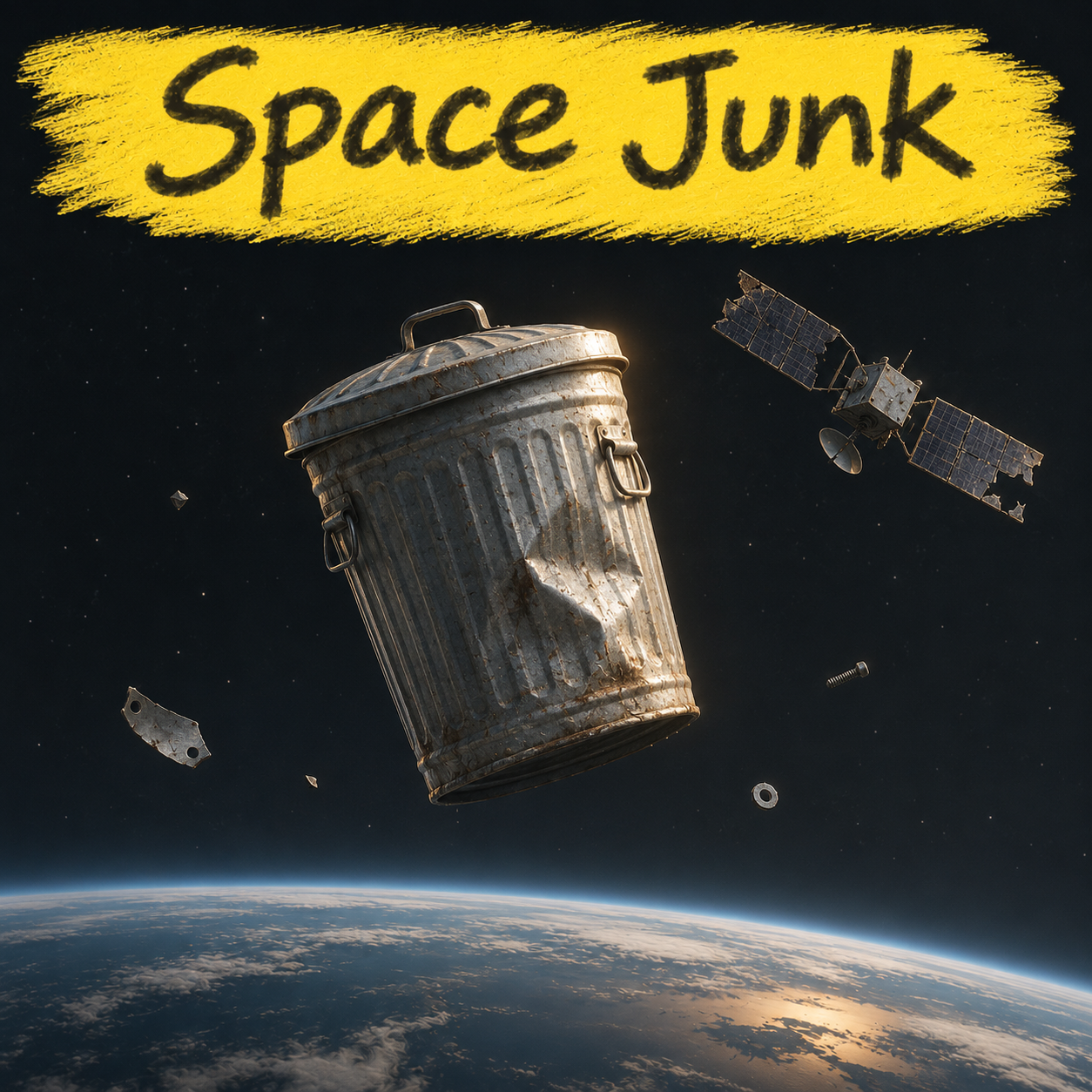
Space Junk
Low Earth orbit is shared infrastructure that nobody owns, and every operator adds to its risk for free. Europe's first debris-removal mission shows how hard cleaning up has become. Economists have shown that charging for orbit would make the satellite industry several times more valuable. The open question for any business that relies on satellites is who starts paying, and when.
Before you read, make a guess.
In 2024 this newsletter said there were 34,000 pieces of debris larger than 10 cm in orbit. How many does ESA's model estimate today?
68450
ESA estimates 68,450 objects larger than 10 cm, including about 11,300 working satellites. Below that sit around 1.5 million objects between one and ten centimetres, and 230 million between a millimetre and a centimetre.
Sources
ESA Space Environment Statistics, MASTER-8 reference population, February 2026Here is a mission that tells the whole story. In 2020, the European Space Agency bought a €86 million service from a Swiss start-up, ClearSpace, to capture and remove a 112 kg piece of a rocket left in orbit in 2013. Launch was set for 2025. (ESA)
In 2024 the target was changed, because debris detected near the object suggested it had itself been struck by something too small to track. (ClearSpace) The mission now aims at a different object, an ageing ESA satellite called PROBA-1, and ESA lists the launch for 2029. (ESA)
The thing Europe paid to remove appears to have been hit by the very problem it was meant to help solve. That is not bad luck. It is what an unpriced commons looks like from the inside.
Europe's first debris-removal mission, so far
From service contract to launch, the date has moved by four years and the target has changed once.
| When | What happened | Planned launch |
|---|---|---|
| 2013 | Vega's second flight leaves the upper part of a 112 kg payload adapter in a disposal orbit | No mission yet |
| 2020 | ESA buys a €86 million removal service from ClearSpace, targeting that adapter | 2025 |
| April 2024 | Debris detected near the target suggests it has been hit by untraceable debris; the mission is retargeted to ESA's PROBA-1 satellite | Second half of 2026 |
| November 2026 | ESA's mission page lists the launch | 2029 |
The numbers moved, in the wrong direction
When this newsletter first looked at space debris, the headline figure was 34,000 pieces larger than ten centimetres. ESA's current models put that population at 68,450, alongside about 1.5 million objects between one and ten centimetres and around 230 million between a millimetre and a centimetre. Space surveillance networks track and catalogue about 47,000 objects. More than 660 break-ups, explosions and collisions have scattered fragments since the space age began. (ESA Space Environment Statistics)
Size is misleading. Objects in low Earth orbit travel at seven to eight kilometres a second, and NASA identifies millimetre-sized debris, far too small to track, as the highest mission-ending risk to spacecraft. (NASA Orbital Debris Program Office) The one famous collision between two intact satellites, Iridium 33 and Cosmos 2251 on 10 February 2009, produced 783 catalogued pieces of larger debris within seven weeks. (NASA Orbital Debris Quarterly News)
What happened to every satellite ever launched
About 28,570 satellites have been placed in Earth orbit since 1957; about 3,810 of them are dead but still up there. Drawn to one scale with the debris estimate below. Select any block for detail.
Satellites placed in orbit since 1957
| Item | Amount | Detail |
|---|---|---|
| Still working | 15800 | About 15,800 satellites are still functioning. |
| Dead, still in orbit | 3810 | About 3,810 satellites are still in space but no longer functioning: large, uncontrolled objects that can break up or be hit. |
| Re-entered | 8960 | About 8,960 have come back down and burned up or fallen to Earth. |
Now the estimated population of debris larger than 10 cm, on the same scale. Each gridline is 10,000 objects.
| Item | Amount | Detail |
|---|---|---|
| objects larger than 10 cm (ESA model estimate) | 68450 | |
| objects tracked and catalogued | 47280 |
Sources
The most important finding is the least intuitive. ESA's 2025 assessment concludes that even if nobody launched anything again, the amount of debris would keep growing, because fragmentation now adds objects faster than the atmosphere removes them. In 2024 alone, fragmentation events added more than 3,000 tracked objects. (ESA Space Environment Report 2025)
That is the Kessler cascade in its real form: not a sudden catastrophe, but a slope that steepens on its own. ESA's conclusion is blunt. Active debris removal is now required.
Even without any additional launches, the number of space debris would keep growing.
European Space Agency, Space Environment Report 2025
A commons with no meter
Economists have a name for this. Each operator captures the full value of its own satellite while spreading the risk it creates across everyone else in orbit. Nobody owns low Earth orbit, so nobody charges for using it, and the cost of crowding it falls on whoever is unlucky enough to be in the way.
The response so far has been to regulate behaviour rather than price it. For decades the norm was that a satellite should leave low orbit within 25 years of finishing its mission. In September 2022, the US Federal Communications Commission turned that into a binding rule and cut it to five years, with a two-year transition. (FCC) ESA reports that about 80% of low Earth orbit rocket bodies now meet a five-year standard, and its voluntary Zero Debris Charter has been signed by 19 countries and more than 150 organisations. (ESA)
The disposal deadline, then and now
Maximum time a satellite may stay in low Earth orbit after its mission ends, under US rules.
| Measure | Long-standing guideline | FCC rule adopted 2022 |
|---|---|---|
| Years allowed in low Earth orbit after mission end | 25 years | 5 years |
Sources
These are real improvements, and they share a limitation. They set a minimum standard of behaviour but put no price on the risk each additional satellite adds, so the incentive to crowd the most valuable orbits remains untouched.
What a price would do
In 2020, three economists, Akhil Rao, Matthew Burgess and Daniel Kaffine, modelled the alternative in the Proceedings of the National Academy of Sciences. They proposed an orbital-use fee: a charge per satellite for each year in orbit, starting at about $14,900 and rising by 14% a year to roughly $235,000 per satellite-year by 2040. Their finding runs against instinct. Rather than shrinking the industry, the fee would more than quadruple its value by 2040, and raise its long-run value from about $600 billion to around $3 trillion. (Rao, Burgess and Kaffine, PNAS)
The logic is the same as any well-run commons. Charging for access cuts collisions, which cuts debris, which keeps orbits usable and makes every remaining satellite more valuable. The operators who would pay the fee are also the ones who gain most from a cleaner orbit.
Charging for orbit makes the industry worth more, not less
Modelled long-run value of the satellite industry, with and without an orbital-use fee.
| Measure | Business as usual | With orbital-use fees |
|---|---|---|
| Long-run value of the satellite industry | $600bn | $3000bn |
Sources
Why cleaning up is a bad business
If debris is so costly, why is removing it so slow? Because nobody owns the mess, nobody is obliged to pay for clearing it. A defunct rocket stage has no owner with a reason to hire a removal service, so the only buyers are space agencies.
ESA structured its ClearSpace contract as a service purchase precisely to create that market. Japan is doing the same. Its space agency's commercial removal programme has funded Astroscale's ADRAS-J, which approached within 15 metres of a three-tonne abandoned rocket stage. The removal attempt, ADRAS-J2, is planned for 2027. (Astroscale) Both are impressive engineering. Both depend on public money, because until a rule or a price creates liability for debris, there is no private customer.
This newsletter reached the same conclusion about packaging. Markets do not clean up commons on their own. A regulation or a fee creates the customer.
What this means for leadership teams
The first implication is that orbit is a supply chain risk most boards have not priced. Positioning, timing, weather data, communications and earth observation all depend on satellites. A slow rise in debris raises the cost and fragility of all of them, long before any dramatic collision.
The second is that the regulatory direction runs one way. The disposal deadline has gone from a 25-year guideline to a five-year rule in the United States, and Europe is building a zero-debris standard around its own missions. Companies that build or buy satellites should assume disposal obligations will tighten, and that some form of charge for orbital use is a question of when rather than whether.
The third is that the cheapest debris is the debris never created. Designing satellites to deorbit reliably, and to be captured if they fail, costs far less at the drawing board than in orbit.
Three questions are worth asking. Which of our operations depend on satellite services, and what happens if they degrade? If we operate or commission satellites, what would an orbital-use fee cost us? Are we designing for the disposal rules of 2030, or of 2020?
Space debris is not a technology problem waiting for a clever robot. It is a missing price. The robots will arrive when someone is obliged to pay for them.
Your turn: who should pay to keep orbit usable?
Pick the approach you think would work best.
- Operators, through a fee per satellite-year
- Launch providers, through a charge per launch
- Governments, through public removal contracts
- Nobody yet: tighten disposal rules first
Vote and see current results on the website.
Thanks for reading,
Ideas for a Better World Editor, Simon Hill
About the Editor: Founder of Wazoku including Innocentive, author of the award winning Expected Value, Mapping Value, TEDx speaker and innovation thought leader.
Read next
The 9% Problem
Recycling was an alibi for plastic packaging, and the bill has arrived.
From the archive
Brain health, revisited
The next revised edition from the Ideas for a Better World archive.
Every edition
Ideas for a Better World
Subscribe for the weekly edition.
How we checked this piece
This edition was first published in September 2024 and has been rewritten for 2026. Every claim is graded HIGH against a named primary source. Claims from the original that could not be sourced were removed.
| Claim | Grade | Source |
|---|---|---|
| €86m service purchase in 2020; 112 kg Vespa adapter from Vega's 2013 flight; launch planned for 2025 | HIGH | ESA |
| Retargeted in April 2024 after debris near the target suggested a collision with untraceable debris | HIGH | ClearSpace |
| New target PROBA-1; launch now listed for 2029 | HIGH | ESA ClearSpace-1 page |
| 68,450 objects over 10 cm; 1.5 million at 1 to 10 cm; 230 million at 1 mm to 1 cm; about 47,280 tracked; 660+ fragmentation events; satellites launched, in space and functioning | HIGH | ESA Space Environment Statistics, 2 November 2026 |
| Speeds of 7 to 8 km/s; millimetre debris the highest mission-ending risk | HIGH | NASA ODPO |
| Iridium 33 and Cosmos 2251, 10 February 2009; 783 catalogued fragments by end of March | HIGH | NASA Orbital Debris Quarterly News |
| Debris grows without new launches; 3,000+ tracked objects from 2024 fragmentations; active removal required; about 80% meet a five-year standard; Zero Debris Charter signatories | HIGH | ESA Space Environment Report 2025 |
| FCC five-year rule adopted 29 September 2022, replacing the 25-year guideline, with a two-year transition | HIGH | FCC |
| Orbital-use fee from about $14,900 rising 14% a year to about $235,000 per satellite-year by 2040; industry value more than quadruples by 2040; long-run value about $600bn to $3tn | HIGH | Rao, Burgess and Kaffine, PNAS (2020) |
| ADRAS-J within 15 m of a three-tonne rocket stage; ADRAS-J2 removal planned for 2027 under JAXA's programme | HIGH | Astroscale |
| Orbit as an unpriced supply-chain risk; disposal rules likely to tighten; designing for disposal is cheaper | ANALYSIS | Editorial judgement drawn from the sources above |
| Starlink collision-avoidance manoeuvres | HELD BACK | Reported from a SpaceX filing we could not obtain from the FCC directly |
| Removed from the 2024 original: digital habits driving satellite demand; citizen-science advice | CUT | No traceable primary source |