Ideas for a Better World newsletter
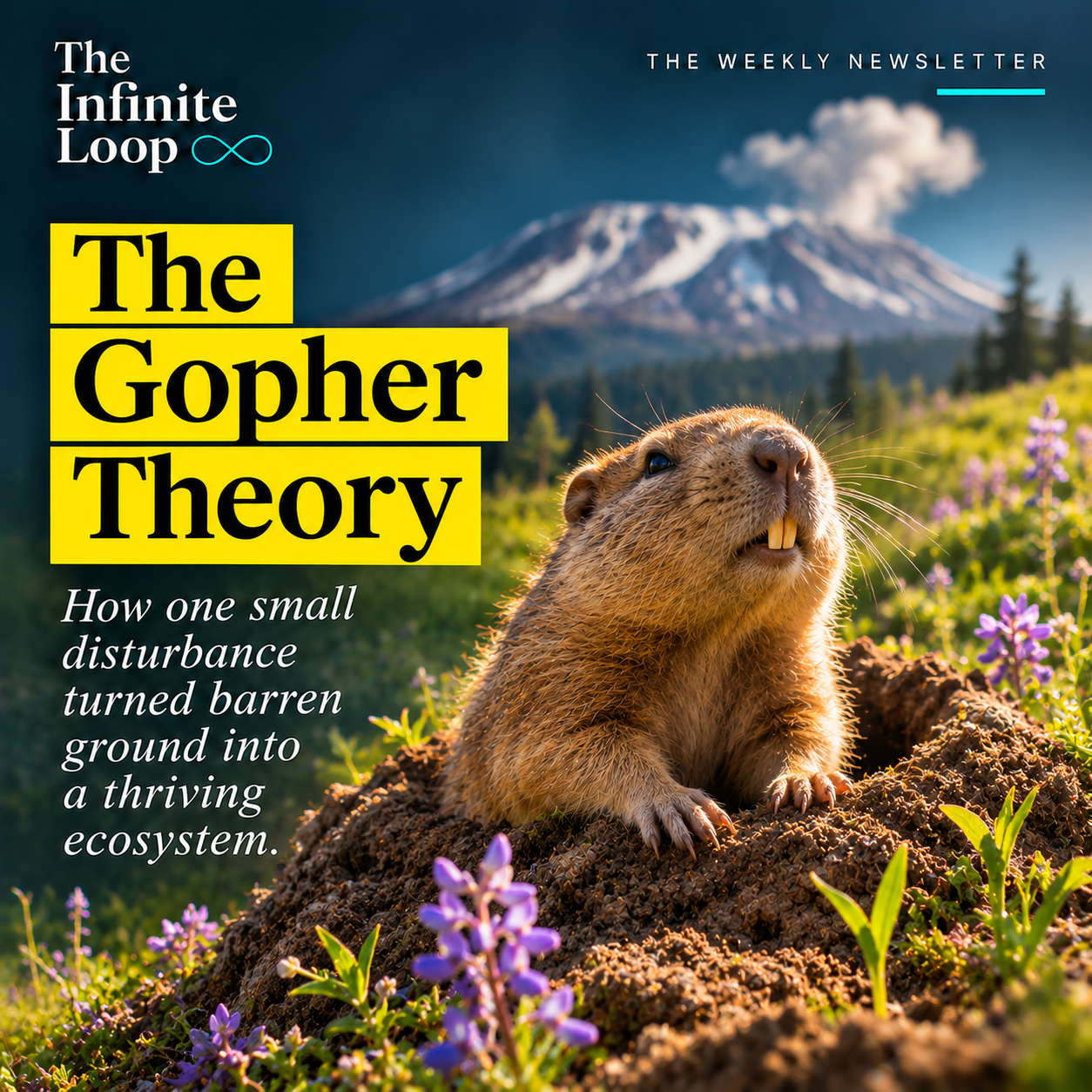
The Gopher Theory
In 1982 one gopher spent one day in a square metre of Mount St. Helens pumice. Six years later the gopher plots held 40,000 plants, and the soil was still different three decades on. The real lesson for leaders is in the forest that was clearcut: not empty, but busy with the wrong mix.
Tags: Innovation, AI, Leadership, Science, Ecosystems
Mount St. Helens
One gopher, one day
Two plots on the Pumice Plain. Move along the timeline.
Gopher plot
Untouched pumice
Pumice and ash. A few seeds dropped by birds; almost nothing growing on either plot.
Gopher plot
Untouched pumice
On one plot, a single pocket gopher is enclosed in a one-square-metre pen around a lupine for 24 hours, then removed. The other plot is left alone.
Gopher plot
Untouched pumice
About 40,000 plants are growing on the gopher plots. The untouched pumice nearby is still almost bare.
Gopher plot
Untouched pumice
Soil sampled 32 years after that single day: the microbial communities of the gopher plots are still measurably different.
Plant density is illustrative. Figures from UC Riverside, 2024 and Maltz et al., Frontiers in Microbiomes, 2024.
There is a management lesson buried under the ash of Mount St. Helens. Quite literally.
When the volcano erupted in 1980 it did not just rewrite the landscape; it incinerated it. Miles of thriving ecosystem were reduced to pumice and ash. A few seeds dropped by birds. A handful of struggling seedlings. Otherwise, nothing. Two years later, scientists tried something characteristically audacious. They put a pocket gopher onto the scorched ground, fenced it into a square metre, and took it away again 24 hours later. (Maltz et al., 2024)
This edition was first published in March 2026. The story has been retold widely since a 2024 paper revisited the site, and some of the retellings, including mine, smoothed over details that turn out to matter. The corrected version is a better lesson than the neat one.
What the gophers actually did
Six years after the experiment, there were 40,000 plants growing on the gopher plots, while land left alone nearby stayed largely barren. (UC Riverside, 2024) When the team sampled the soil in 2014, more than three decades on, the microbial communities on the gopher plots were still measurably different from those on plots the gophers never touched. (Maltz et al., 2024) "Who would have predicted you could toss a gopher in for a day and see a residual effect 40 years later?" said Michael Allen, now a microbiologist at UC Riverside, who worked on the original experiment. (UC Riverside, 2024)
The gophers dug. In doing so they moved soil, seeds and the spores of mycorrhizal fungi from below and from elsewhere, partly through their droppings. (Maltz et al., 2024) Mycorrhizal fungi penetrate plant root cells and trade nutrients and water with them; they act as a biological supply network that lets plants reach resources they could not reach alone. The gopher plots ended up richer in the kinds of these fungi that live closely with roots, which the authors suggest may have helped plants establish on hostile ground. The gophers were not the solution. They were the connector.
Most organisations lack connectors, not potential
The innovation parallel is almost embarrassingly neat. Most organisations in crisis do not lack potential. They lack connectors: people willing to dig around in the existing substrate (the buried knowledge, the dormant relationships, the undervalued expertise sitting just below the surface) and bring it up where it can do something. We call them innovation champions, corporate explorers, intrapreneurs and knowledge brokers. Perhaps we should just call them gophers. They are underestimated, and they are transformative.
The corporate explorer does not wait for permission to cross into unfamiliar territory. The intrapreneur does not ask whether an idea fits the current business model before testing it. They share the gopher's essential quality: a willingness to dig beneath the surface, into the uncomfortable and the unmapped, and surface something that would not otherwise see daylight. Organisations that protect these people from the instinct to optimise everything into conformity are building their network before the eruption, not after. Building those networks is also Wazoku's business, so weigh the argument with that interest in mind.
What the clearcut actually lost
The same research compared two forests on the mountain. One was old-growth Douglas fir that survived the eruption. Ash made its needles overheat and drop, and scientists feared the forest would collapse; instead it recovered, with the fallen needles feeding the fungi in the soil. "It didn't all die like everyone thought," said Emma Aronson, the UC Riverside microbiologist who co-authored the study. The other had been clearcut before the eruption. "There still isn't much of anything growing in the clearcut area," she said. (UC Riverside, 2024)
The original version of this edition said the clearcut had no fungi and no network. The soil data say something more interesting. Click through the three assumptions below.
Old-growth versus clearcut
What the soil actually showed
Assumption
The clearcut soil is dead
Check the soil →Bacterial and archaeal diversity was actually higher in the clearcut soils than in the old-growth forest, the opposite of what the researchers expected.Activity is not the same as capability.
Assumption
It lost its fungi
Check the soil →The number of fungal types was not significantly different. What differed was the mix: which fungi were there, and which were missing.The headcount survived. The composition did not.
Assumption
Nothing else changed
Check the soil →Old-growth soils held more carbon and nitrogen, and more of the long-established mycorrhizal lineages, than the clearcut.The stored capital was gone, and with it the specialists.
Source: Maltz et al., Frontiers in Microbiomes, 2024, soil sampled in 2014.
Composition, not headcount
That is a sharper warning than the one I first wrote. The clearcut was not empty underground. It was busy, but with a different cast, and without the carbon, nitrogen and long-established partners that the old-growth forest had accumulated. (Maltz et al., 2024) The authors are careful to say this is a single snapshot and cannot by itself prove why the two forests diverged; but the pattern is suggestive.
Organisations that restructure away their networks, outsource their institutional knowledge, or treat their connectors as costs rather than capital rarely end up empty. They end up busy. Headcount recovers, activity looks healthy, and dashboards stay green. What is missing is the specific mix of relationships and accumulated know-how that turns a shock into regrowth. When the eruption comes, and it always comes, that is what decides whether anything grows back.
And then there is AI
If the gopher is the corporate explorer who digs across boundaries, AI is something faster and in some ways more unsettling. It does not need a helicopter or 24 hours. It can traverse an organisation's documents, conversations and decisions at a speed no human connector could. In the gopher analogy, AI is not one gopher; it is the capacity to deploy thousands at once, in every direction, without fatigue.
The Mount St. Helens story carries a warning here too. The gophers mattered because of what they carried: soil, seeds and spores moved into a place that lacked them. An AI pointed only at an organisation's own knowledge will dig efficiently but not adventurously. It will surface what is already there, faster. It will not bring soil from somewhere else. The more powerful combination is AI as an amplifier of what human explorers find: the person ranges further, makes stranger connections and takes the organisational risk of bringing back something foreign; the machine spreads what they surface across the enterprise before anyone has decided whether it is welcome. Used this way, AI does not replace the connector. It makes the connector's discoveries impossible to ignore.
The clearcut was not empty underground. It was busy, but with a different cast. Organisations that cut away their connectors rarely end up empty. They end up busy.
What this means for leaders
The first implication is that invisible infrastructure is the real competitive advantage. You cannot see mycorrhizal fungi, and you often cannot see an organisation's knowledge networks either, until they are gone. The question is not whether the organisation has capability. It is whether it has the connective tissue to activate it under pressure.
The second is that small, precise interventions can compound out of all proportion. One gopher, one square metre, one day, and a difference still measurable three decades later. The logic of innovation is not always scale first. Sometimes it is the right catalyst, in the right place, at the right moment, with returns that arrive later and last longer than anyone predicted.
The third is that headcount is a poor proxy for network health. The clearcut kept its numbers and lost its mix. Restructuring decisions that count people but not relationships, tenure and cross-boundary ties will keep cutting the thing that matters while the metrics look fine.
Three questions follow. Who are the gophers in our organisation, and what happens to them in the next restructuring? Which of our networks would we only notice once they were gone? And when our AI tools dig, are they pointed only at our own soil?
Your turn
In your organisation, what happens to the connectors when budgets tighten?
- They are protected
- They are cut first
- Nobody knows who they are
- We expect AI to replace them
Vote and see current results on the website.
Thanks for reading,
Ideas for a Better World Editor, Simon Hill
About the Editor: Founder of Wazoku including Innocentive, author of the award winning Expected Value, Mapping Value, TEDx speaker and innovation thought leader.
Also on innovation systems
One Third of Global Revenue Will Flow Through Ecosystems by 2030
Why most ecosystems fail, and how to make yours deliver.
Also on invisible networks
What is Water? Part III: The Invisible Infrastructure
The hidden platform beneath the economy.
Also on measurement
High-Growth Firms Track This One Innovation KPI
What to measure when the value is hard to see.
How we checked this piece
This edition was first published on LinkedIn on 20 March 2026, inspired by Jules Bernstein's article for UC Riverside. This revision goes back to the underlying paper, which changes several details and one part of the argument: the clearcut section now reflects what the soil data actually show. Factual claims in the body are graded HIGH against named sources.
| Claim | Grade | Source |
|---|---|---|
| Gopher enclosed in a 1 m² pen around a single lupine for 24 hours in 1982 | HIGH | Maltz et al., Frontiers in Microbiomes, 2024 |
| About 40,000 plants on the gopher plots six years later; untouched land stayed largely barren | HIGH | UC Riverside, 7 November 2024 |
| Soil sampled 2014; gopher plots still had different bacterial and fungal communities | HIGH | Maltz et al., 2024 |
| Gophers translocated soil, seeds and mycorrhizal spores, partly in faeces; gopher plots richer in root-associated AMF | HIGH | Maltz et al., 2024 |
| Allen quote on "residual effect 40 years later"; Aronson quotes on old-growth and clearcut | HIGH | UC Riverside, 2024 |
| Clearcut: higher bacterial diversity; fungal richness not significantly different; composition differed; old-growth higher C and N and more ancestral AMF taxa | HIGH | Maltz et al., 2024 |
| Organisational parallels and AI argument | ANALYSIS | Author's argument |
| Plant density in the opener | ANALYSIS | Illustrative |
| Corrected from the original: "scientists from UC Riverside helicoptered in" and dropped "a few gophers" | CUT | One gopher per 1 m² enclosure; the release names Allen and Utah State's James McMahon on a 1983 helicopter trip; Allen is at UCR now |
| Corrected from the original: "when researchers returned in 2024, the difference was still visible" | CUT | Soil was sampled in 2014; the paper was published in 2024 |
| Corrected from the original: the clearcut had "no fungi, no network" | CUT | Fungal richness did not differ significantly; composition, carbon and nitrogen did |
| Removed from the original: "forty-five years later" for the clearcut quote | CUT | The quote dates from 2024; the timing is not stated |
| Wazoku interest | HIGH | Disclosed inline and in the author note |
Simon Hill is the founder of Wazoku, which owns Innocentive, the open innovation platform. Wazoku helps organisations build innovation networks, the subject of this piece.