Ideas for a Better World newsletter
The Homes of 2050 Are Already Built
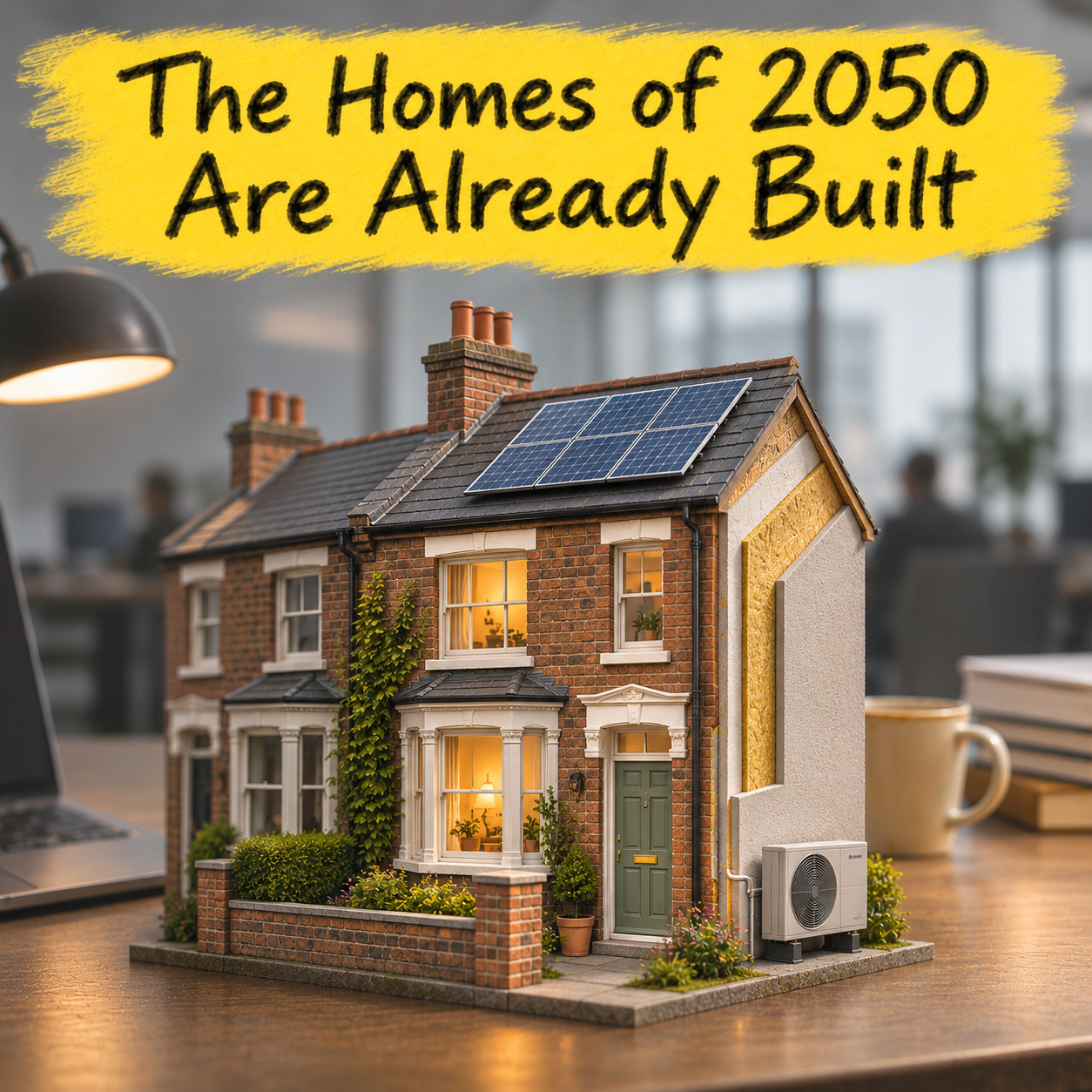
The future of energy-efficient housing is usually sold as 3D printers, smart materials and AI. In Britain it will be decided by houses that already stand, many of them more than a century old. The cost of upgrading them is known, the money is now committed, and the question is whether the work happens fast enough.
Before you read, make a guess.
What percentage of homes in England built before 1919 reach energy performance band C or better?
27%
Just 27%, against 56% of all homes. Older homes are more likely to have solid walls, and bringing one up to band C costs an average of £10,728, more than for any other age of home.
Walk through London and then through Stockholm and the difference in the housing is hard to miss. London's streets are lined with Victorian and Edwardian terraces, solid-walled and draughty. Stockholm's homes are, on the whole, newer, often timber-built, and designed for a far colder climate. When this newsletter first made that walk in 2024, it went looking for the future of energy-efficient homes in new technology: homes that generate more energy than they use, 3D-printed neighbourhoods, AI that runs your heating.
Two years on, the better answer is less exciting and more important. Most of the homes Britain will live in for the next few decades already exist. The future of the energy-efficient home is mostly a story about fixing old ones.
The homes of 2050 are already built
Buildings account for around 30% of the world's energy demand, and homes for about 70% of that, according to the International Energy Agency. (IEA) In England there were about 25.8 million homes in March 2025. Over the previous year the stock grew by 208,600, or 0.81%. (Dwelling stock estimates)
That growth rate is the whole argument. If England kept adding homes at that pace for the next 25 years, and demolished nothing, around four in five of the homes standing in 2050 would be ones that exist today. Whatever new homes achieve, the energy performance of the country's housing will be set mainly by what is done to the old ones.
England's homes in 2050, if building continues at today's pace
Today's 25.8 million homes, plus 25 years of growth at 0.81% a year with no demolitions. Select a block for detail.
Homes standing in 2050 (illustrative)
| Item | Amount | Detail |
|---|---|---|
| Already built today | 25.8m | About 82% of the 2050 total. Their energy performance depends on retrofit. |
| New by 2050 | 5.8m | About 18% of the 2050 total, built to whatever standards apply at the time. |
Sources
What makes a home warm
England has made real progress. In 2024, 56% of homes reached energy performance band C or better, up from 23% in 2013. The average energy efficiency rating has climbed from 45 in 1996 to 68. (English Housing Survey 2024-25); (2023-24)
The problem is concentrated in exactly the houses that line London's streets. Only 27% of homes built before 1919 reach band C. They are more likely to have solid walls, which are harder to insulate, and bringing one up to band C costs an average of £10,728, more than for any other age of home. (English Housing Survey)
A decade of real progress
Share of homes in England at energy performance band C or better.
| Measure | 2013 | 2024 |
|---|---|---|
| All homes | 23% | 56% |
Sources
The oldest homes lag furthest, and cost most to fix
Homes built before 1919 against all homes, England, 2024.
| Measure | Built before 1919 | All homes |
|---|---|---|
| Share at band C or better | 27% | 56% |
Sources
Heating is the other half of the gap. In 2023-24, 86% of English households heated their homes with gas, and about 276,000 homes, around 1%, used a heat pump as their main heating. (English Housing Survey) Sweden had around 2.2 million heat pumps installed by 2022, roughly 209 for every 1,000 residents. (European Commission JRC) The two figures measure different things, but they describe two different systems: one that heats homes by burning gas, and one that largely does not.
What happened to 2024's breakthroughs
The original edition of this newsletter profiled a set of innovations, and two years is long enough to check on them. (Snøhetta); (3DPrint.com); (M-KOPA)
2024's breakthroughs: where are they now?
The original edition of this newsletter profiled these innovations. Guess what happened to each, then open the card.
01Norway's energy-positive homeTap to reveal
Not a homePowerhouse Brattørkaia in Trondheim is an 18,000 square metre office building. Its designers say it produces more than twice the electricity it uses on an average day, and more energy than it consumes over a 60-year life, including construction. Impressive, but not a house.
023D-printed homes from Mighty BuildingsTap to reveal
Up for saleThe Californian firm was put up for sale in January 2025 after a restructuring, in a year when other 3D-printed construction firms cut staff or liquidated assets.
03M-KOPA's off-grid solar for a million homesTap to reveal
PivotedM-KOPA now reports 10 million customers across five African markets. Its business is largely financing smartphones.
04AI home energy management cutting use by up to 40%Tap to reveal
UnprovenWe could not trace this figure to any primary source, and have removed it.
05Mushroom-based insulation with 80% lower emissionsTap to reveal
UnprovenWe could not trace this figure to any primary source either.
None of this means innovation does not matter. It means the innovations that reach the most homes are the unglamorous ones.
The unglamorous fix
Britain has now put money behind that. In January 2026 the government announced a Warm Homes Plan with £15 billion of public investment to upgrade up to five million homes, covering insulation, heat pumps, solar panels, batteries and smart controls, with a £7,500 grant towards a heat pump and a target to lift up to a million families out of fuel poverty by 2030. (GOV.UK)
The hard part is not the technology. Insulation, heat pumps and solar panels are mature and widely available. The hard part is doing millions of small, house-by-house jobs on old buildings, each one different, at a pace the country has never managed.
The future of the energy-efficient home turned out to be the past, insulated.
What this means for leaders
For anyone who owns, lends against or manages housing, energy performance is becoming a measure of value and risk, not just a certificate in a drawer. Older stock carries the largest and most expensive upgrade bill, and that bill is now visible in official data.
For businesses in construction, energy and finance, the opportunity is less in breakthrough materials than in the industrial problem of retrofit: surveying, financing, installing and assuring millions of upgrades efficiently. That is a delivery challenge, and delivery is where the value will be made.
Three questions are worth asking. How much of the property we own or finance was built before 1919, and what would it cost to bring it to band C? Who in our supply chain can actually do retrofit at scale? And are we still waiting for a breakthrough when the tools we need already exist?
Your turn: what would speed up retrofit most?
Pick the one change you think would make the biggest difference.
- More trained installers and assessors
- Cheaper finance tied to the property
- Minimum standards for homes that are sold or let
- One trusted service that handles the whole job
Vote and see current results on the website.
Thanks for reading,
Ideas for a Better World Editor, Simon Hill
About the Editor: Founder of Wazoku including Innocentive, author of the award winning Expected Value, Mapping Value, TEDx speaker and innovation thought leader.
Read next
The 9% Problem
Recycling was an alibi for plastic packaging, and the bill has arrived.
From the archive
The Synthocene, revisited
The next revised edition from the Ideas for a Better World archive.
Every edition
Ideas for a Better World
Subscribe for the weekly edition.
How we checked this piece
This edition replaces "The Future of Energy-Efficient Homes" (October 2024). Every claim is graded HIGH against a named primary source. Unsourced and incorrect material from the original was removed.
| Claim | Grade | Source |
|---|---|---|
| Buildings about 30% of global energy demand; homes about 70% of that | HIGH | IEA, Energy Efficiency 2025 |
| 25.8 million homes in England, March 2025; up 208,600 (0.81%) in a year | HIGH | Dwelling stock estimates 2025 |
| About four in five homes of 2050 already exist | ANALYSIS | Our calculation: 0.81% annual growth for 25 years with no demolitions gives about 82% |
| 56% at band C or better in 2024; average rating 68 (45 in 1996); pre-1919 homes 27%; £10,728 average cost to band C | HIGH | English Housing Survey 2024-25 |
| 23% at band C or better in 2013 | HIGH | English Housing Survey 2023-24 |
| 86% of households heated by gas (2023-24); about 276,000 homes (1%) with a heat pump as main heating (2023) | HIGH | EHS low-carbon technologies fact sheet |
| Sweden about 2.2 million heat pumps (2022), 209 per 1,000 residents | HIGH | European Commission JRC; different basis from the England figure, as stated |
| Powerhouse Brattørkaia: office, 18,000 m², more than twice its daily electricity use, energy-positive over 60 years including construction | HIGH | Snøhetta |
| Mighty Buildings for sale January 2025 after restructuring; wider sector cuts | HIGH | 3DPrint.com |
| M-KOPA 10 million customers, mainly smartphone financing | HIGH | M-KOPA, 22 July 2026 |
| Warm Homes Plan: £15 billion, up to 5 million homes, measures, £7,500 heat pump grant, fuel poverty target | HIGH | GOV.UK, 20 January 2026 |
| Removed from the original: 2014 energy and emissions shares (replaced by IEA); mycelium 80%; 3D printing 70% and 50%; AI 40%; aerogel ten times; Exeger solar windows; Passivhaus Trust described as German | CUT | Unsourced or incorrect |