Ideas for a Better World newsletter
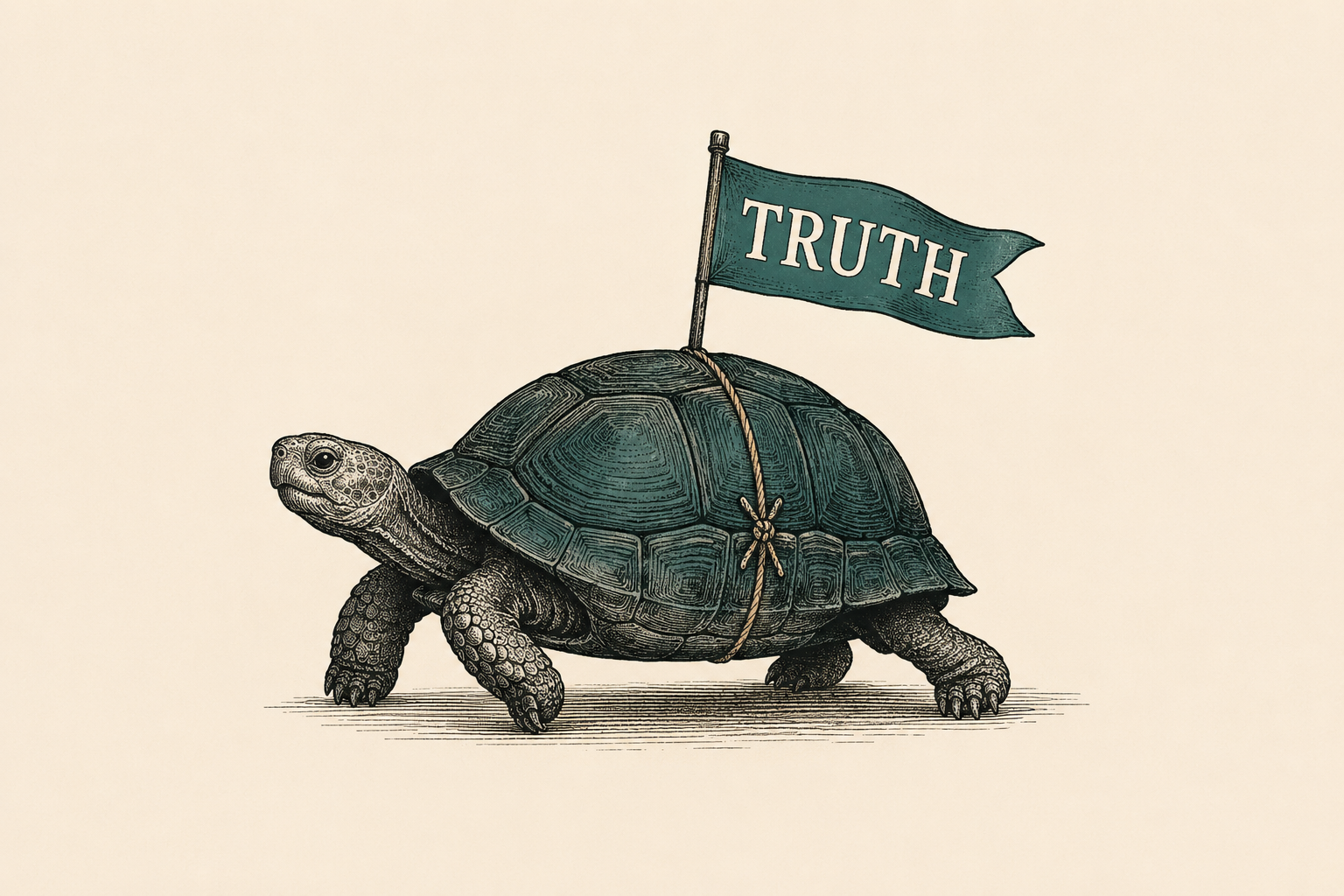
The Tortoise of Truth
A modern twist on the tortoise and the hare. A perspective on truth in the age of AI.
Tags: AI, Innovation, Ecosystem
The internet said 500 tortoises turned the Sahara green from space. They didn’t. The real story is slower, stranger, and far better, and it’s really a story about who you trust.
It’s a perfect story. For years, scientists plant trees along the edge of the Sahara. The trees keep dying. Then someone releases 500 tortoises, and a few years later, the desert is green enough to see from orbit.
You’ve probably seen it this week: “They Kept Planting Trees in the Sahara and Kept Failing. Then They Released 500 Tortoises, and the Desert Looked Alive From Space.” It bolted out of the gate. Villain, underdog, twist, and a number, and a satellite. It is built to be shared.
There’s just one problem. The best part of it isn’t true. Nobody can show that it happened.
So this is a story with two animals in it. One is the story itself: fast, flashy, sprinting across every feed. The other is the small, slow, real thing it claims to be about. A hare and a tortoise. And the oldest fable we have already told us how this ends.
The hare always wins the morning. The tortoise wins the day. It’s worth knowing which one you’re reading, and which one you’d rather be.
The hare always has a tell
Go looking for the source of “500 tortoises” and the trail evaporates. No scientific paper. No NASA, no European Space Agency. No IUCN. What you find is a cluster of websites. A defence-news site writing about reptile ecology, a tourism aggregator, an oil-and-industry portal. All posting within a day or two of each other, all reaching for the same phrases, all hedging with the word reportedly. The “alive from space” line, the emotional core of the whole thing, traces back to nothing you can check.
The shape of the headline is the tell. They kept failing. Then they did one strange thing, and everything changed. That clean three-act sprint is the house style of AI-assisted content farms, and it’s a tell precisely because real life almost never resolves that tidily.
Here is the thing about slop worth holding onto: it is smooth. It was generated to travel, and travelling means shedding friction (the caveats, the proper nouns, the dates that don’t quite line up), the parts where someone says “we’re not sure yet.” But friction is where the information lives. Sand a story until it slides freely and you have sanded off everything that made it worth knowing. The hare runs fast because it is carrying nothing.
And here is the irony to sit with. There is a real satellite story about greening the Sahara, and it runs the other way. The Great Green Wall, launched by the African Union in 2007, set out to plant a band of trees across eleven countries and restore 100 million hectares of land; more than $20 billion has been pledged toward it. When researchers checked satellite imagery of Senegal’s stretch, they found only one or two of 36 planted plots had genuinely greened, and just one beyond what the rainfall alone would explain. By some estimates, around 80% of trees planted in the region since the 1980s have died. The satellites didn’t catch a desert waking up. They caught how hard this really is.
What the tortoise was doing
Here is the part the hare ran straight past, because it was slower and stranger and didn’t fit the sprint.
The animal in the story is real. Centrochelys sulcata, the African spurred tortoise, is the largest tortoise on mainland Africa, big males pass 100 kilograms, and it is native to the Sahel. It is also, on the IUCN Red List, Endangered.
To escape the heat it burrows, and its tunnels can run up to 15 metres long. That detail is the whole point. Across much of the Sahel the soil bakes into a crust so hard that rain simply runs off it, which is why Sahel farmers dig zaï, small pits that hold water long enough for it to soak in. A 15-metre tortoise burrow is, in effect, a biological zaï pit. It breaks the crust. Water finds a way down. Dormant seeds get a chance.
That a 100-kilogram reptile quietly re-plumbs the desert by digging is the kind of thing nobody would invent, and that is the fingerprint of the real. Fiction has to stay inside the believable; reality has no such obligation. The fake story is bounded by what an algorithm guessed you’d share. The true one is free to be strange, and it is. Truth is stranger than fiction because fiction has a budget and the truth does not.
It is also, unlike the viral version, genuinely documented, and modest. There is a real idea here, with real backing. In 1994 the ecologists Clive Jones, John Lawton and Moshe Shachak named a category the textbooks had missed: some organisms don’t just compete and feed, they rebuild the place. Beavers dam rivers into wetlands. Earthworms remake soil. Corals build reefs. They called them ecosystem engineers, and the paper became one of the most-cited in modern ecology. A burrowing tortoise fits the definition cleanly. And the work of bringing this one back has been running quietly in Senegal’s Ferlo region, led by conservationists such as Tomas Diagne, for well over a decade: slow, unglamorous, mostly about pulling a species back from the brink. What it is not is a satellite-confirmed miracle. That part was added later, by people who weren’t there.
Who gets to build the world
Now hold the two animals side by side, because the fable has a sharper edge than “slow and steady wins.”
Jones and his colleagues defined an ecosystem engineer as anything that reshapes the environment everyone else has to live in, not by competing head-on, but by changing the terrain itself. By that definition a content farm is also an ecosystem engineer. It doesn’t out-report journalism. It floods the shared substrate (feeds, search results, the first page of answers) with smooth, plausible, frictionless text until that is simply what grows there, and the slower real reporting is crowded into the shade.
So the environment always gets engineered. That is not optional. The only question the fable leaves you with is by whom and toward what. A beaver builds a wetland that hundreds of species can live in. A different engineer silts the whole thing up.
This is why quality ecosystem builders matter far more than they are ever credited for. The careful scientist; the editor who kills the exciting-but-shaky story; the conservationist who gives a decade to a tortoise; the farmer who passes on the zaï technique; the newsletter that writes “nobody can show this is true”. These are the tortoises. They build slow, structural, often invisible things, and the payoff of their work is that other people can stand on it. They dig burrows, and the burrow outlasts them and shelters whatever comes next.
And that points at the only thing that actually defends you in an ecosystem full of hares: trust. Trust is the one asset slop cannot manufacture and cannot sprint to. It is built the tortoise way, slowly, by being right when it was costly to check, by showing your sources, by carrying your shell on the outside where everyone can see it. It compounds for decades and it shatters in an afternoon. A content brand that understands this would rather be the tortoise than the hare: slower, yes, but trusted, and still moving long after the morning’s miracle has been quietly deleted.
Which, for the record, is the side this newsletter is choosing.
Engineers, not planters
There is a working principle buried in all of this, and it reaches well past deserts.
Most effort is brute force; the rare good stuff is leverage. The Great Green Wall is brute force made enormous, fight the desert directly, tree by tree, and count success in trees planted. It mostly fails because it works against the system: the baked soil, the missing rain and the grazing cattle are all still there, unchanged. The tortoise works the other way. It changes one underlying condition, whether water can enter the ground, and lets the system take it from there, for free and indefinitely. Adding headcount, spend and features is planting trees. Finding the single structural change that makes the next unit of progress cheaper than the last is digging the burrow. It is worth being honest about which one you are doing.
Notice, too, where the fix actually came from. While the $20-billion megaproject struggled, the regreening that worked in the Sahel came largely from farmers, nurturing the trees that resprouted on their own land, digging the pits that caught the rain. The cheap, local, unglamorous answer beat the expensive, centrally planned, announceable one. Organisations do this endlessly: they overfund the initiative that looks impressive in the room and underfund the people closest to the problem who have half-solved it already.
And spectacle is not substance, in any ecosystem. The researchers studying the wall reached for a precise word for its pledges and campaigns: spectacular and built for symbolic value over practical effect. The viral tortoise story is that same instinct loose in the information world. The launch event, the rebrand, the headline metric: easy to admire, easy to fake. The compounding, unglamorous, self-sustaining thing is neither, and it is the only one still there in the satellite image five years on.
The tortoise of truth
The hare is faster. It will always be faster. It wins the morning, every morning (the first share, the first half-million views, the screenshot).
But the hare is carrying nothing, and it does not last. Slop has a half-life: it ranks today and is load-bearing for no one tomorrow. The tortoise’s work compounds. A 1994 paper still cited thirty years on, a burrow that keeps working with no maintenance, a name you have learned you can trust. Time, as the fable promised, is on the tortoise’s side.
The fake miracle gives you a feeling. The real one gives you a method.
That’s the whole loop: slow down, look closer, and the true thing is almost always strange, and more worth keeping, than the invention.
Follow the tortoise.
Sources & Notes
Jones, C.G., Lawton, J.H. & Shachak, M. (1994). “Organisms as Ecosystem Engineers.” Oikos 69: 373–386 — origin of the term; among the most-cited papers in modern ecology.
IUCN Tortoise & Freshwater Turtle Specialist Group — species account for Centrochelys sulcata: Endangered status, range, body size, burrowing behaviour, and reintroduction work in Senegal.
On the Great Green Wall: African Union (2007 launch); satellite analysis of Senegal’s planted plots by A.L. Zhu, A. Ndiaye and colleagues (Land Use Policy), including the “spectacular vs. mundane” framing; reporting in Smithsonian and The Conversation on tree mortality, unmet funding pledges and farmer-led regreening.
The viral claim: the specific story — a 2021 release of 500 tortoises producing satellite-visible greening of the Sahara — could not be traced to any primary source: no peer-reviewed study, no space agency, no IUCN statement. It appears only in recent content-farm aggregators. The tortoise, its burrowing and the Senegal reintroductions are real; the spectacular outcome is unverified.