Ideas for a Better World newsletter
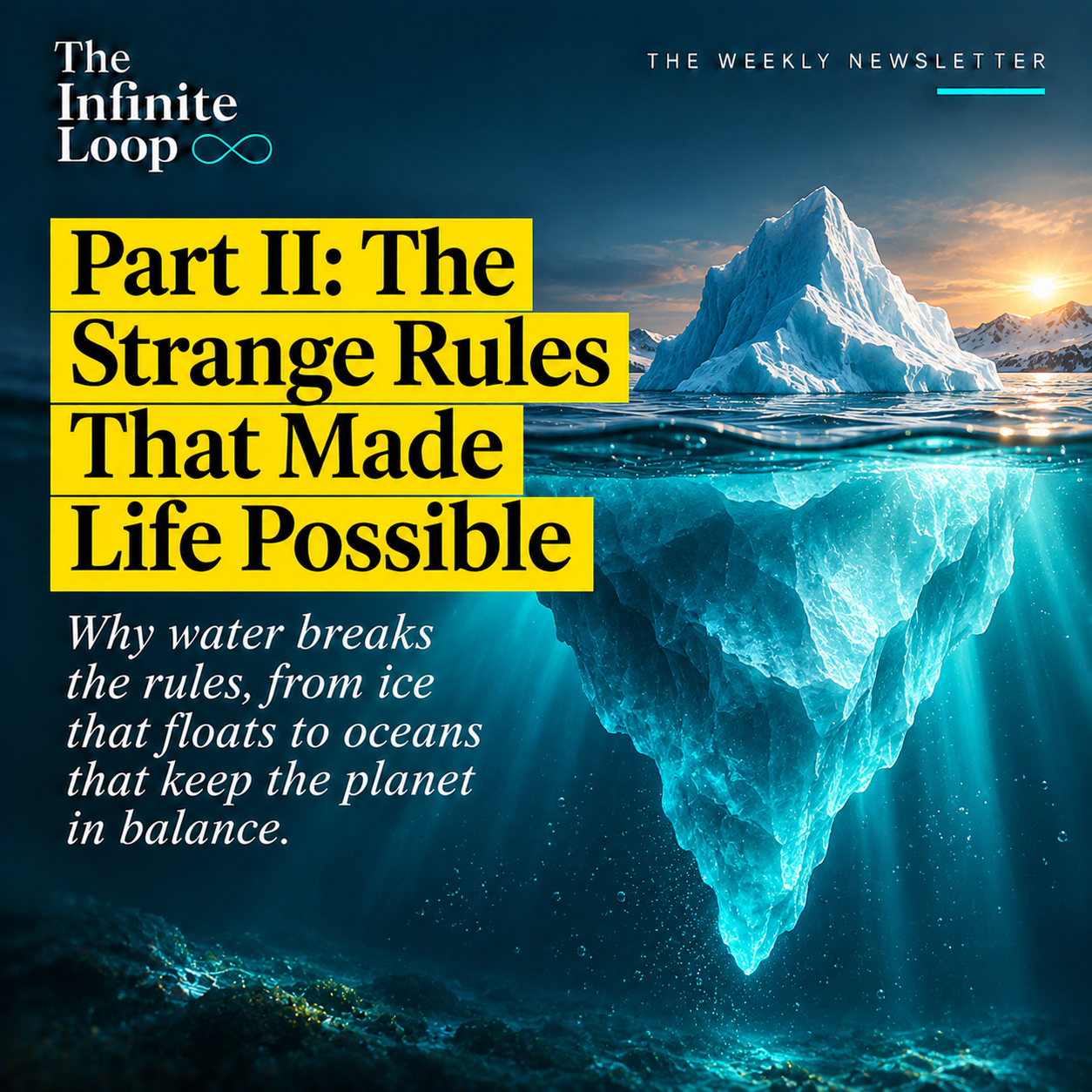
Part II: The Strange Rules That Made Life Possible
Water breaks the rules almost every other substance follows. Ice floats, so lakes survive winter. Water holds vast amounts of heat, so the oceans act as the planet's thermostat, absorbing a record 23 zettajoules in 2025. And it dissolves more than any other liquid, which makes biochemistry possible.
Tags: Water, Climate, Science, Innovation, Sustainability
One rule broken, one planet saved
Two lakes, one winter
The same lake through a winter: filled with real water, and with a liquid that follows the usual rules. Step through the season.
Both lakes are liquid throughout. So far, water behaves like anything else.
Water is densest at about 4°C, so water at that temperature collects at the bottom. Below 4°C, real water starts getting lighter again; an ordinary liquid keeps getting denser.
Ice is about 9% less dense than liquid water, so it floats and forms a lid. In the ordinary liquid the solid is denser than the liquid, so it sinks and builds up from the bottom.
Floating ice insulates the water beneath it, and the deep lake stays liquid. The ordinary lake freezes from the bottom up, and everything living in it freezes too.
Schematic. Density figures: USGS Water Science School.
Water looks ordinary until you look past the obvious. We drink it, swim in it, ship goods on it, generate power with it and irrigate crops with it. Beneath that ordinary surface sits a set of physical properties so unusual that they break the rules almost every other substance follows. They are not curiosities. They are the physics that makes Earth habitable and complexity possible.
This is the second part of "What is Water?", first published in February 2026. Part I looked at water as an ancient inheritance. This part looks at its strange rules, starting with the one the opener shows: how a single broken rule decides whether a lake survives the winter.
A molecule that should not behave like this
Water is two hydrogen atoms bonded to one oxygen atom, but that simple structure is the root of its complexity. The molecule is polar, slightly negative at the oxygen end and slightly positive at the hydrogen ends, so neighbouring molecules attract each other through hydrogen bonds. Those bonds constantly form and break, creating a dynamic three-dimensional network. That network is responsible for the anomalies that make water so useful to life.
The density anomaly: when water breaks the rule
Most substances get denser as they cool and denser still when they freeze. Water does so only part of the way down. Liquid water is densest at about 4°C; below that it becomes less dense, and when it freezes the molecules lock into an open lattice that holds them further apart. Ice is about 9% less dense than liquid water, which is why it floats, with about a tenth of its volume above the surface. (USGS)
The consequences are planetary. If ice sank, lakes and seas would freeze from the bottom up, and whole bodies of water could turn solid in winter, destroying the life within them. Instead, floating ice forms an insulating lid that protects the liquid water beneath through the coldest seasons.
The planetary thermostat
How much heat water can hold
Switch between one kilogram and one ocean.
Energy to warm 1 kg by 1°C. Source: USGS. Water takes nearly eleven times as much.
The extra heat the ocean absorbed in 2025 alone, a record for the ninth year running. The ocean takes up more than 90% of the excess heat trapped by greenhouse gases. One zettajoule is a thousand billion billion joules.
Source: Eos, January 2026, on a study in Advances in Atmospheric Sciences.
High heat capacity: the planet's thermostat
Water can absorb a great deal of heat before its own temperature rises. Warming a kilogram of water by 1°C takes 4,184 joules; warming a kilogram of copper by the same amount takes 385. (USGS) That thermal inertia lets the oceans moderate the climate, carrying heat from the tropics towards the poles, softening the swing between day and night and between seasons, and giving coastal places milder climates than inland ones.
It also means the oceans have been absorbing most of the heat that greenhouse gases trap. In 2025 the ocean took up about 23 zettajoules of extra heat, setting a record for the ninth consecutive year; the ocean absorbs more than 90% of the excess heat in the climate system. (Eos, 2026) The thermostat is still working. It is also filling up, which is why ocean warming drives sea-level rise, coral bleaching and more intense storms.
The universal solvent: chemistry made possible
Water's polarity makes it one of the best solvents known. It dissolves more substances than any other liquid, which is why it is called the universal solvent, though it cannot dissolve everything. (USGS) As it moves through soil, plants and bodies, it carries minerals, nutrients and gases with it. Inside cells it lets chemical reactions happen; in plants and animals it moves food in and waste out. Its high surface tension drives capillary action, pulling water up through roots and through the smallest blood vessels. (USGS) No universal solvent, no complex biochemistry; no complex biochemistry, no life as we know it.
Water as a foundational material
These anomalies do more than make life possible; they shape planetary systems. Ocean circulation redistributes energy around the globe. Ice regulates how much sunlight the Earth reflects. Lakes and rivers sustain food webs. Water's thermal behaviour steadies the weather that farming and settlement depend on. A simple molecule becomes a platform for complexity, in the way silicon became a platform for the digital revolution; an earlier edition on photonics explores what happens when a platform material reaches its limits.
In innovation terms, water is a foundational material layer. Understanding its physics is not just science; it is design literacy for anyone working on climate resilience, infrastructure, ecology or sustainable innovation.
Water's physics is a planetary operating system with very specific parameters. Innovation has to work within them.
What this means for leaders
The first implication is that water's physics sets hard limits on design. Cooling systems, pipes that freeze and burst, concrete that cracks, reservoirs that stratify: all follow from the properties described here. Engineering that ignores them fails expensively.
The second is that the planet's thermostat is changing. The oceans are absorbing record amounts of heat each year. That shows up as warmer cooling water for power stations and data centres, rising seas for coastal assets and stronger storms for supply chains.
The third is that water's properties are an innovation resource. Its capacity to store heat, carry solutes and move by capillary action already underpins heating networks, cooling, desalination and medicine. There is more to be done by designing with these properties rather than against them.
Three questions follow. Which of our systems depend on water's physical behaviour without our having thought about it? How does a warmer ocean change the risks to our assets and suppliers? And where could water's properties do work for us that we currently pay energy to do?
Your turn
Which of water's strange properties surprised you most?
- Ice floats
- How much heat it holds
- It dissolves almost anything
- None: I knew all of these
Vote and see current results on the website.
Thanks for reading,
Ideas for a Better World Editor, Simon Hill
About the Editor: Founder of Wazoku including Innocentive, author of the award winning Expected Value, Mapping Value, TEDx speaker and innovation thought leader.
Next in What is Water?
Part III: The Invisible Infrastructure
The unseen backbone beneath food, energy, cities and industry.
Earlier in What is Water?
Part I: The Ancient Substance That Still Rules Us
An ancient inheritance with a tiny usable margin.
How we checked this piece
This edition was first published on LinkedIn on 5 February 2026 as "What is Water Part 2?". The physics is unchanged; the revision ties each property to a USGS source, tightens one figure, and adds the 2025 ocean heat record. Factual claims in the body are graded HIGH against named sources.
| Claim | Grade | Source |
|---|---|---|
| Maximum density at about 4°C; ice about 9% less dense than liquid; about 10% of floating ice above water | HIGH | USGS Water Science School, water density |
| Specific heat: water 4,184 J/kg·°C, copper 385; moderating effect on climate | HIGH | USGS, specific heat capacity and water |
| Universal solvent (dissolves more substances than any other liquid, but not everything); high surface tension and capillary action | HIGH | USGS, facts about water |
| Ocean absorbed about 23 ZJ in 2025, ninth consecutive record; oceans take up more than 90% of excess heat | HIGH | Eos, 9 January 2026, reporting Advances in Atmospheric Sciences |
| Lake schematic and platform analogy | ANALYSIS | Illustrative; author's framing |
| Corrected from the original: "when water freezes, it expands by about 9 per cent" | CUT | USGS states density falls by about 9%; the volume increase is slightly larger, so the density figure is used |
Simon Hill is the founder of Wazoku, which owns Innocentive, the open innovation platform.