Ideas for a Better World newsletter
What is Strategy?
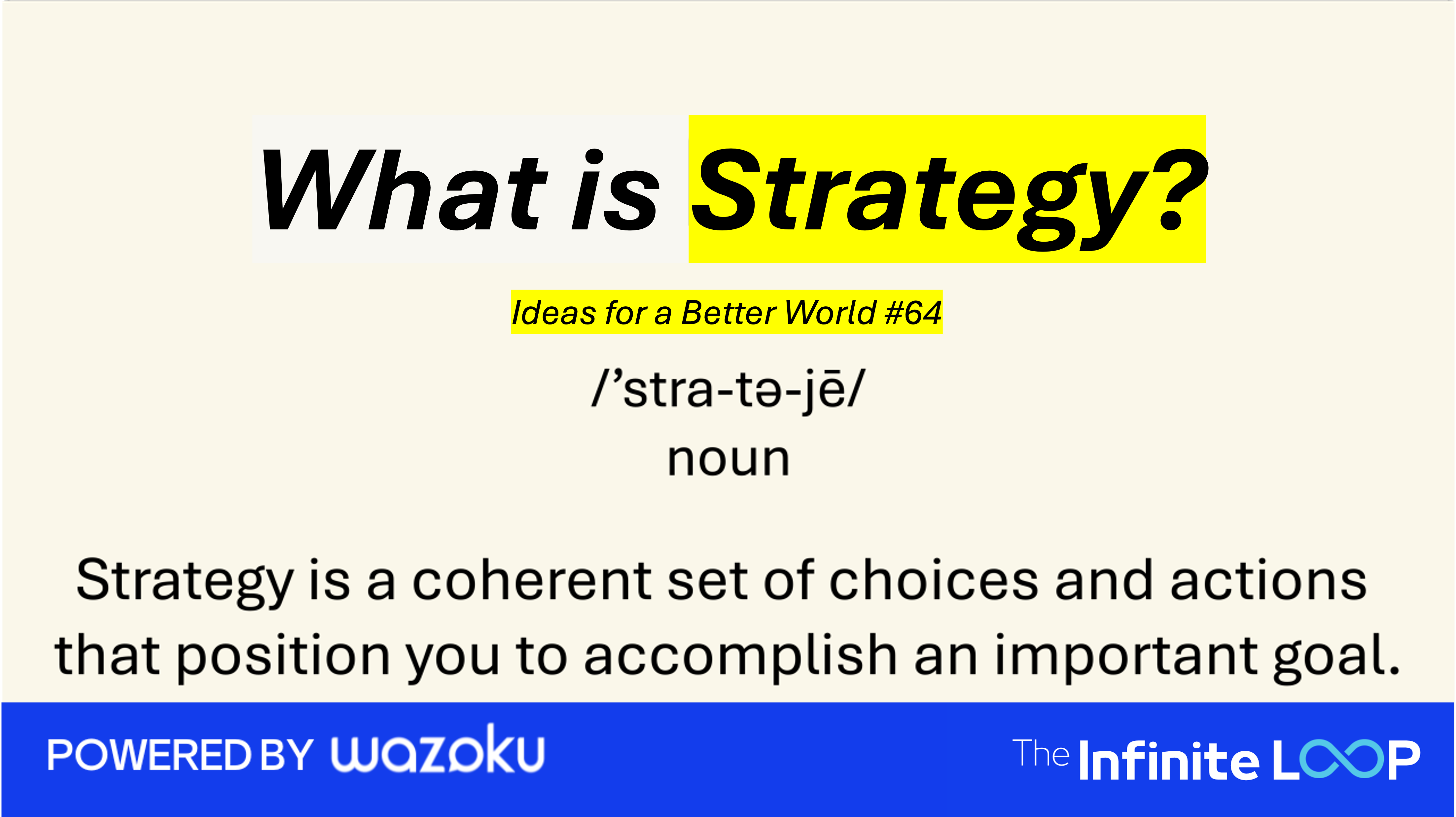
Strategy is one of the most misused words in business. Most documents labelled "strategy" are not strategies at all. They are budgets with adjectives, lists of aspirations, or roadmaps masquerading as choice. The result is organisations that are busy, stretched, and directionless, often all three at once.
What separates a real strategy from the substitutes? The question has occupied serious thinkers for more than forty years, and the good news is that the answers converge. Different traditions use different language, but the best frameworks point at the same underlying truth: strategy is the act of making hard choices about where to compete, how to win, and what to leave behind.
This piece is a practitioner's tour of what we actually know. It covers Porter's foundational insight, Rumelt's diagnostic approach, the Playing to Win cascade, and Blue Ocean's creation lens. It shows where the frameworks agree, where they diverge, and how to stress-test whatever you are currently calling a strategy.
Porter's starting point: strategy is not operational effectiveness
In 1996, Michael Porter wrote an article in the Harvard Business Review titled "What is Strategy?". It remains the most important single essay on the subject. Porter's central argument was that companies had confused operational effectiveness with strategy. Operational effectiveness means doing the same things better: faster, cheaper, with fewer defects. Strategy means doing different things, or doing the same things in a demonstrably different way.
The distinction matters because operational effectiveness is not sustainable. Best practices spread. Competitors catch up. The returns compete away. Strategy, by contrast, involves deliberately choosing a different set of activities to deliver a unique mix of value. It is about being different on purpose.
Porter identified three positioning approaches. Variety-based positioning focuses on a subset of an industry's products or services. Needs-based positioning serves the full set of needs of a particular customer group. Access-based positioning serves customers reachable in distinctive ways. All three require the same discipline: choosing what not to do.
The deeper idea in Porter's essay is fit. Sustainable advantage comes not from any single activity but from how activities reinforce each other. Southwest Airlines' short routes, fast turnarounds, point-to-point network, automated ticketing, standardised fleet, and frugal culture do not each create advantage alone. They lock together as a system. Competitors can copy one activity, but they struggle to copy the whole.
Rumelt's kernel: diagnosis, guiding policy, coherent action
Richard Rumelt's 2011 book Good Strategy / Bad Strategy reset the field. Rumelt's claim is that most strategy documents are structurally incoherent. They state goals as if they were strategies. They list priorities without a logic connecting them. They confuse ambition with plan.
His alternative is what he calls the kernel of good strategy. It has three components, in this order.
Diagnosis identifies the nature of the challenge. What is actually going on? What is the crux of the problem? Most strategies skip this step, or worse, pretend the diagnosis is obvious. Rumelt insists it rarely is. A good diagnosis simplifies reality by naming the dominant feature of the situation and treating other factors as secondary.
Guiding policy sets the overall approach to the challenge. It is not a detailed plan. It is a directional choice that rules out some responses and points towards others. A hospital's guiding policy might be "focus on services where we can achieve regional dominance". That single sentence immediately tells the organisation what to stop doing.
Coherent action is the set of steps that follow from the guiding policy. The word that matters is coherent. The actions must reinforce each other, not merely coexist on a slide.
Rumelt's contribution is also diagnostic. He identifies four hallmarks of bad strategy: fluff (using inflated language to hide thought), failure to face the challenge, mistaking goals for strategy, and bad strategic objectives (too many, too vague, or disconnected from a real problem). The test is practical. If you cannot clearly state the challenge you are solving, you do not yet have a strategy.
The cascade: Martin and Lafley's Playing to Win
Roger Martin and A.G. Lafley, the former Dean of the Rotman School and the former CEO of Procter & Gamble, wrote Playing to Win in 2013 based on their work rebuilding P&G's strategy. Their contribution is a model that is unusually operational. You can run a meeting with it.
They frame strategy as five integrated choices that cascade from top to bottom.
- Winning aspiration.What does winning look like for us?
- Where to play.Which markets, customers, geographies, channels, and stages?
- How to win.What is our right to win in those chosen arenas?
- Capabilities.What must we be distinctively good at to execute?
- Management systems.What structures, measures, and processes are required to sustain the capabilities?
The power of the cascade is that each choice constrains the next. If your aspiration is to lead a new masstige skincare segment, then where-to-play has to include a particular price band and a particular set of channels. How-to-win narrows further. By the time you reach capabilities, you know what you must be good at and, more importantly, what you do not.
The cascade is powerful because it exposes inconsistency. When an aspiration does not match the where-to-play choice, or when stated capabilities do not match the how-to-win, you do not yet have a strategy. You have a wish list.
The creation lens: Blue Ocean and value innovation
Porter's framework assumes you are competing in an existing industry. W. Chan Kim and Renée Mauborgne, in Blue Ocean Strategy (2005), argued that the best strategic moves often come from creating new market space rather than competing in the old one. Their paradigmatic example is Cirque du Soleil, which did not compete with Ringling Brothers. It created a new category between circus and theatre.
Their central tool is the Four Actions Framework, commonly called the ERRC grid.
Eliminate: which factors that the industry takes for granted should be eliminated? Reduce: which factors should be reduced well below the industry standard? Raise: which factors should be raised well above the industry standard? Create: which factors should be created that the industry has never offered?
Cirque du Soleil eliminated animal acts, star performers, and multiple show rings. It reduced fun and humour, thrill and danger. It raised the venue experience. It created themed productions, artistic music and dance, and a refined environment. The result was simultaneously lower cost structure and higher perceived value, which is the defining signature of what Kim and Mauborgne call value innovation.
The Blue Ocean view does not replace Porter. It complements him. Porter tells you how to win in a defined industry. Kim and Mauborgne ask whether you should be defining a different one.
The four frameworks at a glance
Each of these frameworks answers a different question. They are not rival theories. They are complementary lenses that serious strategy processes use together.
Rumelt's kernel gives structural coherence. Martin's cascade gives operational integration. Porter's positioning gives a test for sustainability. Blue Ocean gives a prompt to reconsider the arena itself. A strategy that survives all four lenses is unusually likely to work.
The principles every good strategy shares
Despite their different entry points, the frameworks converge on a small set of principles. Any good strategy has all of them. Any document missing one or more is probably not a strategy.
It starts with a real diagnosis. What is the actual situation? What is the crux? Skipping this step is the most common failure. Most strategies begin with aspiration and work backwards, which means they never engage with the problem.
It makes explicit choices about where to compete. A strategy that is true for any organisation in your sector is not a strategy. A useful test: would this document make sense if it were handed to a competitor? If yes, it lacks specificity.
It commits to a theory of advantage. How will we win in the arenas we have chosen? The answer must be contestable, because if it is not contestable it is probably trivial.
It requires trade-offs. A strategy that tells you to do more of everything is not a strategy. Porter's point about fit depends on trade-offs. You cannot be the cheapest and the most premium. You cannot serve everybody and serve anybody particularly well.
It connects aspiration to capability. A plan that ignores what the organisation is actually capable of, or what it would need to build, is fiction. Good strategies name the capabilities required and the investments needed to acquire them.
It is coherent across actions. The individual moves must reinforce each other. A set of good ideas is not a strategy. A set of good ideas that lock together is.
Six questions for a real strategy
If your current strategy cannot answer these cleanly, it needs more work. If the answers feel uncomfortable, you are probably closer to a real strategy than you think.
- What is the specific challenge we are responding to, and why now?Diagnosis
- Which customers, segments, and geographies are we choosing to serve, and which are we explicitly not serving?Where to play
- Why will we win for those customers, against whom, and how long will that advantage hold?How to win & sustainability
- What are we choosing not to do?Trade-offs
- Which capabilities are mission-critical, and which will we deliberately underinvest in?Capabilities & fit
- How will we know in twelve months whether this is working?Measurement & feedback
Strategy as a portfolio of decisions
Strategy lives or dies in execution. And execution is ultimately a series of decisions, large and small, made under uncertainty. This is where the strategic becomes the practical.
Every choice inside a strategy, whether to enter a market, launch a product, hire a team, or acquire a company, has four features that determine whether it will pay off. How confident are we in our hypothesis? How much value is on the table? How time-sensitive is the window? How well does it fit the strategy we have chosen?
This is what the xV lens captures: Confidence × Value × Time Sensitivity × Strategic Fit. Good strategies supply the denominator that strategic fit tests against. Without a clear strategy, every decision gets argued on its own merits, and the organisation drifts. With a clear strategy, decisions become cleaner, faster, and more consistent.
This is also why bad strategy is so expensive. It is not only that bad strategies fail at the top. It is that they fail to guide the thousands of smaller decisions that compound into the organisation's real trajectory.
Strategy in the agentic age
The frameworks above are nearly three decades old at the youngest, and more than forty at the oldest. They have held up because they describe the logic of strategic choice, not the speed at which it has to be made. That logic is not changing. What is changing is the operating environment in which the logic runs.
Two assumptions inside classical strategy are now loosening. The first is that strategy is slow because the cost of revisiting it is high. Running a full strategy cycle traditionally took months and consumed the attention of the most expensive people in the organisation, so most companies ran one a year and hoped the world did not move in between. Agents change this. A strategic thesis can now be continuously tested against the data, with scenarios rerun, assumptions stress-checked, and alternatives generated and evaluated at a cost and cadence that was not possible five years ago. Strategy becomes less a document produced annually and more a living system maintained continuously.
The second assumption is that capabilities are sticky. Martin and Lafley's choice 4, "what capabilities must we have," has historically been the slowest choice in the cascade because building capability takes years. With agentic systems, some capabilities are now composable and rentable on demand: research, analysis, synthesis, coding, monitoring, drafting, modelling. "What we are good at" is becoming a more configurable question than it has ever been, which in turn changes the logic of where-to-play and how-to-win above it. The cascade still holds. Its inputs are more fluid.
The implication for leaders is a shift of discipline. Less "set a strategy, then execute." More "hold a thesis, test it continuously, and recompose capability around it." This is closer to how the best investors have always operated than to how most operating companies traditionally have. And it puts decision quality at a premium, because if strategy cycles faster, the rightness of many smaller strategic decisions matters more than the rightness of one big set-piece one. Which returns us to the xV frame: the work of strategy becomes, increasingly, the work of deciding well at scale.
The short version
Good strategy is honest about the problem, specific about the choices, coherent in its actions, and disciplined about the trade-offs. It is designed to produce an advantage that others cannot easily copy. It helps an organisation make better decisions faster at every level.
Bad strategy is expensive and abundant. Good strategy is difficult and rare. The frameworks will not do the work for you, but they will stop you from fooling yourself.
Further reading
- Michael Porter, "What is Strategy?" Harvard Business Review1996
- Richard Rumelt, Good Strategy / Bad Strategy2011
- A.G. Lafley and Roger Martin, Playing to Win2013
- W. Chan Kim and Renée Mauborgne, Blue Ocean Strategy2005
- Henry Mintzberg, The Rise and Fall of Strategic Planning1994
- Simon Hill, Expected Value2025