Ideas for a Better World newsletter
What is Value Creation in the Agentic Era?
The agentic era is changing the game: execution is commoditising, and value is migrating. I'll show you where value is truly found when the cost of work collapses and what you need to build to capture it.

Tags: Innovation, Technology, Future of Work, Digital Transformation
The previous edition of this newsletter (What is an Agent?) ended on a hard fact: when it comes to work you can now rent the doing, but you still own the result. That splits the world in a way most companies have not caught up to. If execution is becoming a commodity you can summon on demand, then producing more of it, faster, is not the same as creating more value. It may be the opposite. This edition is about where value actually goes when the work gets cheap, and what to build so that you are standing where it lands.
Start with the trap, because almost everyone is in it. The instinctive way to measure value creation is output over cost: how much did we produce, and how little did it take. By that measure agents look like pure, uncomplicated gain, because they drive the denominator towards zero. But if the thing you are now producing so cheaply is the thing that just stopped being scarce, you can increase your output and destroy value in the same quarter. The number on the dashboard goes up. The worth goes down. To see why, you have to look at where value comes from in the first place.
Value follows scarcity, and scarcity just moved
Value accrues to whatever is scarce and hard to copy. This is the one durable law underneath every business model, and it is worth holding onto precisely because the agentic era is about to move the scarcity.
Two things are collapsing in cost at once. The first is execution: the doing of the work, which agents now absorb across research, analysis, drafting, coding, modelling, and more. The second, quieter but just as important, is coordination: the cost of organising that work, of getting the right task to the right resource at the right moment, which agents also drive down as they plan, route, and hand off among themselves. When both the doing and the organising of the doing get cheap, the intuitive conclusion is that value must be collapsing too. The opposite is true, and Clayton Christensen explained why more than twenty years ago.
In The Innovator's Solution, Christensen described what he called the law of conservation of attractive profits. When modularity and commoditisation cause attractive profits to disappear at one stage in a value chain, he observed, the opportunity to earn attractive profits with proprietary products usually emerges at an adjacent stage. Value is not destroyed when a layer commoditises. It migrates to the layers next door that are still scarce. The clearest illustration is the one Christensen used: as the personal computer became a box of modular, commodity components that anyone could assemble, the assembly itself stopped being where the money was, and the attractive profits migrated to the two adjacent stages that stayed scarce and hard to copy, the microprocessor and the operating system.
Apply that to the present. Execution is commoditising. So value is migrating to the stages on either side of it that do not commoditise. There are exactly two, and naming them is the whole argument.
The two things that don't commoditise
Value in the agentic era moves to the two ends of the chain and hollows out the middle. Picture a barbell. At one end, the choice of what is worth doing. At the other, accountability for how it turns out. In between, the doing, which is exactly the part the machines now carry, and exactly the part where worth is draining away.
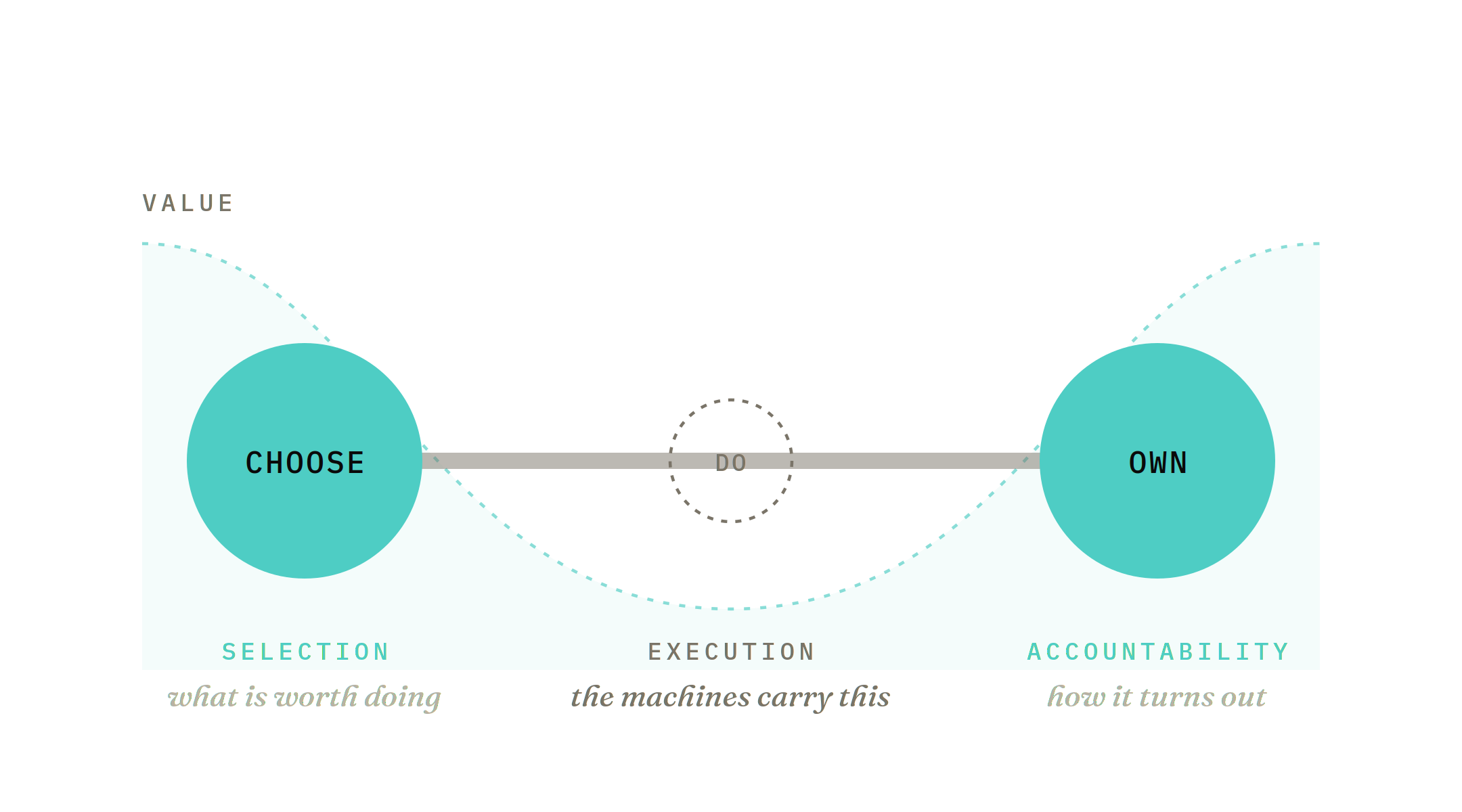
Fig. 01 The value barbell. Worth concentrates at the choosing and the answering, the two stages that stay scarce, and hollows out in the execution the machines now carry.
Upstream: selection. Choosing what is worth doing at all. This is the discipline the first edition in this arc was about, and it becomes the dominant value-creating act the moment execution stops gating it. When you could only attempt a few things, because each one was expensive to do, the doing was the constraint and choosing was almost a luxury. When you can attempt anything cheaply, choosing is the entire game, and choosing badly at scale is the fastest way to burn a cheap-execution advantage. Selection is decision quality, and decision quality is measurable: the xV lens, weighing confidence, value, time sensitivity and strategic fit, is simply the instrument for doing selection well and doing it often. In an era of cheap execution, the organisation that decides well beats the organisation that merely does much.
Downstream: accountability. Owning how it turns out. The previous edition established that an agent can carry the work but cannot answer for it, and that accountability has to sit with a human who can. Here is the part that reframes it from a cost into a source of value: in a world flooded with cheap, plausible, machine-made output, the scarce and valuable thing is a party willing and able to stand behind a result. Trust does not commoditise. When anyone can generate a passable answer, the premium goes to whoever will put their name on it and be answerable if it is wrong. Accountability stops being the compliance tax at the end of the process and becomes the thing the customer is actually paying for.
The hollow middle: execution. The doing. It is not that execution stops mattering; a barbell still needs a bar. It is that execution stops being where the worth is captured, because it is now abundant and copyable. The strategic error of the moment is to keep investing your scarcest resource, human attention, in the middle of the bar, optimising the production of something that no longer pays a premium, while the two ends go understaffed.
Orchestration is the value-creating act
If value lives at the two ends and the middle is cheap and distributed, then the act that actually creates value is the one that connects them: composing distributed capability, human and machine, toward a chosen end, with accountability held at defined points along the way. Call it orchestration.
It is worth being precise about what orchestration is not. It is not middle management, which existed to supervise execution, to make sure the doing got done. When the doing is cheap and self-organising, supervising it is not where value is made. Orchestration is a different function entirely: it points scarce human judgement at the two ends of the barbell, deciding what the distributed capability should be aimed at, and owning what comes out. It is the connective tissue of the new value chain, and it is a genuinely creative act, not an administrative one.
You can increase output and destroy value in the same quarter.
This is not a thought experiment for me. The model my own work has run on for the best part of two decades is a distributed one: a large community of external solvers, self-selecting onto hard problems that a single organisation could not crack alone, with the value created not by any one contributor but by the orchestration of many toward a defined, owned outcome. The research bears out why it works. In a study of 166 broadcast problem-solving challenges involving more than twelve thousand solvers, Lars Bo Jeppesen and Karim Lakhani found that the people most likely to crack a problem were often those at the margins of its field, whose distance from the usual way of thinking was the source of the breakthrough. Value came not from concentrating the work in expert hands but from orchestrating a diverse field toward the result. Agents extend that field rather than replace it: they are new contributors in the distributed model, and the orchestrating function, choosing the aim and owning the outcome, stays exactly where it was, with the humans.
Three ways this has already happened
The pattern is not new. Only its latest instance is.
Historical. When the personal computer commoditised, value fled the assembly of the box and settled at the scarce adjacent stages, the processor and the operating system. The firms that kept their attention on building the machine competed away their margins. The firms that moved to the scarce ends captured the era.
Current. Consider how Nvidia operates. It is one of the most valuable companies in the world, and it does not manufacture a single one of its own chips: that execution is handed to a contract foundry, TSMC. What Nvidia keeps is the scarce work at the two ends, the chip design and the CUDA software ecosystem that everything else is built around, and that is where the value is captured. The doing is outsourced. The choosing and the owning are not.
In motion. Watch what is happening to software as coding agents mature. Writing the code, once the scarce and expensive craft at the centre, is commoditising fast. Value is visibly migrating outward to the two ends: deciding what should be built and why, upstream, and reviewing, integrating and standing behind what the agents produce, downstream. The engineer who creates the most value is no longer the fastest typist. It is the one who chooses well and owns the result, with a fleet of agents doing the middle.
The blueprint: where to stand
The practical question for any leader is simple to ask and uncomfortable to answer. For each thing your organisation does, where does the value actually sit: in the choosing, the doing, or the answering? Run the test honestly on any activity.
Is the value here in the doing? Then expect it to commoditise, and stop investing your scarcest people in defending it. Automate it, orchestrate it, and move on.
Is the value in the choosing? Then this is where your best judgement belongs. Selection at scale, decided well and often, is now a primary source of advantage, not a preamble to the real work.
Is the value in the answering? Then build the accountability in deliberately, resource it, and treat it as a product feature rather than an overhead. It is increasingly what people are paying for.
The same four factors that make a good decision, confidence, value, time sensitivity and strategic fit, are the ones that tell you which activities to orchestrate first: the high-value, time-sensitive, strategically central ones, where doing it cheaply and choosing it well compound. Everything else can wait for the machines to make it trivial.
Three editions, one argument. Strategy is the choosing of what is worth doing. The agent question is the owning of what gets done on your behalf. Value creation in the agentic era is what happens at the intersection: worth is made by orchestrating cheap execution toward chosen ends under owned outcomes. Choose, answer for, orchestrate into worth.
"Value creation" is itself a phrase that does quiet work, which is the thing this series keeps finding in the words we use most casually. It lets people count what they produced and call it worth, hiding the fact that the two activities which actually make value are the two you cannot buy cheaply: the judgement to choose well, and the willingness to be answerable for the result. The machines are very good at the middle. They are no help at all at the ends.
So the agentic era is not the end of human value. It is the relocation of it, upstream to the choice and downstream to the accountability, with the machines doing the middle. The work got cheap so that the humans could finally move to where the worth was all along.
Until next time,
Editor, Ideas for a Better World
Sources & further reading
01. Clayton M. Christensen and Michael E. Raynor, The Innovator's Solution: Creating and Sustaining Successful Growth, Harvard Business School Press, 2003.
02. Ronald H. Coase, "The Nature of the Firm", Economica, 1937.
03. Lars Bo Jeppesen and Karim R. Lakhani, "Marginality and Problem-Solving Effectiveness in Broadcast Search", Organization Science, vol. 21, no. 5, 2010.
04. Bobby Yerramilli-Rao, John Corwin, Yang Li and Karim R. Lakhani, "Strategy in an Era of Abundant Expertise", Harvard Business Review, March–April 2025.
05. Simon Hill, Expected Value, 2025.