Ideas for a Better World newsletter
Are We Moving from the Anthropocene to the Synthocene?
Geologists have formally declined to name an age of human domination, but the measurements behind the idea have not gone away. The more useful question for leaders is whether humanity is moving towards a different relationship with the planet, one built on synthesis rather than extraction. On the evidence of 2026, that shift is under way in energy and almost nowhere else.
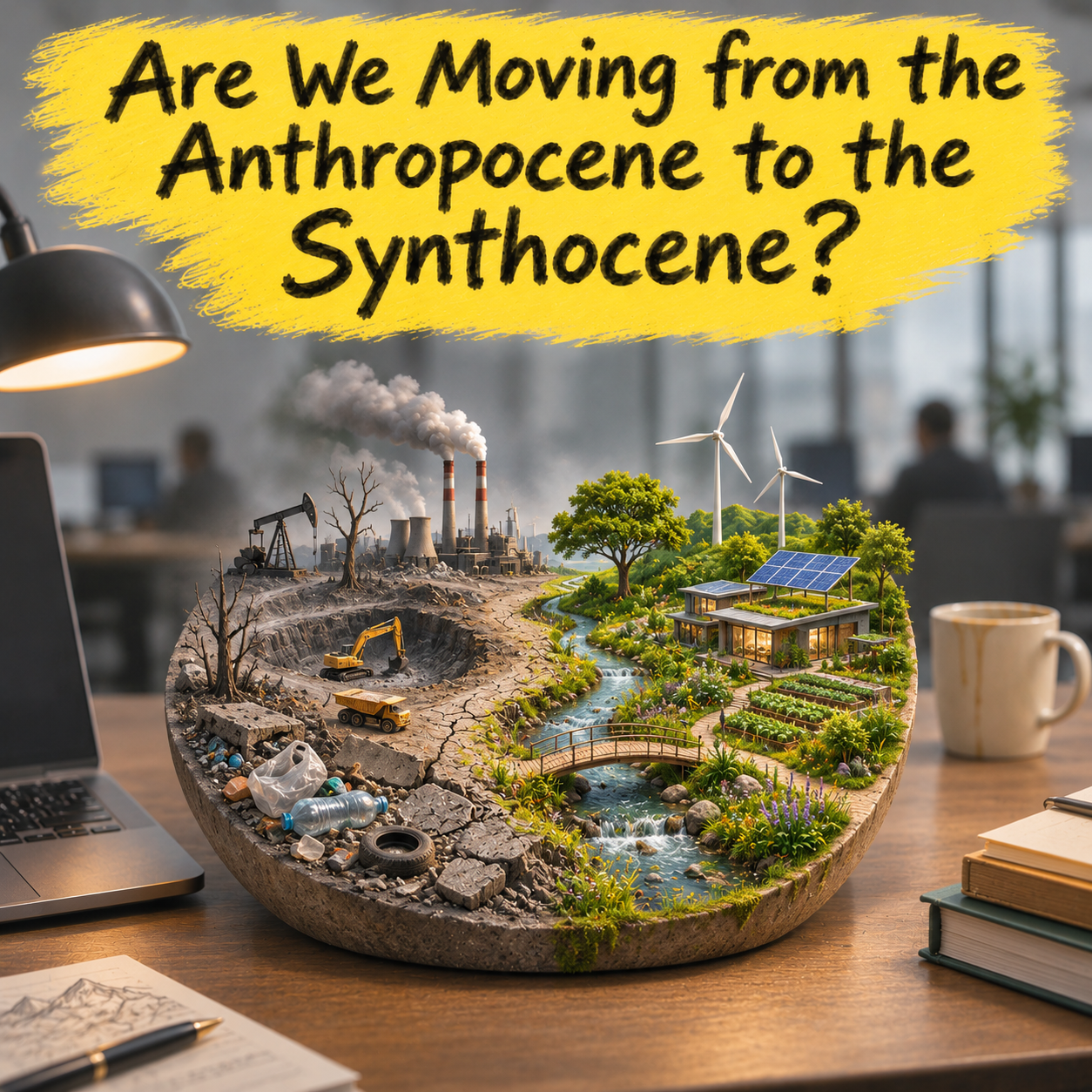
In March 2024, the scientists responsible for dividing Earth's history into official units voted down a proposal to declare a new geological epoch, the Anthropocene, beginning in the 1950s. The International Union of Geological Sciences confirmed the decision on 20 March. Officially, we still live in the Holocene, the epoch that began at the end of the last ice age. (IUGS)
The union was careful about what it was rejecting. The Anthropocene, it said, "will remain an invaluable descriptor of human impact on the Earth system." The argument was about where to draw a line in rock, not about whether the impact is real.
The impact is very real. In 2020, researchers at the Weizmann Institute calculated that the mass of everything humans have made, from concrete and asphalt to metal and plastic, had reached about 1.1 trillion tonnes, overtaking the dry mass of all living things on Earth. At the start of the 20th century, human-made mass was about 3% of that figure. It now roughly doubles every 20 years. (Elhacham et al., Nature)
Before you read on: which way is each one moving?
In 2024 this newsletter named four signs that a more synthetic relationship with the planet had begun. Make your call on each, then see the 2026 verdict.
2026 verdict: Getting better. In 2024, 91% of new renewable power projects were cheaper than the cheapest fossil fuel alternative. New solar was on average 41% cheaper, onshore wind 53% cheaper.
2026 verdict: Getting worse. Just 6.9% of the 106 billion tonnes of materials the world uses each year come from recycled sources, down 2.2 percentage points since 2015.
2026 verdict: Stalled. The Bonn Challenge targets 350 million hectares by 2030. Pledges stand at a little over 210 million hectares, and no figure is published for land actually restored.
2026 verdict: Getting worse. Around a million species are threatened with extinction, and nothing since the 2019 global assessment suggests the decline has reversed.
The full scorecard, with sources, follows below.
Humanity now outweighs life on Earth
Human-made mass against the dry mass of all living things, drawn to one scale. Select a block for detail.
All living things (dry mass), 2020
| Item | Amount | Detail |
|---|---|---|
| Living biomass | 1.1 Tt | Plants make up the great majority of the planet's dry biomass. |
Everything humans have made, 2020
| Item | Amount | Detail |
|---|---|---|
| Human-made mass | 1.1 Tt | Concrete, aggregates, bricks, asphalt, metals and plastics. Roughly doubling every 20 years. |
Now human-made mass at the start of the 20th century, on the same scale. Each gridline is 0.1 trillion tonnes.
| Item | Amount | Detail |
|---|---|---|
| human-made mass in 1900, about 3% of living biomass | 0.033 Tt |
Sources
The Anthropocene, by the numbers
The case for an age of human domination rests on a handful of measurements. The world's leading biodiversity assessment, published in 2019, found that around a million animal and plant species are threatened with extinction, with current extinction rates tens to hundreds of times the average of the past 10 million years. (IPBES) In 2024, according to the Copernicus climate service, the global average temperature was 1.60°C above pre-industrial levels, the first calendar year above 1.5°C. That does not on its own breach the Paris Agreement limit, which refers to an average over at least 20 years, but it shows the direction of travel. (Copernicus)
Whatever the geologists call it, the pattern is the same: an economy that takes materials, energy and land faster than natural systems can replace them.
What would a Synthocene look like?
When this newsletter first wrote about this in 2024, it proposed a name for what might come next: the Synthocene, from synthesis, meaning parts working together as a whole. It is our coinage rather than a scientific term, and others have since used the same word differently. The trends agency The Future Laboratory has described a "Synthocene Era" of partnership between people and artificial intelligence. (The Future Laboratory) Our meaning is narrower: an economy in which human activity works with natural systems rather than against them.
The original edition named four signs that such a shift had begun: cheap renewable energy, circular use of materials, large-scale restoration of land, and a halt to the loss of species. Two years on, it is possible to check each one.
The scorecard
Energy is moving, decisively. In 2024, 91% of new renewable power projects worldwide were cheaper than the cheapest fossil fuel alternative, according to the International Renewable Energy Agency. New solar was on average 41% cheaper, and onshore wind 53% cheaper. Clean power is winning on price rather than on virtue. (IRENA)
Clean power now wins on price
How much cheaper new renewable projects were than the cheapest fossil fuel alternative, on average, in 2024.
| Measure | Solar PV | Onshore wind |
|---|---|---|
| Cheaper than the lowest-cost fossil fuel option | 41% | 53% |
Sources
Materials are moving the wrong way. The Circularity Gap Report 2025 found that just 6.9% of the 106 billion tonnes of materials the world uses each year come from recycled sources, down 2.2 percentage points since 2015. The world is recycling more in absolute terms, but consuming new materials faster still. (Circularity Gap Report 2025)
Restoration is pledged more than done. The Bonn Challenge set a goal of restoring 350 million hectares of degraded and deforested land by 2030. By late 2025, countries and partners had pledged a little over 210 million hectares. Pledges are not restored land, and the organisers do not publish a figure for how much has actually recovered. (IUCN)
Pledges are not restored land
Bonn Challenge pledges against the 2030 target. No figure is published for land actually restored.
| Measure | Pledged by late 2025 | Target for 2030 |
|---|---|---|
| Degraded and deforested land | 210 million ha | 350 million ha |
Sources
Species loss has not turned. Nothing since the 2019 assessment suggests that the decline it described has reversed.
One of four. The Synthocene, if it is coming, has so far arrived only in the power sector.
Why energy moved and the rest did not
The difference is not technology. Recycling, restoration and conservation have well-understood methods. The difference is economics. Renewable power became cheaper than the alternative, so it spread through ordinary commercial decisions without anyone needing to be persuaded. Circular materials, restored land and protected species have not yet reached that point. In most markets, virgin materials are still cheaper than recycled ones, and degraded land costs its owners nothing extra.
This newsletter has reached the same conclusion about plastic packaging and orbital debris. Systems change when the economics change, usually because a price, a rule or a technology shifts what the cheapest choice is.
The original edition also told the story of wolves reintroduced to Yellowstone in 1995 changing the park's plants and even its rivers. That story has become contested: a 20-year field experiment published in 2024 found only weak effects, and the debate continues. (Utah State University) We have left it out rather than present a disputed case as proof.
In energy, the transition has already happened. The rest is waiting for its price.
What this means for leaders
The first implication is that the energy transition is no longer a bet. When nine in ten new renewable projects undercut fossil fuels, the strategic risk sits with organisations that assume otherwise.
The second is that materials are the next frontier, and the gap is enormous. With less than 7% of materials coming from recycled sources, any business that depends on primary materials should expect pressure from regulation and cost to keep building, as it already has for packaging.
The third is that pledges are not outcomes. Restoration targets, net-zero commitments and circularity goals are easy to announce and hard to deliver. The organisations that measure what actually changes will be better placed than those that report what they intend.
Three questions follow. Which of our costs would change if recycled materials became cheaper than virgin ones? Where are we relying on pledges, our own or our suppliers', rather than measured results? And in which of our markets has the clean option already become the cheap one, without our strategy noticing?
Whether or not geologists ever name an Anthropocene, the transition to something better will be decided by economics.
Your turn: which transition tips next?
Which do you expect to become the cheaper choice soonest, without needing subsidy?
- Recycled materials over virgin ones
- Heat pumps over gas boilers
- Electric over petrol and diesel
- Alternative proteins over livestock
Vote and see current results on the website.
Thanks for reading,
Ideas for a Better World Editor, Simon Hill
About the Editor: Founder of Wazoku including Innocentive, author of the award winning Expected Value, Mapping Value, TEDx speaker and innovation thought leader.
Read next
The 9% Problem
Recycling was an alibi for plastic packaging, and the bill has arrived.
From the archive
Space Junk
Nobody pays for orbit. That is why it is filling with junk.
Every edition
Ideas for a Better World
Subscribe for the weekly edition.
How we checked this piece
This edition was first published in October 2024 and has been revised for 2026. Every claim is graded HIGH against a named primary source. Incorrect, dated and unsourced material from the original was removed.
| Claim | Grade | Source |
|---|---|---|
| Anthropocene epoch proposal rejected; confirmed 20 March 2024; "invaluable descriptor" | HIGH | IUGS statement |
| Human-made mass about 1.1 trillion tonnes in 2020, exceeding living biomass; about 3% in 1900; doubling about every 20 years | HIGH | Elhacham et al., Nature (2020) |
| About 1 million species threatened; extinction rates tens to hundreds of times the 10-million-year average | HIGH | IPBES Global Assessment (2019) |
| 2024 at 1.60°C above pre-industrial; first calendar year above 1.5°C; Paris limit refers to a 20-year average | HIGH | Copernicus |
| "Synthocene" coined in this newsletter's 2024 edition; a different "Synthocene Era" from The Future Laboratory | HIGH | Original edition; The Future Laboratory |
| 91% of new renewables cheaper than fossil alternatives in 2024; solar 41% and onshore wind 53% cheaper | HIGH | IRENA, July 2025 |
| 6.9% of 106 billion tonnes of materials from recycled sources; down 2.2 points since 2015 | HIGH | Circularity Gap Report 2025 |
| Bonn Challenge: 350 million hectare target; over 210 million pledged; no restored figure published | HIGH | IUCN, November 2025 |
| Yellowstone trophic cascade contested; 20-year experiment found weak effects | HIGH | Utah State University / Global Ecology and Conservation (2025) |
| "One of four" scorecard; economics as the explanation | ANALYSIS | Editorial judgement from the sources above |
| Removed from the original: a "narrow" vote and "maybe an era"; extinction rates of 100 to 1,000 times; a 2017 renewables scenario; UN cost-decline figures; unsourced technology examples; a crowdsourcing platform recommendation | CUT | Incorrect, dated, unsourced, or requiring a disclosure |