Ideas for a Better World newsletter
Move 37: A Lesson in Disruptive Thinking
In 2016 an AI played a move every expert watching thought was a mistake, and won. Ten years on, the more useful lesson is what happened to the humans: they got better. For leaders, Move 37 is a test of how organisations treat ideas that look wrong.
Tags: AI, Innovation, Disruptive Thinking
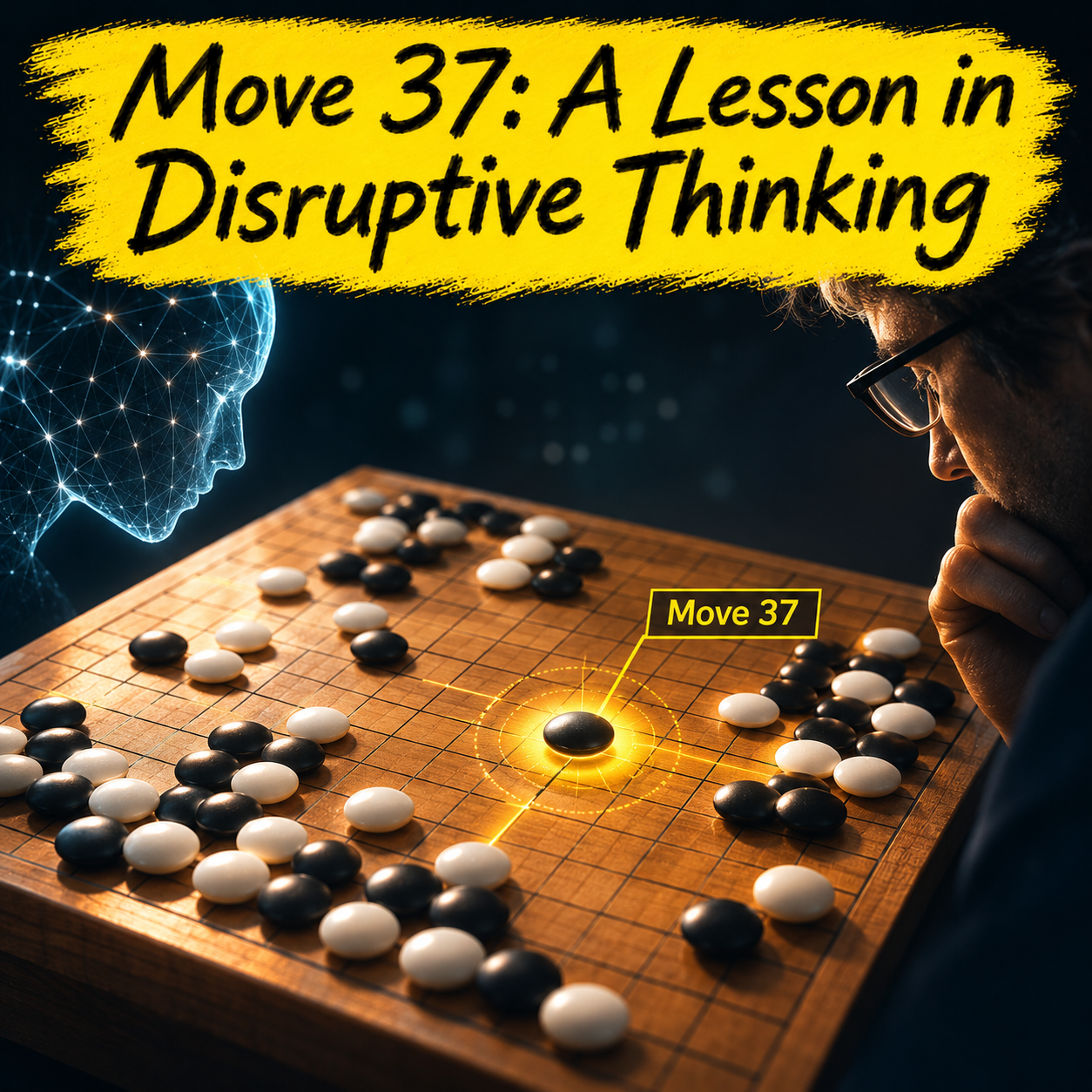
On 10 March 2016, in a ballroom at the Four Seasons Hotel in Seoul, a computer program made a move that the best Go players watching were sure was a mistake. It was the 37th move of the second game between DeepMind's AlphaGo and the South Korean professional Lee Sedol. Within a few hours it was clear the move had decided the game. AlphaGo went on to win the match by four games to one. (British Go Association; Wired)
Move 37 has since become shorthand for a particular kind of breakthrough: an answer that looks wrong to every expert in the room because it lies outside what experience has taught them to consider. Ten years on, the more useful part of the story is what happened next, to the humans.
Game 2 · Four Seasons Hotel, Seoul · 10 March 2016
AlphaGo, playing Black, is about to make move 37. Where did it play?
This is the real position from the game record. The ringed white stone is Lee Sedol's last move. Pick a point.
Black 37 lands on the fifth line, a shoulder hit placed diagonally against the white stone just above it. Commentators called it "a very strange move"; one thought it was a mistake. Lee Sedol left the room and took nearly fifteen minutes to reply. AlphaGo won the game.
Position: official game record, Game 2 (computer-go-dataset, SGF). Odds and reactions: Wired, 16 March 2016.
Why it looked wrong
Go is played on a grid of 19 by 19 lines. Players take turns placing black and white stones, and the aim is to surround more territory than the opponent. Move 37 sat on the fifth line from the right-hand edge: a shoulder hit, placed diagonally against one of Lee's stones to limit his influence before it grew. (game record; British Go Association; Kyunghyang Shinmun)
The reaction was immediate. One commentator called it "a very strange move"; another said, "I thought it was a mistake." Fan Hui, the European champion whom AlphaGo had beaten five games to none before the match, moved from disbelief to admiration, repeating "So beautiful." Lee left the match room and took nearly fifteen minutes to respond. Afterwards he said: "Yesterday, I was surprised. But today I am speechless." (Wired)
AlphaGo itself had calculated that a human player would choose the move only about once in ten thousand times, according to David Silver, who led the research. It played the move anyway, because its own evaluation of the position said the move was good. (Wired; British Go Association)
That is the heart of it. AlphaGo had been trained first on games played by human experts, and then by playing games against itself. (Nature, 2016) It knew what a human would do. It also had a separate judgement of what would work, and when the two disagreed, it backed the judgement over the precedent.
Two moves, the same odds
The machine's surprise, and the human's reply
Both moves were ones AlphaGo rated at about 1 in 10,000 for a human player. One won the machine a game. The other won the only game a human took from it.
Positions: official game records, Games 2 and 4 (computer-go-dataset, SGF). Odds: David Silver (Move 37) and Demis Hassabis (Move 78), reported by Wired.
The human reply
Three days later, in the fourth game, Lee produced his own version. After about 30 minutes of thought he played a wedge between two black stones in the centre of the board, Move 78, which Go players soon called "God's Touch". AlphaGo had judged the chance of a human playing it at, again, about one in ten thousand. Lee won the game. (Wired)
When Lee retired from professional Go in November 2019, he was still the only person to have beaten AlphaGo in a game. He told Yonhap: "With the debut of AI in Go games, I've realised that I'm not at the top even if I become the number one." (Business Standard/PTI)
What happened to the humans
The obvious reading of the match is that the machine won and the humans lost. The evidence since points somewhere more interesting.
In October 2017 DeepMind described AlphaGo Zero, which learned Go from the rules alone, with no human games at all, and beat the version that defeated Lee by 100 games to none. (Nature, 2017) The program that played Move 37 had started from human knowledge; its successor did better without it. Human knowledge, it turned out, had been a ceiling as well as a foundation.
The players adapted. A study published in the Proceedings of the National Academy of Sciences in 2023 analysed more than 5.8 million moves by professional players between 1950 and 2021, using a superhuman Go program to judge the quality of each decision. After superhuman AI arrived, human decisions got significantly better. Players also began making more novel moves, ones never seen before, and those novel moves were associated with better decisions. (PNAS, 2023)
In other words, the machine did not only beat the experts. It showed them that much of the board they had been taught to ignore was worth exploring, and their play improved once they started looking.
In March 2026, for the tenth anniversary of the match, Lee returned to the same Seoul hotel and presented a Go program he had built with an AI agent, framing people and AI as collaborators rather than opponents. (Kyunghyang Shinmun)
Move 37 was not a better answer to the experts' question. It was an answer to a question they had stopped asking.
After Move 37
From one strange move to a decade of change in how Go is played.
| When | What happened |
|---|---|
| 10 March 2016 | Move 37 in Game 2. AlphaGo wins. |
| 13 March 2016 | Lee Sedol's Move 78 in Game 4. Lee wins the only human game. |
| 15 March 2016 | AlphaGo takes the match 4 to 1. |
| October 2017 | AlphaGo Zero, trained without human games, beats AlphaGo 100 to 0. |
| November 2019 | Lee Sedol retires from professional Go. |
| March 2023 | PNAS study: human decisions and novelty improve after superhuman AI. |
| March 2026 | Tenth anniversary. Lee presents a Go program built with an AI agent. |
Machine or human?
Black stone for the machine, white for the human. Five moments from the story.
Verdict: Machine. AlphaGo's Move 37 in Game 2. It went on to decide the game.
Verdict: Human. Lee Sedol's Move 78 in Game 4, the game he won.
Verdict: Human. Lee Sedol, after losing Game 2.
Verdict: Machine. AlphaGo Zero, described in Nature in October 2017.
Verdict: Human. Professional players, in a study of 5.8 million moves published in PNAS in 2023.
Each answer is sourced in the piece and the fact-check below.
What this means for leaders
The first lesson is about what expertise filters out. The commentators in Seoul were not careless; they were applying the patterns that made them experts. The same patterns made a winning move look like an error. Every organisation has its own version of the fifth line: options that are never considered because experience says they are not done. Those are precisely the places where the unexplored value tends to sit.
The second is that the gain came from the humans' response, not from the machine alone. Go players got better because they used superhuman AI to test ideas they would otherwise have dismissed. That is a different model from replacing experts with AI. It treats AI as a way of widening the search, with people still deciding what to play.
The third is that a strange idea needs a fair test rather than a quick verdict. AlphaGo had something the commentators lacked in the moment: a way of judging the move on its merits instead of its familiarity. Most organisations judge new ideas by how closely they resemble past successes. That is a reliable way to reject the next Move 37. (Disclosure: this is the business I am in. Wazoku, which I founded, owns Innocentive, the open innovation platform, and its work rests on the premise that outsiders often find the answers insiders rule out.)
Three questions follow. What are the moves our experts would call a mistake without testing them? Where could AI help us explore options we currently never consider, rather than simply speed up the ones we already make? And when a proposal looks wrong, do we have a way to judge whether it is wrong, or only that it is unfamiliar?
Lee Sedol's reply to Move 37 was a move of his own that the machine had not expected. The most useful response to disruptive ideas is the same: not to dismiss them, nor to defer to them, but to learn from them and play better.
Your turn: what happens to a Move 37 in your organisation?
When someone proposes an idea that looks wrong to the experts, what usually happens next?
- It is rejected before anyone tests it
- It is parked until someone senior backs it
- It gets a small, fair test
- Honestly, it never reaches the room
Vote and see current results on the website.
Thanks for reading,
Ideas for a Better World Editor, Simon Hill
About the Editor: Founder of Wazoku including Innocentive, author of the award winning Expected Value, Mapping Value, TEDx speaker and innovation thought leader.
Read next
Cracking the Code of Life
What AlphaGo's makers did next, and why the hard part moved from the computer to the clinic.
From the archive
Dim Sum, revisited
The next revised edition from the Ideas for a Better World archive.
Every edition
Ideas for a Better World
Subscribe for the weekly edition.
How we checked this piece
This edition first appeared in the Ideas for a Better World newsletter on LinkedIn and has been revised for 2026. Every claim is graded HIGH against a named primary source. Unsourced claims from the original were removed. The board diagrams are drawn from the official game records.
| Claim | Grade | Source |
|---|---|---|
| Game 2 on 10 March 2016 at the Four Seasons Hotel, Seoul; match won 4 to 1; dates of Games 4 and 5 | HIGH | British Go Association match report |
| Move 37 was Black (AlphaGo) at P10, on the fifth line; Move 78 was White (Lee) at L11; Game 4 won by White | HIGH | Official game records (SGF), replayed for the board diagrams |
| Move 37 a shoulder hit to limit the opponent's influence; AlphaGo judged it good but unlikely for a human | HIGH | British Go Association; Kyunghyang Shinmun |
| Commentators' quotes; Fan Hui "So beautiful"; Lee took nearly fifteen minutes; "surprised" and "speechless" quotes | HIGH | Wired, Cade Metz, 16 March 2016 |
| 1 in 10,000 for Move 37 (David Silver) and for Move 78 (Demis Hassabis); about 30 minutes before Move 78; "God's Touch" | HIGH | Wired |
| AlphaGo trained on human expert games and then self-play; beat the European champion 5 to 0 | HIGH | Silver et al., Nature 529 (2016) |
| AlphaGo Zero learned without human data and beat AlphaGo 100 to 0 | HIGH | Silver et al., Nature 550 (2017) |
| Lee the only human to beat AlphaGo; retirement quote to Yonhap, November 2019 | HIGH | Business Standard/PTI, 27 November 2019 |
| 5.8 million moves, 1950 to 2021; better decisions and more novel moves after superhuman AI | HIGH | PNAS 120(12), 2023 |
| Tenth anniversary event, March 2026; Lee's Go program built with an AI agent | HIGH | Kyunghyang Shinmun, 11 March 2026 |
| Expertise filters out unfamiliar options; AI as a way to widen the search | ANALYSIS | Editorial judgement from the sources above |
| Removed from the original: claims that could not be traced to a named primary source | CUT | Unsourced |