Ideas for a Better World newsletter
Outcomes Over Workers: A New Model for Exponential Productivity
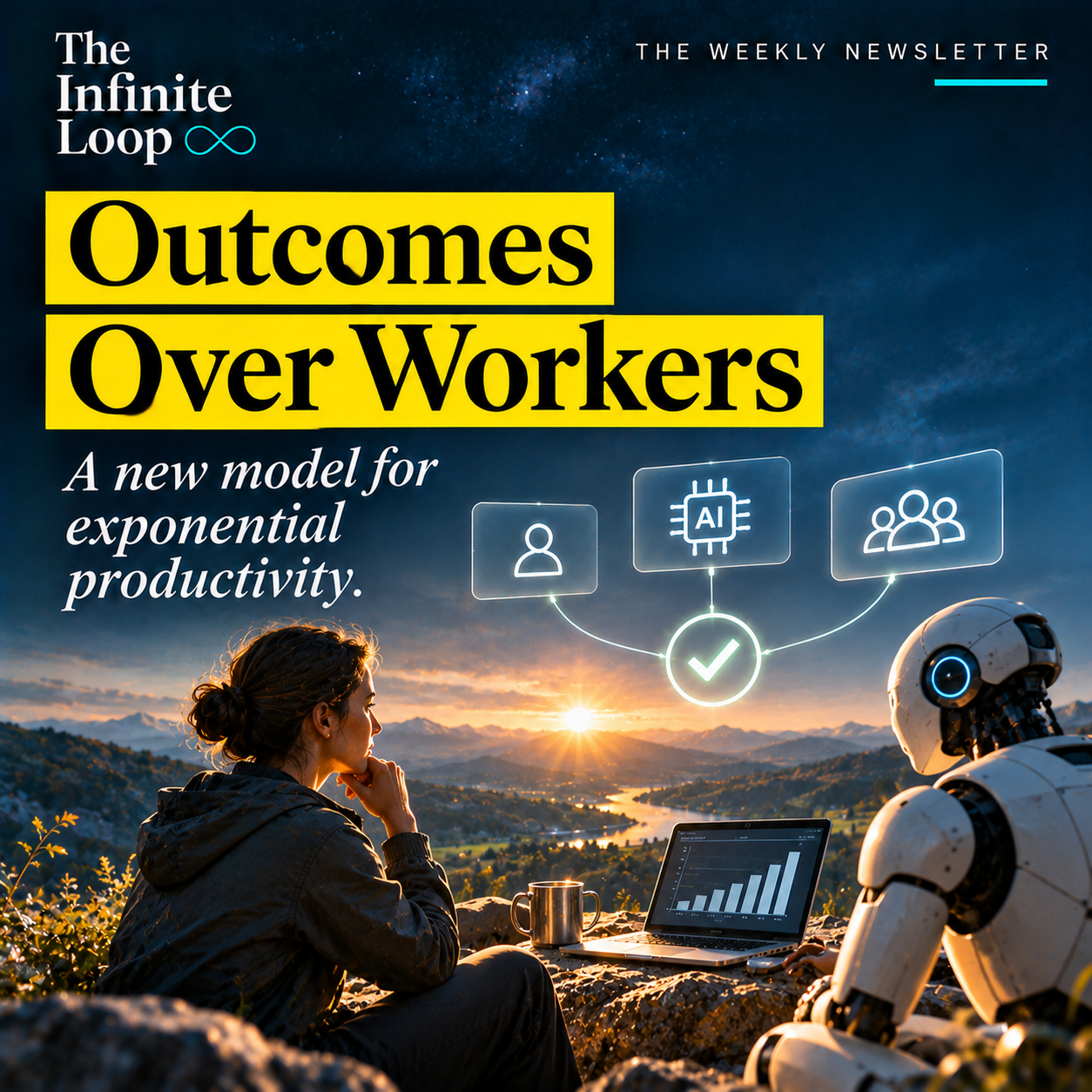
What if organisations stopped asking who should do a job, and asked what is the best way to get the outcome: a person, an AI, a crowd or all three? Twenty months on, the evidence shows where that works, where it has stumbled, and why the law is moving the other way.
Tags: AI, Productivity, Future of Work, Crowdsourcing, Leadership
Guess first
Twenty-six companies posted 166 science problems that their own R&D teams had not solved to an open network of outside scientists. What share were solved?
30%
49 of 166, about 30%. And winners were more likely to come from fields further from the problem, not closer to it.
In March 2025 this newsletter ran a thought experiment. What if organisations stopped asking "who should do this job?" and asked instead "what is the fastest, most effective way to achieve this outcome, whether by a person, an AI, a crowd or some mix of them?" It proposed replacing fixed jobs and departments with dynamic ecosystems of solvers, and asked what would have to change for that to happen.
The question has only become more pressing. AI agents now complete multi-hour tasks on their own, companies have tried replacing whole teams with them, and lawmakers have begun to respond. Twenty months on, this revision keeps the provocation and adds what the evidence now says about where outcome-based work succeeds, where it has stumbled, and what still stands in its way.
Why we organise around jobs
In 1937 the economist Ronald Coase asked why firms exist at all, when markets could in principle coordinate everything. His answer was that using the market has costs: finding the right supplier, agreeing terms, checking the work. Where those costs are high, it is cheaper to employ people and direct them. Jobs, departments and hierarchies are, in this view, a way of economising on the cost of organising work through contracts.
The provocation in the original edition follows from that logic. If digital platforms, open talent networks and AI agents sharply lower the cost of finding and directing a solver for each task, the boundary of the firm should move, and more work should be organised around outcomes rather than around fixed roles. My own work in open innovation over more than a decade has convinced me that the shift is real. The question is how far and how fast it goes.
The productivity stack
Five ways to get work done
The original edition's five models, updated with the evidence. Choose one.
1. Human expertise
Judgement, trust, relationships, ethics
Leadership, high-stakes negotiation, policy.
The tasks where experts already work at the frontier, and where AI help has so far added least.
2. Autonomous agents
Well-specified tasks, speed, scale
Code changes, data analysis, research synthesis.
METR estimates the length of task a frontier model completes half the time has been doubling every few months; in January 2026 it was over five hours of human work.
3. Human + AI
Complex work with a clear quality bar
Drafting, support, analysis with review.
The most consistent gains in controlled trials, especially for less experienced people.
4. The crowd
Hard problems that have stalled inside
Open innovation challenges, prize problems.
Outsiders solved about 30% of problems that had stumped company R&D, and distance from the field helped.
5. Pure outcomes
Modular tasks done by whoever is best placed
Micro-tasks routed to a person or an AI in real time.
The furthest-reaching model, and the one now meeting regulation and quality limits.
Sources: METR (2026); Brynjolfsson, Li and Raymond (2025); Noy and Zhang (2023); Jeppesen and Lakhani (2010).
What outsiders can do
The strongest evidence for organising around outcomes comes from open innovation. In a study of 166 science problems that 26 companies had posted on the Innocentive platform after failing to solve them internally, the economists Lars Bo Jeppesen and Karim Lakhani found that 49, about 30%, were solved by outside scientists. Winners were more likely to come from fields further from the problem, and women, who made up a small share of entrants, were more likely to win than men. (Jeppesen and Lakhani, Organization Science, 2010) (Wazoku, which I founded, now owns Innocentive.)
The point is not that crowds beat employees in general. It is that for a particular kind of problem, one that has stalled inside an organisation because everyone shares the same expertise, broadcasting the outcome you need to a wide, diverse network finds solutions that hiring would not.
What agents can now do
The second change since the original edition is the rise of AI agents that complete tasks rather than answer questions. METR, an independent evaluation group, measures the length of software and research tasks, in human working time, that AI models can complete half the time. In January 2026 it estimated the leading model's horizon at about 320 minutes, with wide uncertainty, and found the horizon for models released since 2024 doubling roughly every three months. (METR, 2026)
The evidence on deployment is more mixed. In February 2024 Klarna said its AI assistant was handling two-thirds of customer-service chats, the work of about 700 full-time agents, with satisfaction on a par with humans. (Tech.eu, 2024) In May 2025 its chief executive told Bloomberg that focusing on cost had led to "lower quality", and that the company would always offer customers a human; Klarna began piloting flexible, remote human agents. (Fortune, 2025) Outcome-based work had found its limit not in capability but in the quality customers expected.
Who should do this task?
Five tasks. Pick the solver the evidence favours today.
Verdict: human + AI. AI raised support agents' output by 14% on average and 34% for novices. Klarna's attempt to let AI do most of the work alone led, by its chief executive's account, to lower quality.
Verdict: the crowd. Outside solvers cracked about 30% of 166 problems that had stumped company R&D, with distance from the field an advantage.
Verdict: an AI agent. Frontier models now complete such tasks most of the time on METR's benchmarks, though the work still needs checking.
Verdict: the human. In a 2025 trial, experienced developers working on their own projects were slower with AI tools than without.
Verdict: human + AI. Professionals using ChatGPT finished writing tasks 40% faster, with quality rated 18% higher, with a person still in charge.
The evidence behind each answer is set out in the article.
The law is moving the other way
The original edition argued that labour law and social safety nets would need to adapt to project-based, AI-augmented work. They are adapting, but not in the direction a pure outcomes model would want. The EU's Platform Work Directive, adopted on 14 October 2024, creates a rebuttable presumption that people working through digital platforms are employees where there are facts indicating control and direction, and requires transparency and human oversight of algorithmic management. Member states must transpose it by 2 December 2026. (Ius Laboris, 2026)
That is a reminder that "jobs" are not only an economic arrangement. They also carry protections, obligations and accountability. A model that routes every task to whoever is cheapest at that moment has to answer who is responsible when the outcome goes wrong, and who looks after the people doing the work between tasks.
Instead of asking who should do this, ask what is the best way to get it done: a person, an AI, a crowd or all three.
What this means for leaders
The first implication is to design work from the outcome backwards. For each important result, ask which mix of employees, AI agents, partners and open networks would produce it best, rather than which department owns it. The answer will often still be an internal team, but the exercise exposes the work that is done in-house only by habit.
The second is to match the solver to the problem. The evidence now supports a rough map: agents for well-specified tasks, human and AI together for most knowledge work, outside crowds for problems that have stalled inside, and experienced people where judgement and deep context matter most. Treating every task the same way, whether all human or all automated, leaves value on the table.
The third is to keep quality and accountability in the design. Klarna's experience and the EU's new rules point the same way: outcome-based models fail when nobody owns the result, or when cost is the only measure. Every route to an outcome needs a named person responsible for it.
Three questions follow. Which of our key outcomes have we never tested against an external crowd or an AI agent? Where are we using one kind of solver for every task? And for each outcome we automate or open up, who is accountable when it goes wrong?
Your turn: jobs or outcomes?
Five years from now, how will most knowledge work in your organisation be organised?
- Much as now, around fixed jobs and teams
- Fixed teams, heavily augmented by AI
- A core team orchestrating agents and outside networks
- Mostly outcomes, with few fixed roles
Vote and see current results on the website.
Thanks for reading,
Ideas for a Better World Editor, Simon Hill
About the Editor: Founder of Wazoku including Innocentive, author of the award winning Expected Value, Mapping Value, TEDx speaker and innovation thought leader.
Next in the archive
The Work Revolution Has Begun
Coming soon in the refreshed archive.
Previously
Stuck in Neutral
Why the productivity bottleneck is adoption, not invention.
Also in the archive
Small Plates, Big Problems
Why many small attempts can beat one big bet.
How we checked this piece
This edition was first published on LinkedIn on 6 March 2025 as a thought experiment, "Outcomes Over Workers: A New Model for Exponential Productivity". It has been updated with the evidence available in November 2026. Every factual claim in the body is graded HIGH against a named primary source; the perspective is the author's. The author has a commercial interest in open innovation through Wazoku, which owns Innocentive.
| Claim | Grade | Source |
|---|---|---|
| 166 problems from 26 firms; 49 solved (29.5%); technical marginality and female solvers associated with winning | HIGH | Jeppesen and Lakhani, "Marginality and Problem-Solving Effectiveness in Broadcast Search", Organization Science 21(5), 2010 |
| METR: leading model 50% time horizon about 320 minutes (Claude Opus 4.5), wide interval; doubling about 89 days for models since 2024 | HIGH | METR, Time Horizon 1.1, 29 January 2026 |
| Klarna 2024: two-thirds of chats, work of about 700 agents, satisfaction on par | HIGH | Tech.eu, 28 February 2024, reporting Klarna's announcement (company claim) |
| Klarna 2025: "lower quality", always a human available, piloting flexible remote agents | HIGH | Fortune, 9 May 2025, reporting the CEO's Bloomberg interview |
| Support agents +14% on average, +34% for novices | HIGH | Brynjolfsson, Li and Raymond, QJE 2025 |
| Writing tasks 40% faster, quality 18% higher | HIGH | Noy and Zhang, Science 2023 |
| Experienced developers slower with AI tools in a 2025 trial | HIGH | METR (2025), sourced in When Prototypes Cost Nothing |
| EU Platform Work Directive (EU) 2024/2831: adopted 14 October 2024; presumption of employment; algorithmic management rules; transposition by 2 December 2026 | HIGH | Ius Laboris, 28 September 2026 |
| Coase (1937): firms exist because using markets has costs | HIGH | Coase, "The Nature of the Firm", Economica 4(16), 1937 |
| Lower coordination costs should move the boundary of the firm | ANALYSIS | Author's argument, following Coase |
| Flagged from the original: open, flatter models outperform closed, hierarchical ones "by a factor of 3–5x" | FLAGGED | Author's experience; no published primary source; removed from the body |
| Removed from the original: Wazoku Crowd challenges deliver outcomes faster than traditional models | CUT | Company claim; replaced with the peer-reviewed Innocentive study, with the ownership disclosed |
| Removed from the original: blockchain-based gig economy example | CUT | Illustrative only |
Simon Hill is the founder of Wazoku, which owns Innocentive, the open innovation platform.