Ideas for a Better World newsletter
Small Plates, Big Problems
The Cantonese name dim sum is traditionally translated as "touch the heart". ( Etymonline ) When this newsletter first wrote about it, in October 2024, the appeal was the table: many small dishes, from many kitchens, shared by everyone sitting round it. That image turns out to de
Guess first
Researchers studied 166 hard scientific problems that companies had failed to crack in-house and then posted to an open crowd of up to 80,000 solvers. How many did the crowd solve?
49
49 of the 166, about 30%. These were problems the companies' own scientists had not solved. Nearly a third were cracked by strangers.
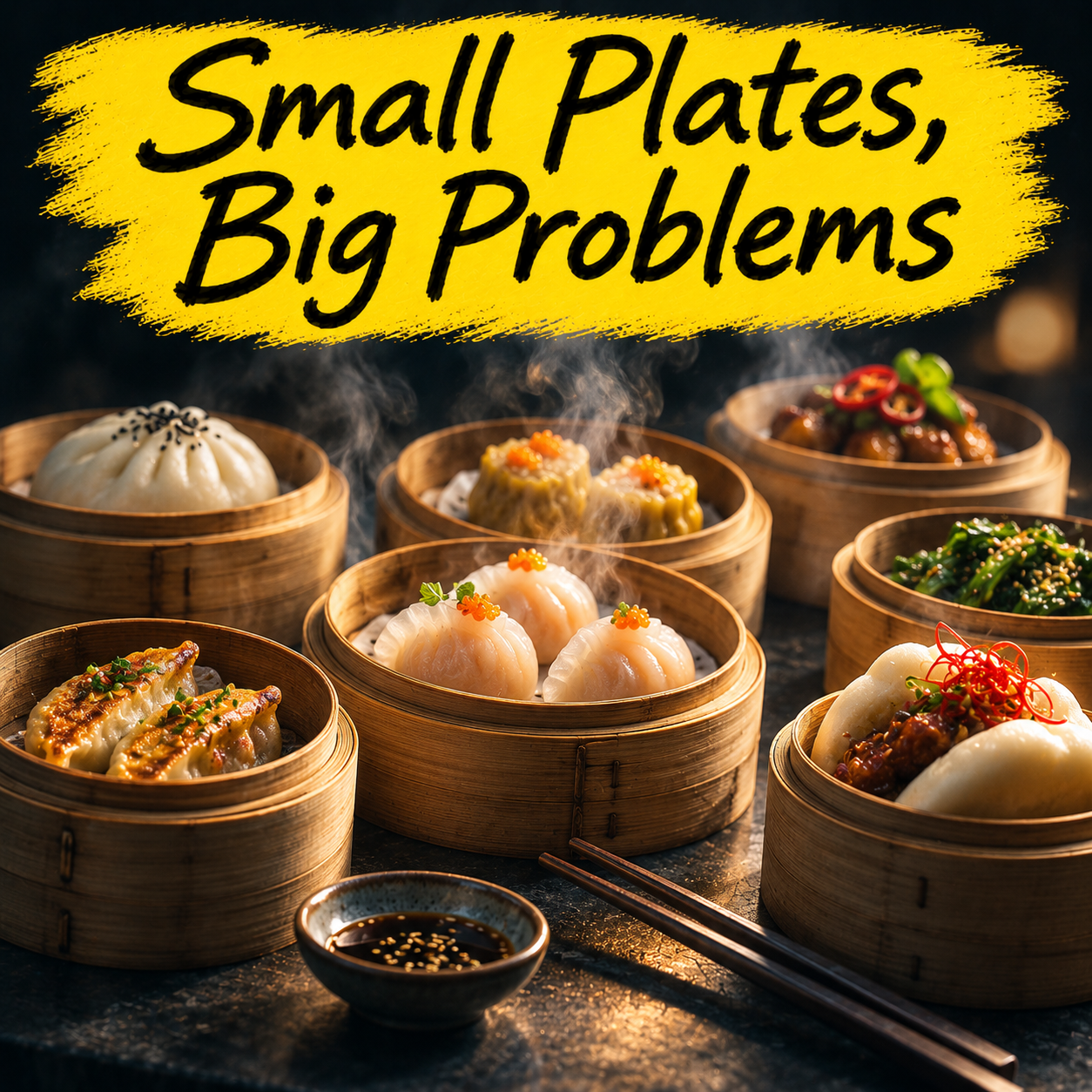
The Cantonese name dim sum is traditionally translated as "touch the heart". (Etymonline) When this newsletter first wrote about it, in October 2024, the appeal was the table: many small dishes, from many kitchens, shared by everyone sitting round it.
That image turns out to describe something more useful than a pleasant meal. Some of the hardest problems organisations face are not solved by one big bet from the most qualified people in the building. They are solved by many small attempts from many directions, and the winning attempt often comes from someone nobody would have thought to ask. There is now good evidence for this, and it should change where leaders look for answers.
The view from the next table
The clearest evidence comes from Innocentive, the open innovation platform on which companies post scientific problems their own laboratories have failed to solve, with a cash award for a working solution. (Disclosure: Innocentive is owned by Wazoku, which I founded.)
In a study published in Organization Science in 2010, Lars Bo Jeppesen and Karim Lakhani analysed 166 challenges posted by 26 companies. Almost 15,000 people downloaded at least one problem, 993 submitted solutions, and 49 problems were solved: about 30% of problems that had already beaten the companies' own experts. (Jeppesen and Lakhani)
The more striking finding was who won. The researchers asked solvers how far the problem sat from their own field. The further away it was, the more likely they were to win: each step outward on a seven-point scale raised the odds of a winning solution by about 3%. Female solvers, who were a small minority on the platform, were about 23% more likely to win than men. The authors' explanation is the same in both cases. People on the margins of a field bring different tools and assumptions to a problem, and sometimes those are exactly what the problem needs. (Jeppesen and Lakhani; Organization Science)
Women's share of solvers, by stage
Fewer at the table, more of the winners
166 Innocentive challenges. Bars run from 0% to 20%.
Women were a small share of entrants and a smaller share of those who submitted, but the women who submitted were about 23% more likely to win than men, holding other factors constant.
A retired engineer and the Sun
A case from 2010 shows the pattern at work. NASA needed to forecast solar particle events, bursts of radiation from the Sun that threaten astronauts and spacecraft, and had no reliable way to predict when they would begin. It posted the problem through Innocentive. More than 500 solvers from 53 countries took part. (NASA)
The winner was Bruce Cragin, a retired radio-frequency engineer from Lempster, New Hampshire. His method forecast the onset of an event within a 24-hour window with 75% accuracy, and he received the full $30,000 award. (NASA) He was not a solar physicist. That was the point.
Four findings
Guess, then turn each card
What the research says about who solves hard problems.
Sources: NASA; Jeppesen and Lakhani (2010); Boudreau, Lacetera and Lakhani (2011).
Why many small plates beat one big dish
A second line of research explains when the crowd approach pays off. Kevin Boudreau, Nicola Lacetera and Karim Lakhani studied 9,661 software contests, published in Management Science in 2011. Adding competitors cuts the effort each one puts in, because each has less chance of winning. But it also raises the chance that at least one competitor finds an exceptional solution. (Boudreau, Lacetera and Lakhani)
Which effect wins depends on the problem. For predictable problems, more competitors made results worse. For highly uncertain problems, where nobody knows in advance what a good answer looks like, more competitors systematically improved the outcome. (Boudreau, Lacetera and Lakhani)
That is the dim sum principle stated precisely. When you know exactly what you want, order one dish from the best kitchen. When you do not, put many small plates on the table.
The answer to a hard problem is often sitting at the next table, with someone who was never invited to the meeting.
What this means for leaders
The first implication is about who gets asked. Most organisations route hard problems to the people closest to them: the specialist team, the incumbent supplier, the expert hire. The evidence says that is the right call for well-defined problems and the wrong one for uncertain ones, where the most valuable answer is likely to come from outside the field.
The second is that breadth has to be designed. Outsiders did not wander into Innocentive by accident; the platform made problems visible to people who would never have been in the room, and stated them in a way strangers could act on. Inside a company, the equivalent means describing problems in terms of what is needed rather than in the jargon of the team that owns them, and opening them to people in other functions, partners and customers.
The third is to be honest about the cost. Crowds work by producing many attempts, most of which fail. Roughly 70% of the problems in the Innocentive study were not solved. A leader who wants the occasional exceptional answer has to accept, and budget for, a great deal of noise. (Disclosure, again: Wazoku, which I founded, owns Innocentive and sells this approach, so treat my enthusiasm accordingly and the published research on its own terms.)
Three questions follow. Which of our hardest problems are uncertain enough that we should be opening them up rather than assigning them? Who outside the owning team could see them, and in what words? And are we prepared to fund many small attempts in order to find one that works?
Dim sum works because no single kitchen has to get everything right. Problem solving, at its best, works the same way.
Your turn: who gets your hardest problems?
When your organisation faces a problem nobody knows how to solve, where does it usually go?
- The specialist team that owns it
- Outside consultants or suppliers
- An open call across the organisation
- An open call outside the organisation
Vote and see current results on the website.
Thanks for reading,
Ideas for a Better World Editor, Simon Hill
About the Editor: Founder of Wazoku including Innocentive, author of the award winning Expected Value, Mapping Value, TEDx speaker and innovation thought leader.
Read next
Move 37
The move every expert called a mistake, and what it did for the humans who studied it.
From the archive
Breaking "Rules", revisited
The next revised edition from the Ideas for a Better World archive.
Every edition
Ideas for a Better World
Subscribe for the weekly edition.
How we checked this piece
This edition was first published on LinkedIn on 31 October 2024 as "Dim Sum" and has been rewritten for 2026 around the evidence on crowd problem solving. Every claim is graded HIGH against a named primary source. Because the piece discusses Innocentive, which is owned by Wazoku, it relies only on independent peer-reviewed research and NASA's own account, not on company figures.
| Claim | Grade | Source |
|---|---|---|
| Dim sum traditionally translated as "touch the heart" | HIGH | Etymonline, citing Ayto, Diner's Dictionary |
| 166 challenges, 26 companies, up to 80,000 solvers; about 14,700 downloaders, 993 submitters, 59 winners; 49 problems solved (29.5%, shown as about 30%) | HIGH | Jeppesen and Lakhani, Organization Science 21(5), 2010 |
| Distance from field: about 3% higher odds of winning per step on a seven-point scale | HIGH | Jeppesen and Lakhani; self-reported distance, and the paper reports the significance level inconsistently |
| Women about 23% more likely to win; shares of 15.6%, 11.4% and 15.2% at each stage | HIGH | Jeppesen and Lakhani |
| NASA solar particle event challenge: over 500 solvers, 53 countries; Bruce Cragin, retired RF engineer; 24-hour window, 75% accuracy; $30,000 | HIGH | NASA |
| 9,661 contests; more competitors help for uncertain problems and hurt for predictable ones | HIGH | Boudreau, Lacetera and Lakhani, Management Science 57(5), 2011 |
| Leaders should open uncertain problems to outsiders and budget for failed attempts | ANALYSIS | Editorial judgement from the sources above |
| Removed from the original: Cape Town "Ubuntu community kitchens" | CUT | No named primary source found |
| Removed from the original: Kamikatsu recycles "nearly 90%" of waste | CUT | The town's own Zero Waste Academy states above 80%; outside this piece's angle |
| Removed from the original: La Cocina example; Dim Sum-mit proposal | CUT | Outside this piece's angle; La Cocina's food hall closed in September 2023 |
Simon Hill is the founder of Wazoku, which owns Innocentive, the open innovation platform.