Ideas for a Better World newsletter
The Day the Tools Started Listening: A Story About the Future of Work
In 2025 this newsletter imagined a workplace whose tools read their users' brain signals. The headset now exists. The inference at the heart of the story, that an employee is overwhelmed, is now prohibited at work across the EU. An annotated story, and what it means for anyone tempted to build it.
Tags: Future of Work, AI, Neuroscience, Technology, Governance, Innovation
A story about the future of work, annotated
The day the tools started listening
First published as fiction in April 2025. Tap the 1 markers to see where the story meets 2026.
In a quiet corner of the city, beneath a soft morning light, a fictional woman named Maren sat at her desk. Her screen blinked back at her: rows of open tabs, a flood of unread messages and a half-finished proposal begging for attention. She rubbed her temples. Her coffee had cooled. Her mind had scattered.
She was a good worker. Always had been. But lately something felt off, not just with her, but with work itself. Her calendar was full and her head fuller. She had the best tools, and every one of them asked the same thing: more. More input, more attention, more hours.
Then, one day, something changed. When Maren sat down the next morning, her screen dimmed slightly and her noise-cancelling softened. A subtle signal: your brain is tired. 1 Her system gently paused notifications.
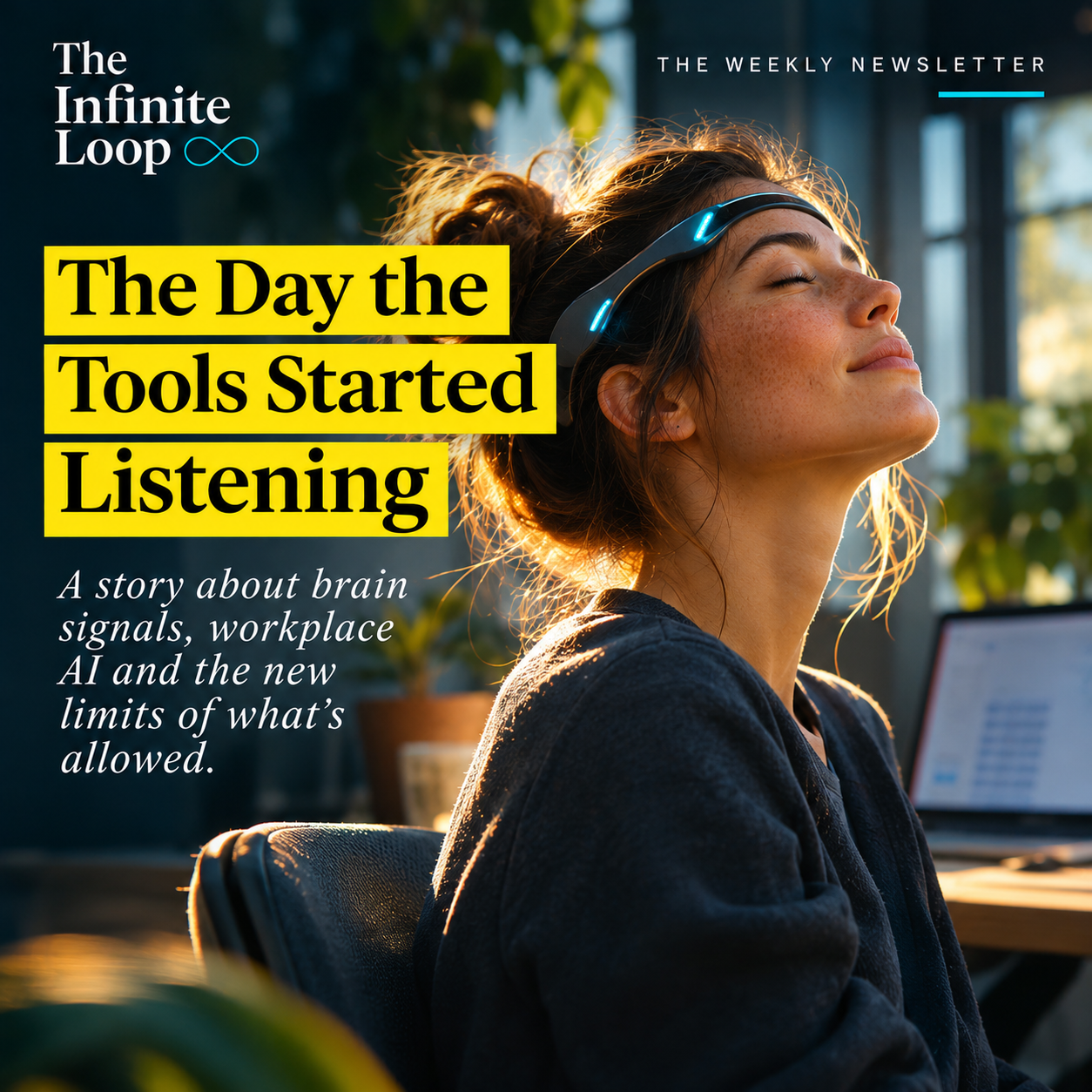
Behind the scenes, her company had introduced something called workware. Tiny sensors in her headset quietly read brain signals, not thoughts or content, but patterns. Was she focused? Was she overwhelmed? 2 Was she in a state to create, or should the system gently guide her towards rest?
Her colleagues noticed, too. Tim in legal said he hit flow more often. Nia in product design said brainstorming felt smoother. Amir in support had stopped hitting the burnout that used to strike every week. It was as if the office had stopped pushing and started listening.
Of course, not everything was simple. Maren had questions. Was her brain data safe? Who had access? What if someone misused the signals? 3
But her company had been thoughtful. It invited employees to co-create the system, gathered their fears, ideas and principles, and built a code of ethics before launching the technology. And, perhaps most important, she always had the choice to unplug. 4
A year later, Maren no longer talked about productivity tools. She talked about her thinking environment. She no longer measured success in hours logged, but in energy invested wisely. The future of work, the story ends, will be defined not by faster apps or bigger screens, but by tools that adapt to our minds, our moods and our deeper human rhythms.
The story, abridged from the original edition
The story above ran in this newsletter in April 2025, a week after an edition on wetware. It imagined a workplace in which tools read their users' brain signals and adapted to them: dimming screens when attention flagged, steering people towards rest, helping teams find flow. It was written as a hopeful fiction, and it ended with a question.
Twenty months on, the question has partly been answered, and not only by technologists. The sensors in Maren's headset are now a consumer product. The inference at the heart of her workware, that she was overwhelmed, is now prohibited at work across the European Union. The rest of this edition looks at the gap between the story and the law, and at what it means for anyone tempted to build Maren's office.
The headset exists
In September 2024, the start-up Neurable and the headphone maker Master & Dynamic launched the MW75 Neuro, priced at $699 in the United States. Dry fabric sensors in the ear cushions feed twelve channels of EEG to an app, which awards points for high, medium and low focus, charts attention over the day and can suggest a break when focus drops. (Engadget, 2024) Bought by an individual and used for their own benefit, it is close to the first half of Maren's morning.
The difference in the story is who deploys it. Maren's company introduced workware; it was a tool that used her biology on the organisation's behalf. That is where the law has drawn its line.
The law has drawn a line
Since 2 February 2025, the EU AI Act has prohibited emotion recognition systems in the workplace: systems that infer people's emotions or intentions from biometric data. The European Commission's draft guidelines interpret "workplace" broadly, to include job candidates, and give examples of prohibited uses, such as tracking call-centre staff's anger through webcams and voice analysis. The only exception is for systems deployed solely for medical or safety reasons, which the Commission says should be narrowly interpreted. Detecting a driver's fatigue falls outside the ban, because fatigue is a physical state; a system detecting burnout or depression at work would remain prohibited. (Lewis Silkin, 2025)
Outside Europe, the direction is similar if less strict. Colorado and California treat neural data as sensitive personal information. (BakerHostetler) In November 2025 UNESCO's member states adopted the first global framework on the ethics of neurotechnology, which cautions against employer tools that track output or build profiles of employees and calls for explicit consent and transparency. (UNESCO UK, 2025)
Read against those rules, Maren's story divides cleanly. A headset she chose, whose data stayed with her, helping her decide when to rest: broadly permissible. An employer system inferring whether she was overwhelmed: in Europe, unlawful. Whether a "focus" score counts as an emotion or a physical state is the kind of question the courts have not yet answered.
The sensors in Maren's headset are now a consumer product. The inference at the heart of her workware is now illegal at work across the EU.
What this means for leaders
The first implication is to know where the line is before anyone buys anything. In the EU, inferring employees' emotional states from biometric signals is prohibited, and fines for prohibited practices have been enforceable since August 2025. Any wellbeing, productivity or engagement technology that reads faces, voices, keystrokes or brain signals needs a legal review before a pilot, not after.
The second is that the story's best idea was its governance, not its sensors. Maren's company asked employees to co-create the system and agreed a code of ethics before launch, and she could always unplug. That is close to what UNESCO's framework now asks for. Tools that individuals choose and control are a very different proposition from tools an organisation deploys on them.
The third is that the goals of the story can be met without reading anyone's brain. Fewer interruptions, protected focus time, shorter meetings and earlier signs of overload are all achievable by changing how work is organised, as an earlier edition argued, and by asking people directly.
Three questions follow. Which of the tools we use or are evaluating infer how our people feel, and have we checked them against the law? Where could we give employees control of their own data rather than collecting it centrally? And which of the problems these tools promise to solve could we solve by changing the work instead?
Your turn: would you wear it?
Your employer offers a headset that tracks your focus and suggests breaks. Would you use it?
- Yes, if the data stayed with me
- Yes, if only anonymous team data were shared
- Only one I bought myself
- No
Vote and see current results on the website.
Thanks for reading,
Ideas for a Better World Editor, Simon Hill
About the Editor: Founder of Wazoku including Innocentive, author of the award winning Expected Value, Mapping Value, TEDx speaker and innovation thought leader.
Next in the archive
High-Growth Firms Track This One Innovation KPI
What high-growth firms actually track.
Previously
Wetware
The biological future of computing.
Also in the archive
The Work Revolution Has Begun
Who is winning the fight over how we work.
How we checked this piece
This edition was first published on LinkedIn on 10 April 2025 as "#30: The Day the Tools Started Listening: A Story About the Future of Work". The story is fiction and has been abridged; the annotations and analysis are new for 2026. Every factual claim is graded HIGH against a named primary source. This is not legal advice.
| Claim | Grade | Source |
|---|---|---|
| MW75 Neuro: announced 24 September 2024; $699; dry fabric EEG sensors in ear pads, 12 channels; focus scores; break prompts | HIGH | Engadget, September 2024 |
| EU AI Act Article 5(1)(f): emotion recognition in the workplace prohibited from 2 February 2025; medical or safety exception narrowly interpreted; burnout detection remains prohibited; driver fatigue outside the ban; call-centre example; workplace includes candidates; fines enforceable from 2 August 2025 | HIGH | Lewis Silkin, February 2025, summarising the Act and the Commission's draft guidelines |
| Colorado and California treat neural data as sensitive personal data (2024) | HIGH | BakerHostetler |
| UNESCO Recommendation on the Ethics of Neurotechnology adopted November 2025; cautions against employer tracking and profiling; explicit consent and transparency | HIGH | UNESCO UK, 18 November 2025 |
| Whether a focus score is an emotion or a physical state is untested | ANALYSIS | Author's interpretation; not legal advice |
| The story | ANALYSIS | Fiction, abridged from the original edition; no factual claims |