Ideas for a Better World newsletter
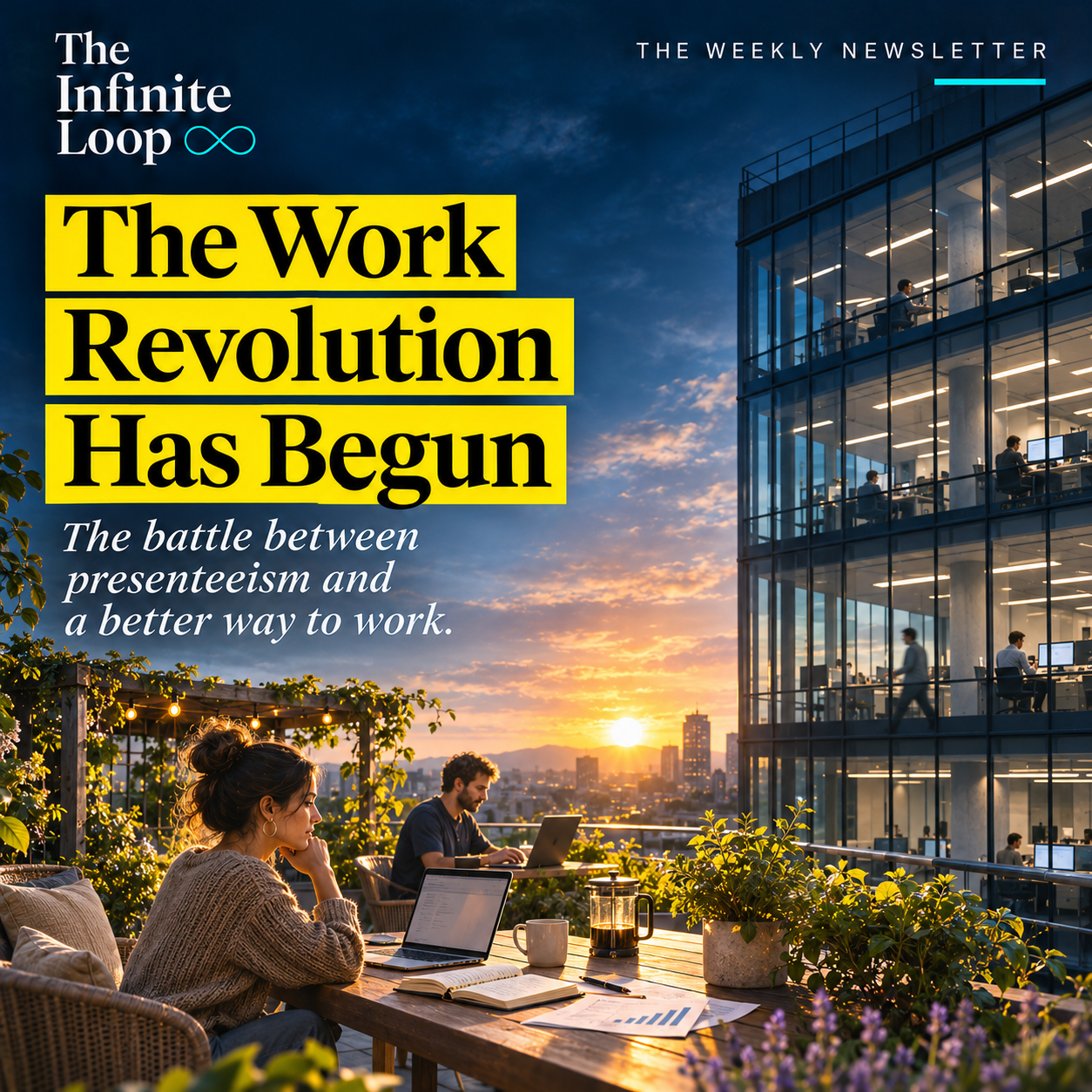
The Work Revolution Has Begun
Twenty months after this newsletter declared a revolution in how we work, the evidence for shorter weeks and flexible working has grown stronger, big employers have ordered staff back five days a week, and engagement has fallen to 20%. The front line now runs through managers.
Tags: Productivity, Future of Work, Leadership, Wellbeing
Guess first
Gallup surveys employees around the world every year. What share of the world's employees were engaged at work in 2025?
20%
20%, down from 21% the year before and 23% in 2022. Among managers it fell to 22%, from 27% a year earlier.
In March 2025 this newsletter declared that a quiet revolution in work had begun. On one side were the many: organisations that measure presence rather than impact, celebrate exhaustion and fill calendars with meetings. On the other were the few: organisations building systems that protect people's energy and attention, and which, the piece argued, were winning in the marketplace too. It ended with a challenge to readers to change one workplace practice that made no sense.
Twenty months on, both sides have dug in. The evidence for the few has grown stronger, with large controlled studies of shorter weeks and hybrid working published in leading journals. At the same time, some of the world's biggest employers have ordered staff back to their desks five days a week, and engagement has fallen. The revolution is real. It is also contested, and the front line has moved.
The broken machine, by the numbers
Gallup's latest global survey found that just 20% of employees were engaged at work in 2025, down from 21% in 2024 and 23% in 2022, the second annual decline in a row. The sharpest fall was among managers, whose engagement dropped from 27% to 22% in a single year. Gallup estimates the cost of low engagement at about $10 trillion in lost productivity, roughly 9% of global GDP. (Gallup, 2026)
The fall among managers matters most. Managers are where the old system and the new one meet: they set the meetings, define what counts as performance and decide whether people are trusted to work in their own way. A revolution in work that does not reach them stalls.
The few, with better evidence
The strongest evidence for the original argument has arrived since it was written. A study published in Nature Human Behaviour in 2025 followed 2,896 employees at 141 organisations in six countries through six-month trials of a four-day week with no loss of pay, after each organisation had first reorganised its work. Burnout fell and job satisfaction, mental health and physical health improved, while a group of control companies showed no such pattern. Those whose hours fell most improved most. (Fan, Schor, Kelly and Gu, Nature Human Behaviour, 2025)
A randomised trial at a Chinese technology company, published in Nature in 2024, found that letting 1,612 employees work from home two days a week had no effect on their performance grades or promotions over two years, and cut quit rates by a third. (Bloom, Han and Liang, Nature, 2024)
Some of the original's favourite examples deserve more care. Microsoft Japan's 2019 experiment, closing offices on Fridays for a month, did record sales per employee 39.9% higher than the same month a year earlier, alongside 30-minute meeting limits. (CNBC, 2019) But it was a single month with no control group, and is better read as a signal than as proof. Shopify's purge of recurring meetings in January 2023 removed nearly 10,000 events, which the company estimated would free more than 76,500 hours; it did not publish what happened to output. (CNN, 2023)
The many, pushing back
Against that evidence, some of the largest employers have moved the other way. Amazon ordered corporate staff back to the office five days a week from January 2025, and JPMorgan Chase, with roughly 300,000 employees, ended its hybrid policy from March 2025. (Fortune, 2025) The case for presence usually rests on collaboration, culture and speed of decision-making, which are harder to measure than performance grades or quit rates.
The studies above do not settle that argument for every organisation. They do shift the burden of proof. Leaders who insist on presence now need to show what it produces, because the best controlled evidence finds that flexibility and shorter hours can improve wellbeing and retention without harming performance.
Which revolution claims hold up?
Five claims about better ways of working. How well does each stand up to the evidence?
Verdict: holds up. A controlled study of 2,896 employees at 141 organisations found less burnout and better mental and physical health.
Verdict: not supported. A randomised trial of 1,612 employees found no effect on performance or promotions, and a third fewer people quit.
Verdict: partly. Sales per employee rose 39.9% in one month against the year before, but with no control group, it is a signal rather than proof.
Verdict: partly. Shopify estimated 76,500 hours freed from nearly 10,000 cancelled events, but published no measure of the effect on output.
Verdict: not supported. Gallup found global engagement fell to 20% in 2025, and managers' engagement fell five points in a year.
Sources for each answer are in the article and the fact-check table.
From wherever you sit
Five revolutionary acts
The original edition's challenge. Tick the ones you will try this month.
✓Audit your meetingsList your recurring meetings and ask what would happen if each disappeared. Remove at least one.
Shopify removed nearly 10,000 recurring events in one go.✓Default to asynchronousBefore calling a meeting, ask whether a written update would do.
Microsoft Japan capped meetings at 30 minutes during its trial.✓Define your own measuresAgree a few visible deliverables with your manager instead of tracking hours.
The four-day-week organisations reorganised work before cutting hours.✓Protect deep workBlock focused time each day and defend it.
Shopify made Wednesdays meeting-free.✓Ask for a trialPropose a time-limited experiment with flexible hours or days, and measure it.
The strongest evidence comes from trials with a control group.committed. Start with one, and measure what changes.
The best controlled evidence has shifted the burden of proof. Leaders who insist on presence now need to show what it produces.
What this means for leaders
The first implication is to put managers at the centre of any change in how work is done. Gallup's numbers show engagement falling fastest among the people who run teams. A new policy on hours, meetings or location will not survive contact with a disengaged or overloaded manager, so the first investment belongs there.
The second is to reorganise before you reduce. The four-day-week organisations in the Nature Human Behaviour study changed how they worked before cutting hours. Shorter weeks, fewer meetings and flexible days work when they are the result of redesigned work, not a perk added to the old design.
The third is to run your own trial, with a comparison group. Most organisations decide these questions by conviction, whether for presence or for flexibility. The strongest evidence now comes from controlled experiments, and any organisation can run one: a team, a quarter, a clear measure of output and wellbeing, and a similar team that carries on as before.
Three questions follow. How engaged are our managers, and what are we doing about it? Which of our working practices exist because of how work used to be organised? And what evidence, from our own organisation, supports our current policy on hours and location?
Your turn: which side?
Which change would make the biggest difference to how well your organisation works?
- Far fewer meetings
- More flexibility over where and when
- A shorter working week
- Better-supported managers
Vote and see current results on the website.
Thanks for reading,
Ideas for a Better World Editor, Simon Hill
About the Editor: Founder of Wazoku including Innocentive, author of the award winning Expected Value, Mapping Value, TEDx speaker and innovation thought leader.
Next in the archive
Sulfates: The Silent Disruptor
How water chemistry shapes nature, industry and policy.
Previously
Outcomes Over Workers
What if we organised around outcomes instead of jobs?
Previously
Stuck in Neutral
Why the productivity bottleneck is adoption, not invention.
How we checked this piece
This edition was first published on LinkedIn on 13 March 2025 as "The Work Revolution Has Begun (Are You on the Right Side of History?)". It has been updated with the evidence available in November 2026. Every factual claim in the body is graded HIGH against a named primary source; the perspective is the author's.
| Claim | Grade | Source |
|---|---|---|
| Global engagement 20% in 2025 (21% in 2024, 23% in 2022); manager engagement 22% (27% in 2024); about $10 trillion lost productivity, about 9% of global GDP | HIGH | Gallup, State of the Global Workplace 2026 (cost is Gallup's estimate) |
| Four-day week study: 2,896 employees, 141 organisations, six countries, six months, no pay cut, pre-trial reorganisation; improvements in burnout, satisfaction, mental and physical health; control companies did not show the pattern; larger individual reductions, larger gains | HIGH | Fan, Schor, Kelly and Gu, Nature Human Behaviour 9(10), 2025 |
| Hybrid trial: 1,612 employees, no effect on performance or promotions, quits down a third | HIGH | Bloom, Han and Liang, Nature 630 (2024) |
| Microsoft Japan, August 2019: sales per employee +39.9% vs August 2018; meetings capped at 30 minutes; about 2,300 employees | HIGH | CNBC, 4 November 2019, reporting Microsoft Japan |
| Shopify, January 2023: nearly 10,000 recurring events cancelled; 76,500 hours freed (company estimate); meeting-free Wednesdays | HIGH | CNN, 3 January 2023 |
| Amazon five days in office from January 2025; JPMorgan about 300,000 staff, five days from March 2025 | HIGH | Fortune, 10 January 2025 |
| Managers are the hinge of workplace change; evidence shifts the burden of proof; the usual case for presence | ANALYSIS | Author's interpretation |
| Corrected from the original: Gallup engagement 21% | CUT | Updated to 20% for 2025 |
| Corrected from the original: Shopify deleted "10,000 calendar events in a single day" and "thrived" | CUT | Nearly 10,000 events; no published outcome data |
| Removed from the original: 31 hours a month in unnecessary meetings; turnover costs 1.5–2x salary; $300 billion stress cost; Atlassian ShipIt revenue; Bolt four-day week results | CUT | No primary source found in the form given |
| Removed from the original: P.P.S. offer of a meeting template | CUT | Not applicable to the republished edition |