Ideas for a Better World newsletter
The Universes We Cannot See
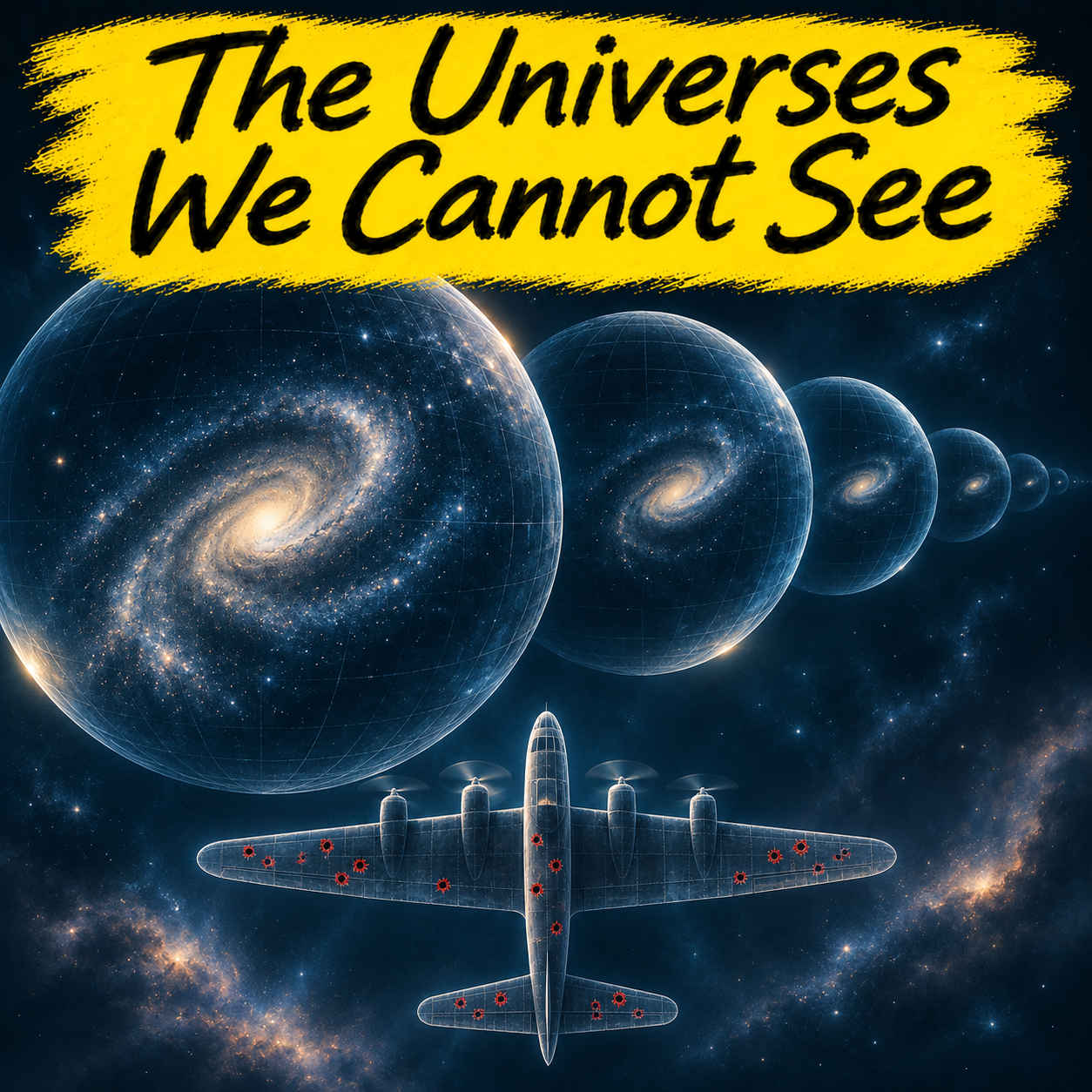
The multiverse is a serious idea without, so far, a single piece of evidence. Its most useful lesson is the one that needs no other universe: what we can observe has already been filtered. For leaders, most business evidence comes from survivors.
Tags: Science, Multiverse, Decision Making, Leadership, Survivorship Bias
I recently suffered a death in my family. The universe often has a strange way of signalling things when you need it to and at times of loss and suffering it is natural to look more intently for such things. However, an undeniable event led me into a more spiritual exploration following this loss. I won't get too much into that here, but it led me into the topic for this newsletter.
We are going to dig into the fascinating concept of multidimensionality: the idea that reality as we know it might be just one layer in a much more complex, multidimensional existence. Unsurprisingly, this is a complex topic and one newsletter does not do it justice, so this is a series.
When these editions first appeared, in late 2024, I said I was just getting into these topics and asked readers to tell me where my understanding erred. Revisiting them two years on, I have held each idea to the standard this newsletter now applies to everything: what does the evidence actually show? That turns out to be the most interesting question of all, and the one with the most to teach anyone who has to make decisions without seeing the whole picture.
Three roads to many universes
The idea that our universe is one of many arrives by at least three separate routes, and it helps to keep them apart.
The first is quantum mechanics. In 1957 Hugh Everett III published what he called the "relative state" formulation of quantum mechanics. (Everett, Reviews of Modern Physics, 1957) Rather than a measurement picking one outcome from many possibilities, every outcome happens, each in its own branch of reality. It later became known as the many-worlds interpretation.
The second is cosmology. In 1986 Andrei Linde described an "eternally existing self-reproducing" inflationary universe, in which the rapid expansion after the Big Bang never stops everywhere at once, so new regions keep budding off. (Linde, Physics Letters B, 1986) In Linde's account, different regions can end up with different laws of physics. "The laws of physics can change," he told Stanford Magazine. "We just can't see it when they do." (Stanford Magazine, 2007)
The third is string theory, which allows an enormous number of possible universes, each with its own physics. That is the subject of the next part of this series.
The trouble with universes you cannot visit
The problem all three share is evidence. Other universes, by definition, are not ones we can observe directly. Physicists have looked for indirect traces: if our universe were one bubble among many, a collision with a neighbouring bubble might have left a mark on the cosmic microwave background, the oldest light in the sky. In 2011 a team of cosmologists searched seven years of data from NASA's WMAP satellite for exactly such marks. They found none, and concluded the data "do not warrant" adding bubble collisions to the standard model of cosmology. (Feeney et al., Physical Review D, 2011)
That does not rule out a multiverse. It shows how hard it is to test. Some physicists argue that a theory can be judged on its elegance and explanatory power when experiments are out of reach. Others reject that firmly. In Nature in 2014, the cosmologists George Ellis and Joe Silk wrote of multiverse theory: "It is not, in our opinion, robust, let alone testable." Their verdict on the idea of judging theories without experiments: "post-empirical science is an oxymoron". (Ellis and Silk, Nature, 2014)
That debate is still running, and it is the honest place to stand. The multiverse is a serious idea held by serious people. It is not, as yet, a finding.
From idea to test
The multiverse has produced more theory than evidence.
| Year | What happened | Evidence? |
|---|---|---|
| 1957 | Everett proposes that every quantum outcome is realised | An interpretation; makes the same predictions as standard quantum mechanics |
| 1986 | Linde describes eternal, self-reproducing inflation | Inflation has support; the many universes do not |
| 2011 | Search for bubble collisions in WMAP data | None found |
| 2014 | Ellis and Silk: multiverse "not robust, let alone testable" | The argument over testability continues |
A thought experiment from 1943
Bombers come back with these holes. Where do you add armour?
Every red dot is a bullet hole recorded on a returning aircraft. Armour is heavy, so you can only add it in one place.
Armour the engines. These are only the planes that came back. Holes in the wings and fuselage show where a bomber can be hit and survive. The missing holes, on the engines, show where hits brought planes down.
A caution in keeping with this newsletter: the story is usually credited to the statistician Abraham Wald. His wartime memos on aircraft survivability are real, but a mathematician who studied them found "very little evidence for the best bits" of the popular version.
Illustrative diagram. History: Casselman, "The Legend of Abraham Wald", American Mathematical Society.
The universe we can see, and the planes that came back
There is one part of multiverse reasoning that does not depend on finding other universes, and it is the part with the most practical value. It is the selection effect.
Whatever else is true, we can only ever observe a universe in which observers like us can exist. If there were many universes with different laws, most of them would contain nobody to notice. So the fact that ours appears well suited to life is not, on its own, surprising. Advocates of the multiverse use this argument to explain why the constants of nature look finely tuned. Critics reply that it explains everything and therefore predicts nothing. Both sides agree on the underlying logic: what you can observe has already been filtered by the conditions that let you observe it.
The same logic turns up in a very different place: the wartime analysis of bombers returning with bullet holes, usually credited to the statistician Abraham Wald. Wald's memoranda on aircraft survivability, written around 1943 for the wartime Statistical Research Group, are real, and his colleague W. Allen Wallis later credited him with the reasoning that hits on the most vulnerable parts were less likely to show up on planes that made it home. The famous details of the story are another matter: there is, as one mathematician who studied the record put it, "very little evidence for the best bits". (Casselman, American Mathematical Society)
What you can observe has already been filtered by the conditions that let you observe it. That is true of universes, bombers and businesses.
What this means for leaders
The first implication is that most business evidence comes from survivors. Case studies, benchmarks, success stories and "what the best companies do" are drawn from the firms still standing, which is the business equivalent of studying only the planes that came home. Before copying what winners did, ask what the losers did, and whether it was any different. Often the honest answer is that nobody looked.
The second is to be wary of explanations that cannot lose. A strategy, forecast or business case that can account for any outcome after the fact is the corporate version of a theory nobody can test. Ellis and Silk's demand of physics applies equally to a board paper: what result would show this is wrong, and when will we know?
The third is that elegance is not evidence. Some of the most compelling ideas in physics remain unconfirmed after decades, and some of the most compelling ideas in organisations are the same. The appeal of an idea and the strength of the case for it are different things, which is a theme running through this archive, from Myths About Myth-Busting to Small Plates, Big Problems.
Three questions follow. Where are our decisions based on the survivors, and what would the full population tell us? Which of our plans could, in principle, be shown to be wrong? And are we judging our most attractive ideas by their evidence or by their elegance?
Your turn: where is the survivor bias?
Where is your organisation most likely to be learning only from the planes that came back?
- Copying competitors' success stories
- Hiring profiles based on current stars
- Lessons drawn only from projects that shipped
- Listening only to customers who stayed
Vote and see current results on the website.
Thanks for reading,
Ideas for a Better World Editor, Simon Hill
About the Editor: Founder of Wazoku including Innocentive, author of the award winning Expected Value, Mapping Value, TEDx speaker and innovation thought leader.
Next in this series
Part 2: Same Data, Different Worlds
Many-worlds, and what to do when every explanation fits the data.
Also in the archive
Small Plates, Big Problems
Why many small attempts beat one big bet, and what that costs.
Every edition
Ideas for a Better World
Subscribe for the weekly edition.
How we checked this piece
This edition was first published on LinkedIn on 21 November 2024 as "Exploring Multidimensionality", the first of a series. The personal introduction is retained as written. The rest has been revised for 2026, and every claim in the body is graded HIGH against a named primary source.
| Claim | Grade | Source |
|---|---|---|
| Everett, "Relative State" Formulation of Quantum Mechanics, 1957 | HIGH | Reviews of Modern Physics 29, 454 (1957) |
| Linde, eternally existing self-reproducing chaotic inflationary universe, 1986 | HIGH | Physics Letters B 175, 395 (1986) |
| Linde: "The laws of physics can change"; "We just can't see it when they do" | HIGH | Stanford Magazine, 2007 |
| WMAP seven-year search for bubble collisions found none; "do not warrant" adding them | HIGH | Feeney, Johnson, Mortlock and Peiris, Physical Review D 84, 043507 (2011) |
| Ellis and Silk: "not robust, let alone testable"; "post-empirical science is an oxymoron" | HIGH | Nature 516 (2014) |
| Wald's survivability memoranda (about 1943), published by the Center for Naval Analyses; Wallis credited him with the reasoning; "very little evidence for the best bits" of the legend | HIGH | Casselman, American Mathematical Society, drawing on Mangel and Samaniego (JASA, 1984) |
| Selection effects in multiverse reasoning and in business evidence | ANALYSIS | Editorial judgement |
| Removed from the original: many-worlds "helps explain" quantum mysteries; String Theory "points to" brane universes | CUT | Overstated; revisited in parts two and three |
| Removed from the original: plan for a part on consciousness and astral planes | CUT | No primary evidence meets this newsletter's standard |