Ideas for a Better World newsletter
What the Square Could Not See
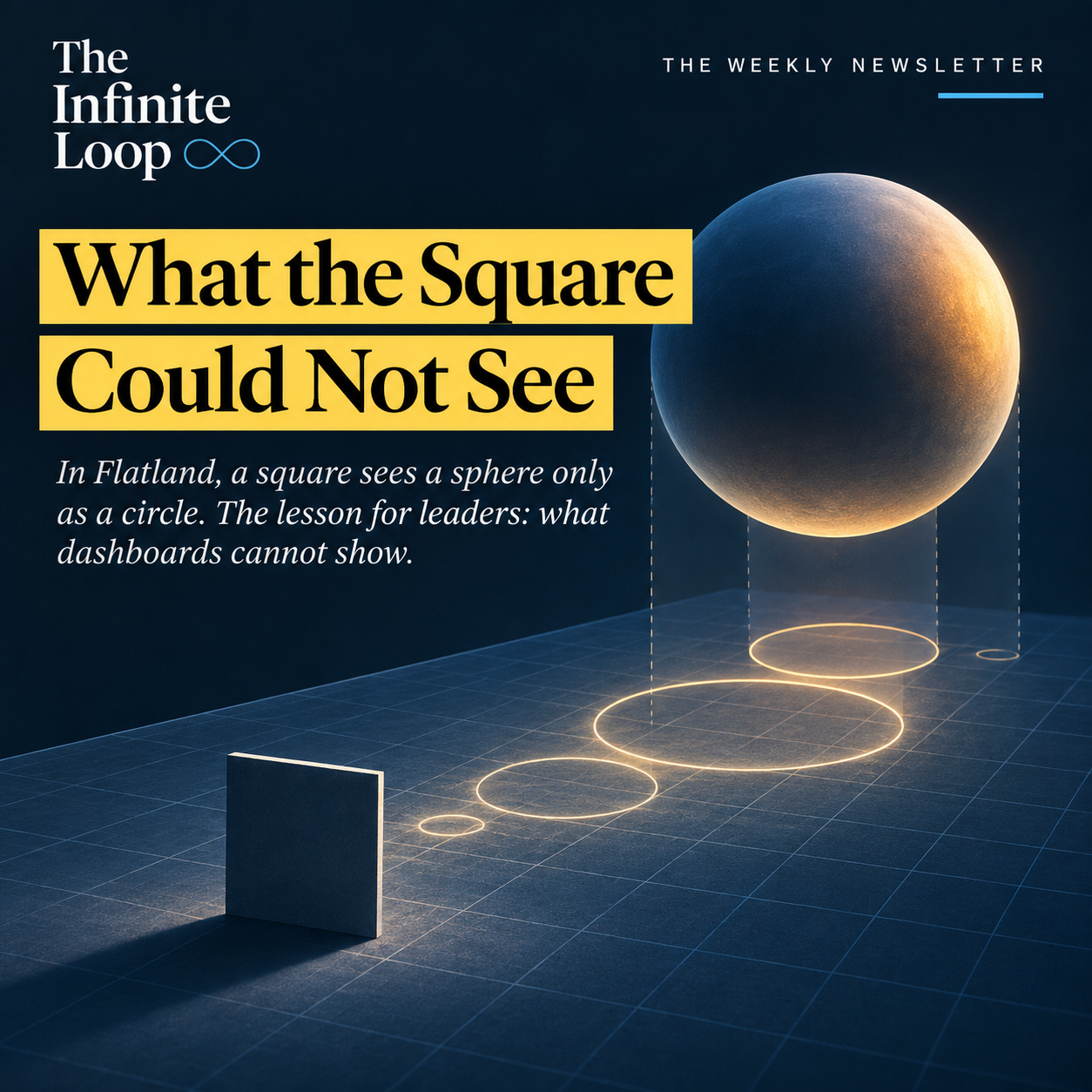
In Flatland, a square sees a sphere only as a circle that appears, grows and vanishes. Physics has looked hard for extra dimensions and, so far, found none. For leaders, the lesson is about what dashboards cannot show.
Tags: Science, Higher Dimensions, Leadership, Decision Making, Measurement
In 1884 Edwin Abbott Abbott published a short book about a square. Flatland: A Romance of Many Dimensions is narrated by A Square, who lives in a two-dimensional world and has no idea that any other direction exists. One day a visitor arrives from Spaceland. "I am not a plane Figure, but a Solid," the Sphere tells him. (Abbott, Flatland, 1884)
The Square cannot see a sphere. He can only see the slice of it that passes through his world: a circle that appears from nowhere, grows, shrinks and vanishes. Abbott's point, made with Victorian wit, was that our own sense of reality may be just as limited. This part of the series asks what physics has learned about extra dimensions since, and what the Square's predicament has to teach anyone who runs an organisation by the numbers they happen to measure.
After Abbott, 1884
A sphere passes through Flatland
Step through the visit. On the left is what is really happening; on the right, all the Square can know.
Illustration after Abbott, Flatland (1884), in which the Sphere's circle "will become smaller and smaller till it dwindles to a point and finally vanishes".
From the fourth dimension to many
Abbott was writing at a time when mathematicians were taking higher dimensions seriously as geometry. Physics followed. In a lecture in Cologne on 21 September 1908, Hermann Minkowski showed that Einstein's special relativity was most naturally described as a single four-dimensional space-time. "Henceforth," he declared, "space for itself, and time for itself shall completely reduce to a mere shadow." (Minkowski, 1908) (The original edition of this newsletter credited that step to Einstein's general relativity; it was Minkowski, building on Einstein's earlier work.)
String theory, the subject of part two, goes further, requiring extra spatial dimensions that are curled up too small to see. And in 1998 three physicists, Nima Arkani-Hamed, Savas Dimopoulos and Gia Dvali, proposed something bolder: that some extra dimensions might be large, perhaps around a millimetre, and that gravity seems weak because it spreads into them while everything else stays in our three. (Arkani-Hamed, Dimopoulos and Dvali, 1998)
The extra dimension that could be tested
What made the 1998 proposal unusual, and admirable, was that it could be tested on a laboratory bench. If gravity leaks into extra dimensions around a millimetre in size, then at distances below that scale it should stop obeying Newton's inverse-square law. The authors said so explicitly. (Arkani-Hamed, Dimopoulos and Dvali, 1998)
Experimenters took up the challenge. In 2020 the Eöt-Wash group at the University of Washington published a measurement of gravity between test masses separated by between 3 millimetres and 52 micrometres (thousandths of a millimetre). "Newtonian gravity gave an excellent fit to our data," they reported. (Lee et al., Physical Review Letters, 2020) The large extra dimensions, at least in the form first proposed, were not there.
That is not a failure of science; it is science working. A bold idea made a specific prediction, the prediction was tested, and the answer came back. It is exactly what the multiverse of part one and the string landscape of part two have so far been unable to offer.
Testing gravity at short range
Where the extra dimensions should have shown up
Distance between test masses, on a logarithmic scale.
The 1998 proposal said gravity should deviate from the inverse-square law at about a millimetre. No deviation was found anywhere in the measured range.
Sources: Arkani-Hamed, Dimopoulos and Dvali (1998); Lee et al., Eöt-Wash (2020).
The universe we do not see
The Square's problem is also, in a sense, ours. In 2013 the European Space Agency's Planck mission reported that ordinary matter, everything made of atoms, accounts for 4.9% of the universe. Dark matter makes up 26.8% and dark energy 68.3%. (ESA and the Planck Collaboration, 2013) We infer both from their effects, not by seeing them directly. Physicists have proposed many explanations, a few involving extra dimensions; none is yet confirmed.
Abbott's insight holds up well. A being limited to some of the dimensions of a situation sees effects without causes: circles that appear from nowhere, change size for no reason and vanish. The causes are real. They are simply in a direction the observer is not equipped to look.
A dashboard is a slice. When the numbers change for no visible reason, the cause is usually in a dimension you are not measuring.
What this means for leaders
The first implication is that every management dashboard is Flatland. It shows the slices of the business that happen to be measured, and when something moves for no visible reason, the instinct is to explain it within the dimensions on the screen. Often the cause sits in one that is not there: customer sentiment, staff morale, a competitor's move, a regulatory shift. Before explaining a surprise, ask what dimension you are not looking along.
The second is to admire, and copy, the 1998 proposal. It was bold, it was wrong, and it was valuable, because its authors stated in advance what result would show it was wrong and invited others to look. Most organisations do the reverse: they make bold claims that cannot be tested and cautious ones that can. A strategy that names the measurement that would disprove it is worth more than one that cannot lose.
The third is humility about what is unmeasured. Some 95% of the universe was inferred rather than seen, and it took decades of careful work to infer it. The equivalent in a business is usually less exotic, but no less real: the things that matter most are often the hardest to count, and the absence of a number is not the absence of a thing.
Three questions follow. Which dimensions of our business are missing from the numbers we review every month? When a metric surprises us, do we look outside the dashboard for the cause? And which of our bold ideas have we stated in a form that could be shown to be wrong?
Your turn: what is missing from the dashboard?
Which dimension of your organisation is most important but least measured?
- Customer trust
- Staff energy and morale
- Capabilities we are losing or building
- What is changing outside the industry
Vote and see current results on the website.
Thanks for reading,
Ideas for a Better World Editor, Simon Hill
About the Editor: Founder of Wazoku including Innocentive, author of the award winning Expected Value, Mapping Value, TEDx speaker and innovation thought leader.
Previously in this series
Part 3: Forty Years Without a Test
String theory, and how to judge a long, expensive bet.
Next in this series
Part 5: The Timelines That Did Not Happen
From mirror universes to counterfactuals: how to learn from the futures that did not happen.
Where it started
Part 1: The Universes We Cannot See
The multiverse and the planes that came back.
How we checked this piece
This edition was first published on LinkedIn on 12 December 2024 as "Exploring Infinite Realities: Unraveling the Mysteries of Multidimensionality", the third in the series. It has been revised for 2026, and every claim in the body is graded HIGH against a named primary source.
| Claim | Grade | Source |
|---|---|---|
| Abbott, Flatland: A Romance of Many Dimensions, 1884; Sphere: "I am not a plane Figure, but a Solid"; circle dwindles "to a point and finally vanishes" | HIGH | Project Gutenberg text (Seeley & Co., London, 1884) |
| Minkowski, Cologne, 21 September 1908: four-dimensional space-time; "space for itself, and time for itself shall completely reduce to a mere shadow" | HIGH | Minkowski, "Space and Time", Saha translation via Wikisource |
| Arkani-Hamed, Dimopoulos and Dvali, 1998: large extra dimensions around a millimetre explain gravity's weakness; testable by sub-millimetre gravity experiments | HIGH | Physics Letters B 429, 263 (1998) |
| Eöt-Wash 2020: separations 52 µm to 3.0 mm; "Newtonian gravity gave an excellent fit to our data" | HIGH | Lee et al., Physical Review Letters 124, 101101 (2020) |
| Planck 2013: ordinary matter 4.9%, dark matter 26.8%, dark energy 68.3% | HIGH | ESA and Planck Collaboration release, 21 March 2013 |
| Large extra dimensions "in the form first proposed" not found | ANALYSIS | Inference from the two papers above; other versions remain possible |
| Dashboards as Flatland; stating disproof conditions | ANALYSIS | Editorial judgement |
| Corrected from the original: general relativity was not the first theory to treat time as a dimension; Minkowski's 1908 space-time was | CUT | Minkowski (1908) |
| Removed from the original: extra dimensions may explain dark matter; time as a landscape bearing on free will | CUT | Speculative; no primary evidence |