Ideas for a Better World newsletter
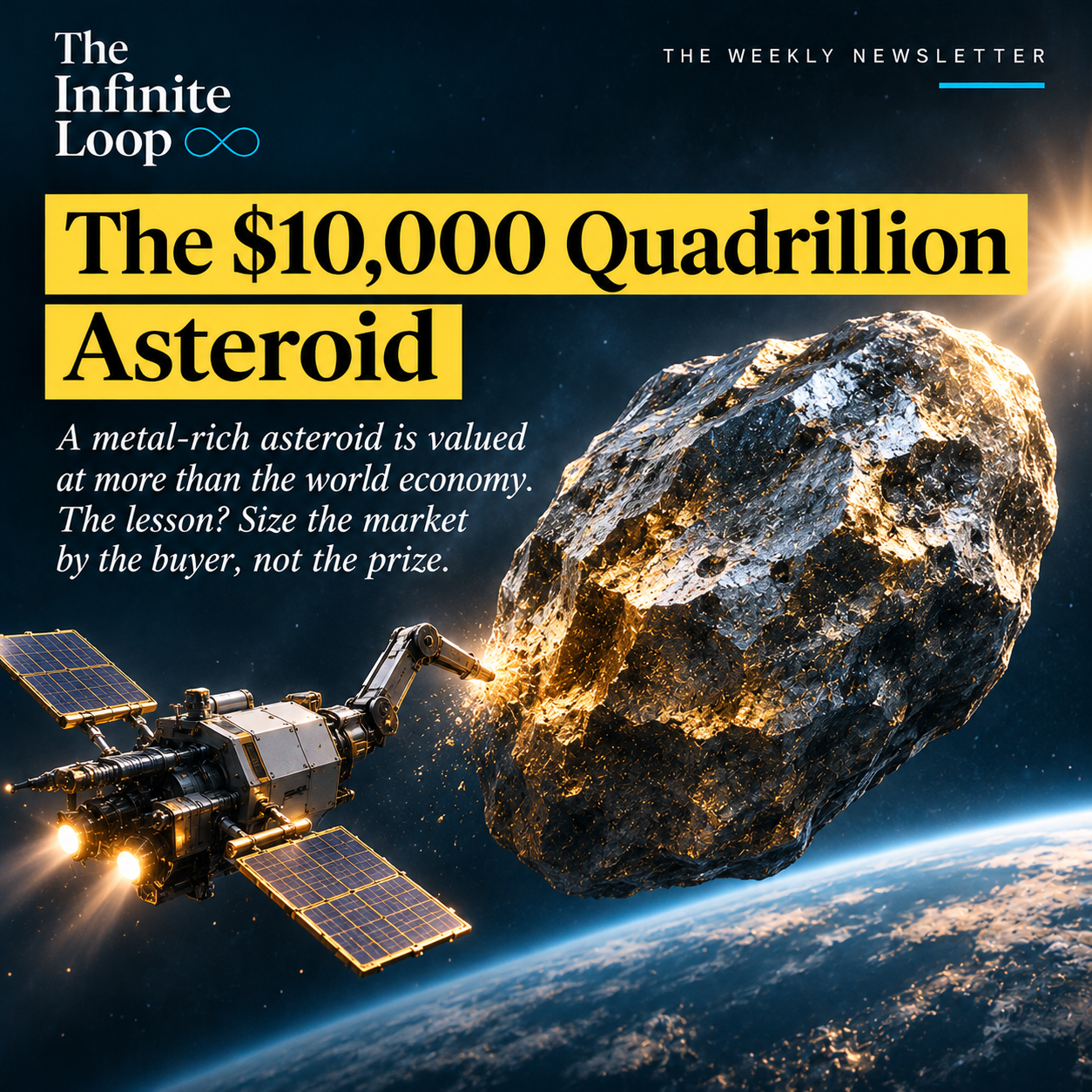
The $10,000 Quadrillion Asteroid
Headlines value one metal asteroid at more than the world economy. The whole global platinum market is worth a few billion dollars a year, and the first wave of asteroid miners sold up. For leaders, it is a lesson in sizing markets by the buyer, not the prize.
Tags: Space, Science, Innovation, Economics, Leadership
Guess first
Asteroids are often described as flying platinum mines. How many tonnes of platinum did the whole world mine in 2025?
170 t
About 170 tonnes, worth roughly $6.6 billion at 2025's average price.
When this newsletter began a series on space mining in January 2025, it opened with a number that has been repeated in countless headlines: the metal asteroid 16 Psyche, "valued at $10,000 quadrillion". Figures like that, and larger ones, still circulate. They come from estimating how much metal an asteroid contains and multiplying by today's prices on Earth. (Space.com, 2023)
It is a striking way to make a point about scale. As a valuation, it is meaningless, and understanding why is the best introduction to the economics of space mining. This revised series asks a different question from the original. Not what could we mine, but what would make it pay.
Why the asteroid is not worth $10,000 quadrillion
Three things are wrong with the headline number. The first is price. The world mined about 170 tonnes of platinum in 2025, at an average of roughly $1,200 a troy ounce. (USGS, 2026) That makes the entire annual market worth about $6.6 billion. A market that small cannot absorb a flood of new supply without the price collapsing; the more successful an asteroid mine, the less its output would be worth.
The second is cost. As the planetary physicist Philip Metzger told Space.com, the cost of bringing the metal back would negate its value. (Space.com, 2023) The third is that nobody is going there to mine it. NASA's Psyche spacecraft, launched on a SpaceX Falcon Heavy on 13 October 2023, is a science mission, due to enter orbit around the asteroid in August 2029. (NASA) There are no plans to mine Psyche. (Space.com, 2023)
A valuation built from the size of the prize, rather than from who would buy it, at what price, and at what cost to deliver, is not a valuation. It is a measure of excitement.
The first gold rush
The excitement has been tested before. Planetary Resources launched in 2012 with high-profile backers, including Google's Eric Schmidt and the film-maker James Cameron, and had raised $50 million by 2016. In 2018 it was sold to ConsenSys, a blockchain software company. Its rival Deep Space Industries, which had raised far less, was bought by Bradford Space, which shifted its focus to green propulsion. (MIT Technology Review, 2019; GeekWire, 2019)
The reasons, as MIT Technology Review reported, were mundane. The companies could not generate revenue from the technology along the way, there was no customer base for mined material for perhaps 12 to 15 years, and decades-long plans did not fit venture funds with a life of around ten years. "The bottom line is that space is hard," the space policy historian Henry Hertzfeld said. (MIT Technology Review, 2019)
A second generation has since tried. The start-up AstroForge sent a small probe, Odin, towards an asteroid in February 2025 as a secondary payload on a lunar mission. The team picked up only faint signals in the first hours and then lost contact; the company's own debrief, titled "Odin't", put its pre-launch chance of success at roughly 30%. Its next, larger spacecraft is planned to fly on a later lunar mission. (AstroForge, 2025)
Asteroid mining, 2012 to 2029
Boom, bust and a second try
The business has had more exits than extractions.
- 2012Planetary Resources launches with high-profile backers
- 2016Planetary Resources has raised $50 million
- 2018Planetary Resources sold to blockchain firm ConsenSys
- 2019Deep Space Industries bought by Bradford; shifts to propulsion
- 2023NASA launches Psyche, a science mission, not a mine
- 2025AstroForge's Odin lost soon after launch
- 2029Psyche due to reach its asteroid
Sources: MIT Technology Review (2019); GeekWire (2019); NASA; AstroForge (2025).
The real reason it matters
None of this means space resources are unimportant. The strategic case for them on Earth is about concentration, not scarcity. China accounted for about 270,000 of the world's roughly 390,000 tonnes of rare-earth mine production in 2025, close to 70%. (USGS, 2026) The International Energy Agency finds China is the dominant refiner for 19 of the 20 critical minerals it analyses, with an average share of around 70%. (IEA, 2025)
That is a genuine strategic problem. But it is a problem of refining capacity, permits and supply chains on Earth, and asteroids are a very long way from solving it. The more immediate economic case for space resources lies somewhere less glamorous, and it is the subject of the next part of this series: the most valuable thing to mine in space is probably water, and the best customer for it is probably already in orbit.
A valuation built from the size of the prize, rather than from who would buy it and at what price, is not a valuation. It is a measure of excitement.
What this means for leaders
The first implication is to distrust any market sized by the value of the resource rather than the behaviour of the buyer. Business plans often do the same thing as the Psyche headline: multiply a large quantity by today's price and call it an opportunity. Ask instead what the price would be once you arrive, who would pay it, and what it costs to deliver. A large enough supply changes the price it was valued at.
The second is to match the time horizon to the money. The first space-mining companies did not fail because the physics was wrong. They failed because their payoff lay decades away and their funding expected returns within one. Long-horizon bets need patient capital, or revenue along the way, as an earlier edition on string theory argued about research programmes.
The third is to find the customer who exists now. The most credible space-resource businesses are those selling to someone who already needs the product, at a price they already pay. On Earth, platinum buyers are not short of supply. In orbit, anyone who needs fuel is.
Three questions follow. Which of our growth plans are sized by the prize rather than by the buyer? Are our longest bets funded by money that can wait for them? And for each new venture, who is the first customer, and are they paying today?
Your turn: when will space mining pay?
When do you expect the first profitable business built on resources mined in space?
- Within ten years
- In ten to twenty years
- Not for twenty years or more
- Not in my lifetime
Vote and see current results on the website.
Thanks for reading,
Ideas for a Better World Editor, Simon Hill
About the Editor: Founder of Wazoku including Innocentive, author of the award winning Expected Value, Mapping Value, TEDx speaker and innovation thought leader.
Next in this series
Part 2: Water is the gold
Why the first valuable resource in space is the one you can drink, breathe and burn.
Also in the archive
Space Junk
The other economics of orbit: who pays to clean it up.
Also in the archive
Small Plates, Big Problems
Why many small attempts can beat one big bet.
How we checked this piece
This edition was first published on LinkedIn on 9 January 2025 as "Space Mining 101: What Is It and Why Does It Matter?", the first of a series. It has been rewritten for 2026 around the economics of space resources. Every claim in the body is graded HIGH against a named primary source.
| Claim | Grade | Source |
|---|---|---|
| Psyche valuations from estimated metal mass multiplied by Earth prices; Metzger: retrieval cost would negate value; no plans to mine Psyche | HIGH | Space.com (Rebecca Sohn, 12 October 2023); Space.com reports $100,000 quadrillion for iron alone, the original edition $10,000 quadrillion |
| Psyche launched 13 October 2023 on Falcon Heavy; orbit insertion August 2029 | HIGH | NASA Psyche blog |
| World platinum mine production about 170 t in 2025; average price about $1,200 per troy ounce | HIGH | USGS Mineral Commodity Summaries 2026, platinum-group metals |
| Annual platinum output worth about $6.6 billion | HIGH | Calculated: 170,000 kg × 32.15 troy oz/kg × $1,200 |
| Planetary Resources: launched 2012; Schmidt and Cameron backers; $50 million by 2016; sold to ConsenSys 2018; DSI bought by Bradford; reasons for failure; Hertzfeld quote | HIGH | MIT Technology Review, 26 June 2019; GeekWire, 2019 |
| Odin launched 26 February 2025 as a secondary payload on IM-2; contact lost; about 30% pre-launch chance of success; next craft planned for IM-3 | HIGH | AstroForge mission debrief, 6 March 2025 |
| China about 270,000 of about 390,000 t rare-earth mine production, 2025 | HIGH | USGS Mineral Commodity Summaries 2026, rare earths (China figure is a quota) |
| China dominant refiner for 19 of 20 critical minerals, average share about 70% | HIGH | IEA Global Critical Minerals Outlook 2025 |
| A large new supply would depress the price | ANALYSIS | Basic supply economics; no forecast given |
| Corrected from the original: Planetary Resources presented as a current key player | CUT | Sold in 2018 (MIT Technology Review) |
| Corrected from the original: China "80%" of production and "almost 100%" of heavy rare-earth processing | CUT | Replaced with USGS and IEA figures |
| Removed from the original: $2,500 per kg launch cost; 1.1 million asteroids over 1 km; Artemis "sustainable presence by 2028" | CUT | To be revisited with primary sources later in the series |