Ideas for a Better World newsletter
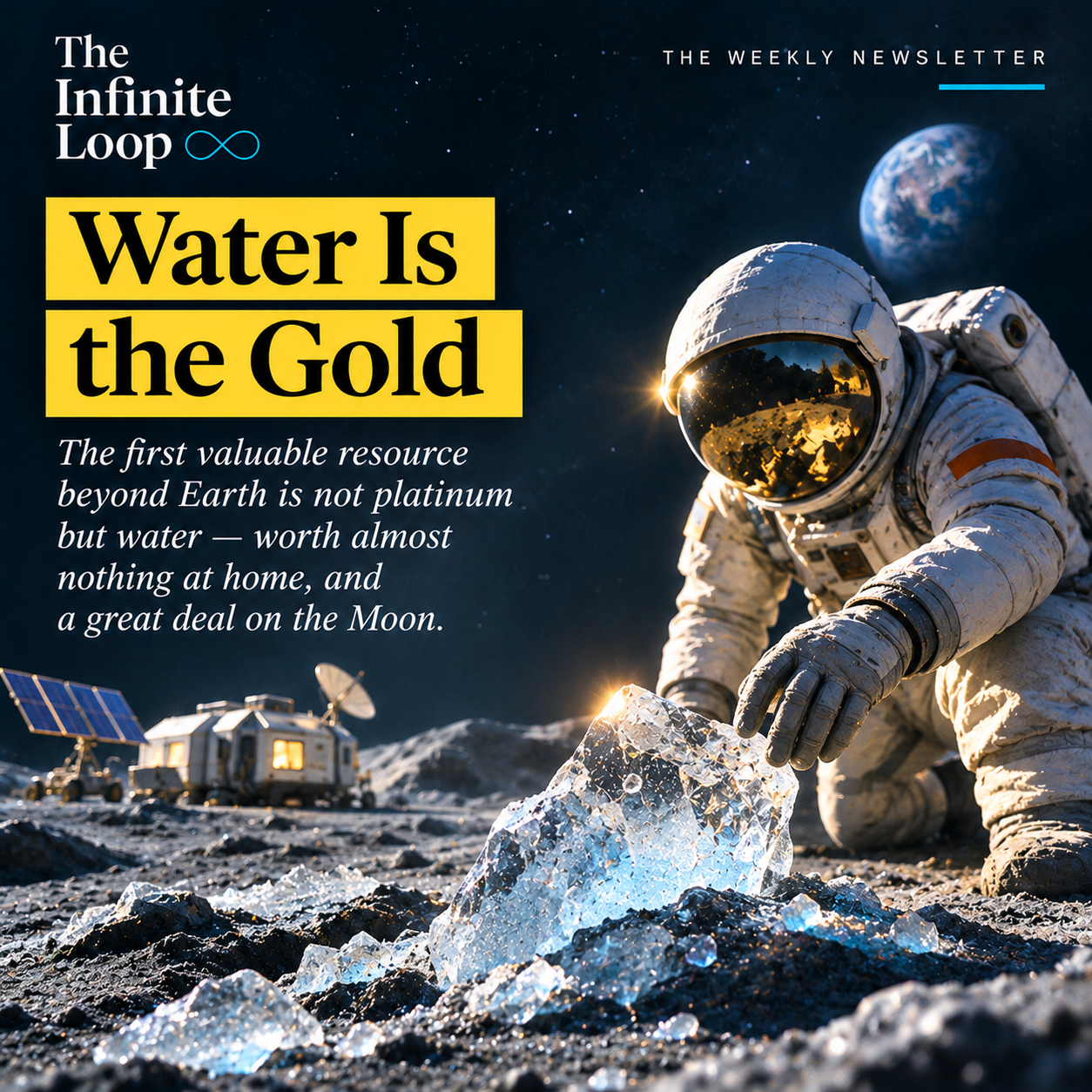
Water Is the Gold
The first valuable resource beyond Earth is not platinum but water, worth almost nothing at home and a great deal on the Moon. Nobody yet knows how much there is. For leaders, it is a lesson in pricing assets where they are used, and proving a resource before building on it.
Tags: Space, Science, Innovation, Economics, Leadership
Guess first
In 2009 NASA crashed a spent rocket stage into a permanently dark crater near the Moon's south pole and measured the debris. What share of the crater's soil, by mass, turned out to be water?
5.6%
About 5.6%, give or take 2.9 percentage points. Wetter than many Earth deserts, but measured at a single spot.
Part 1 of this series argued that the trillion-dollar asteroid is a measure of excitement, not value, and promised a less glamorous answer to the question of what is actually worth mining in space. Here it is. The first valuable resource beyond Earth is unlikely to be platinum, gold or rare earths. It is water.
Water is worth almost nothing on Earth. On the Moon, it could be worth more than any metal, for one reason: it is already there, and everything else has to be lifted out of Earth's gravity at enormous cost. Its value comes entirely from where it is, not from what it is. That is a principle with uses well beyond space.
Drink, breathe, burn
Water does three jobs that any long stay on the Moon requires. People drink it. Split by electrolysis, it yields oxygen to breathe, and oxygen makes up about 89% of water's mass. The same split yields hydrogen, and liquid hydrogen burned with liquid oxygen is one of the most efficient rocket propellants there is. A tonne of water found on the Moon is a tonne of life support or fuel that did not have to be launched.
That last point is where the economics live. To escape Earth, a spacecraft must reach 11.2 kilometres a second. To escape the Moon takes 2.38. (NASA Moon fact sheet) Because the energy required rises with the square of that speed, lifting each kilogram off the Moon takes about one twenty-second of the energy needed to lift it off Earth. Propellant made on the Moon could, in principle, fuel spacecraft far more cheaply than propellant hauled up from home.
One tonne of lunar ice
Three jobs for the same molecule
Choose a use.
Life support
Melted and purified, ice becomes drinking water and the coolant and radiation shielding a base needs. Every litre found locally is a litre that does not ride a rocket from Earth.
Oxygen
Electrolysis splits water into oxygen and hydrogen. Oxygen is most of water's weight, so a tonne of ice holds close to 900 kilograms of it: air for the crew, and the larger half of a rocket's propellant load.
Propellant
Liquid hydrogen burned with liquid oxygen is one of the most efficient chemical rocket fuels. Made on the Moon, it starts out at the bottom of a gravity well about a twenty-second as deep, in energy terms, as Earth's.
Sources: NASA Moon fact sheet; oxygen share from molar masses.
The gravity well
The cost of leaving home
Minimum energy to lift one kilogram to escape velocity.
Water on the Moon starts with an energy advantage of about 22 to one over water shipped up from Earth. Real missions need more than this ideal minimum, but the ratio is why location sets the price.
Source: escape velocities from the NASA Moon fact sheet; energy calculated as ½v².
How much is there?
The difficulty is that nobody yet knows how much water there is, or how easy it would be to extract. The best direct measurement remains NASA's LCROSS mission. On 9 October 2009 it drove a spent rocket stage into Cabeus, a permanently shadowed crater near the south pole, and flew a second spacecraft through the debris. The team estimated the soil at the impact site to be 5.6% water by mass, plus or minus 2.9 percentage points. (Colaprete et al., Science, 2010)
In 2018, researchers using NASA's Moon Mineralogy Mapper, which flew on India's Chandrayaan-1 spacecraft, reported the first direct evidence of exposed water ice on the surface in the polar regions. They described the deposits as "patchily distributed". (NASA JPL, 2018) Neither result is a survey. One is a single impact in one crater; the other sees only the top few millimetres.
The attempts to go and look have been instructive. Intuitive Machines' Athena lander touched down near the south pole on 6 March 2025 carrying NASA's PRIME-1 ice drill, then fell on its side in a crater. It could not generate power, and the drill never operated on the surface. (Space.com, 2025) NASA cancelled its ice-prospecting rover, VIPER, in July 2024 over cost after spending about $450 million, then revived it in September 2025 under a contract worth up to $190 million for Blue Origin to land it in late 2027. It is to search for ice near the south pole for about 100 days. (Space.com, 2025)
Lunar water, resource to reserve
How far up the ladder we are
A mining company would not raise capital on the first two rungs.
- Seen from orbitPatchy surface ice, top few millimetres (2018)Done
- Sampled onceOne impact plume in one crater, 5.6% water (2009)Done
- Drilled on siteAthena tipped over; drill never ran (2025)Failed
- Prospected by roverVIPER, about 100 days at the south poleLate 2027
- Proven reserveEnough mapped ice to plan a mine aroundNot yet
Sources: NASA JPL (2018); Colaprete et al. (2010); Space.com (2025); Space.com (2025).
The customer is coming, slowly
The original version of this piece said NASA's Artemis programme aimed for a sustainable human presence on the Moon by 2028. The timetable has moved. Artemis II launched four astronauts, Reid Wiseman, Victor Glover, Christina Koch and Jeremy Hansen, on 1 April 2026 on a ten-day flight around the Moon (Via Satellite, 2026), and they splashed down safely on 10 April. (Associated Press via OPB, 2026)
In February 2026 NASA restructured what follows. Artemis III, due in 2027, will no longer go to the Moon; its crew will instead dock in Earth orbit with one or both of the commercial landers being built by SpaceX and Blue Origin. The first landings move to Artemis IV and V, both planned for 2028, after which NASA aims for one lunar mission a year. "We've got to get back to basics," said the NASA administrator, Jared Isaacman. (Spaceflight Now, 2026)
That matters for water because the first customer for lunar water is a crew on the Moon, and the size of the market depends on how often they come and how long they stay. A mission a year is a beginning, not a market.
Water is worth almost nothing on Earth. On the Moon it could be worth more than any metal, because its value comes entirely from where it is.
What this means for leaders
The first implication is that value is set by the cost of the alternative, delivered to the customer. Lunar water is valuable only because the alternative is water launched from Earth. Many businesses misprice their assets by valuing them where they sit rather than where they are used. Data, talent and inventory are all worth most where they are needed, and least in a warehouse.
The second is to prove the resource before building the business on it. Mining distinguishes between a resource, which is known to exist, and a reserve, which has been measured well enough to be extracted at a profit. After more than fifteen years of evidence, lunar water is still a resource. Corporate strategies often skip the same step, building plans on a market that has been glimpsed rather than measured.
The third is that the first customer is usually the one already on site. The case for lunar water rests on the people and spacecraft that will be there, not on shipping it back. New ventures often look for distant, large markets when the most credible early buyer is the one who already bears the cost of the problem.
Three questions follow. Which of our assets do we value where they sit, rather than where they are used? Which of our growth plans rest on a resource we have glimpsed but not measured? And who already pays, today, for the absence of what we want to sell?
Your turn: the first lunar product
What will be the first resource commercially produced and sold on the Moon?
- Oxygen for life support
- Rocket propellant
- Building material from lunar soil
- None within twenty years
Vote and see current results on the website.
Thanks for reading,
Ideas for a Better World Editor, Simon Hill
About the Editor: Founder of Wazoku including Innocentive, author of the award winning Expected Value, Mapping Value, TEDx speaker and innovation thought leader.
Next in this series
Part 3: The fusion fuel nobody can burn yet
Helium-3, the most hyped lunar resource, and the reactor it still lacks.
Previously
Part 1: The $10,000 Quadrillion Asteroid
Why a market sized by the prize is not a market.
Also in the archive
Space Junk
The other economics of orbit: who pays to clean it up.
How we checked this piece
This edition was first published on LinkedIn on 16 January 2025 as "Part 2: The Resources in Space: What Can We Mine and Where?". It has been rewritten for 2026 around the economics of lunar water. Every claim in the body is graded HIGH against a named primary source.
| Claim | Grade | Source |
|---|---|---|
| Escape velocity Earth 11.2 km/s, Moon 2.38 km/s | HIGH | NASA NSSDC Moon fact sheet |
| Energy per kg to escape: Earth 62.7 MJ, Moon 2.8 MJ, ratio about 22 | HIGH | Calculated as ½v² from the NASA figures; ideal minimum, ignoring losses |
| Oxygen about 89% of water by mass | HIGH | Molar masses: O 15.999, H₂O 18.015 |
| LCROSS impact 9 October 2009 in Cabeus; 5.6 ± 2.9% water by mass at the impact site | HIGH | Colaprete et al., "Detection of Water in the LCROSS Ejecta Plume", Science 330, 463 (2010) |
| M3 on Chandrayaan-1: direct evidence of exposed surface ice in polar regions; "patchily distributed"; top few millimetres | HIGH | NASA JPL news release on Li et al., PNAS, 20 August 2018 |
| Athena landed 6 March 2025, tipped on its side, no power; PRIME-1 drill did not operate on the surface | HIGH | Space.com, March 2025 |
| VIPER cancelled July 2024, about $450m spent; revived September 2025, Blue Origin CLPS contract up to $190m, landing late 2027, about 100 days | HIGH | Space.com, September 2025 |
| Artemis II launched 1 April 2026, crew of four, ten-day lunar flyby | HIGH | Via Satellite, 1 April 2026 |
| Artemis II splashdown 10 April 2026 | HIGH | Associated Press via OPB, 10 April 2026 |
| Artemis restructure: Artemis III in 2027 in Earth orbit with commercial landers; Artemis IV and V landings planned 2028; one mission a year after; Isaacman quote | HIGH | Spaceflight Now, 27 February 2026 |
| Lunar propellant could be cheaper than propellant launched from Earth | ANALYSIS | Follows from the energy ratio; no cost estimate given |
| Resource versus reserve distinction | ANALYSIS | Standard mining terminology, used as an analogy |
| Removed from the original: Psyche "$10,000 quadrillion… everyone a millionaire" | CUT | Covered and corrected in Part 1 |
| Removed from the original: Artemis "sustainable presence by 2028" | CUT | Superseded by the February 2026 restructure (Spaceflight Now) |
| Moved: helium-3 "25 tons could power the US for a year" | CUT | Held for Part 3, pending a primary source |
| Removed from the original: rare earths in space as a near-term supply | CUT | Supply concentration on Earth addressed in Part 1 |
Simon Hill is the founder of Wazoku, which owns Innocentive, the open innovation platform.