Ideas for a Better World newsletter
What It Actually Takes
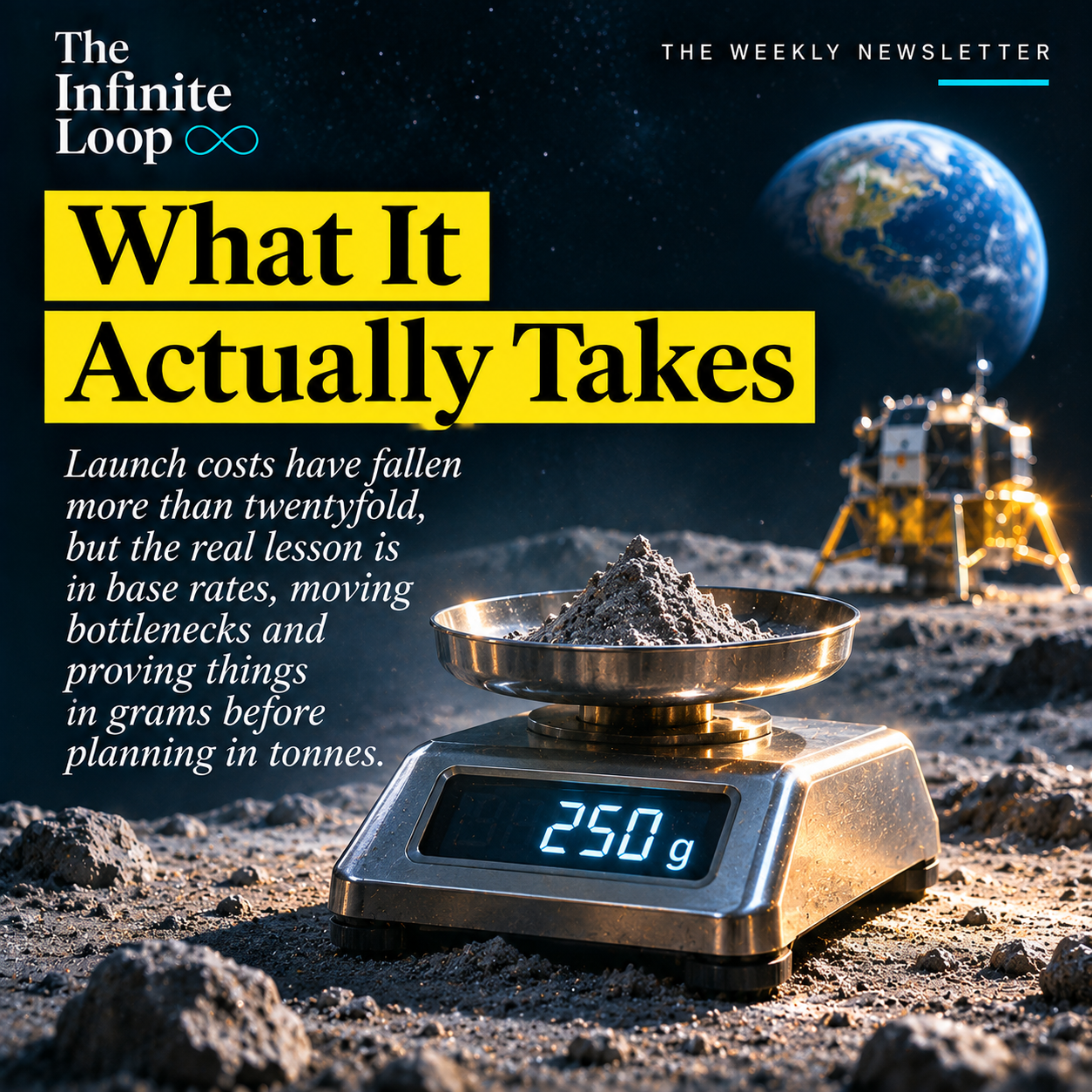
Launch costs have fallen more than twentyfold, but only one of seven private Moon landers has fully succeeded, and everything space resources have yet produced weighs about 250 grams. For leaders, it is a lesson in base rates, moving bottlenecks and proving things in grams before planning in tonnes.
Tags: Space, Science, Technology, Innovation, Leadership
Guess first
Between 2019 and 2025, seven privately built spacecraft set out to land on the Moon. How many landed upright and completed their mission?
1
One: Firefly's Blue Ghost, in March 2025. Three crashed, two landed on their sides and one never reached the Moon.
The original version of this edition, published in February 2025, was a catalogue of promising machines: robotic miners, artificial intelligence, 3D printers fed with lunar soil, and spacecraft from companies such as Planetary Resources. The catalogue has aged quickly. Planetary Resources had been sold to a blockchain firm in 2018, before that edition was written. (MIT Technology Review, 2019)
The deeper problem with a catalogue is that it answers the wrong question. Whether a clever excavator can be built is not in doubt. What the series has been circling, from asteroids to water to helium-3, is whether anyone can reliably get equipment to the surface, keep it alive, and make it produce something. On that question the record is now long enough to read.
Getting up has become cheap
The cost of reaching orbit has fallen dramatically. In a 2018 NASA paper, Harry Jones of the Ames Research Center estimated the Space Shuttle's cost at about $61,700 per kilogram to low Earth orbit and SpaceX's Falcon 9 at about $2,700, both in 2018 dollars, a reduction of roughly 23 times. The Falcon Heavy came in at about $1,400. (Jones, NASA, 2018) That is a genuine revolution, and it is why so many lunar businesses now exist on paper.
But orbit is not the Moon's surface. Each step beyond it, the journey, the descent and the operation on the ground, has its own cost and its own failure rate, and the cheapest launch in history does not help a lander that crashes.
Getting down is the hard part
Between 2019 and 2025, seven privately built spacecraft tried to land on the Moon, and only one fully succeeded. The Israeli lander Beresheet crashed in April 2019 after problems with its guidance system and main engine. (Spaceflight Now, 2019) The Japanese company ispace lost its first lander in April 2023 and its second, Resilience, in June 2025, when a laser rangefinder failed to give valid altitude readings. (Space.com, 2025) Astrobotic's Peregrine suffered a propellant leak and never reached the Moon. (The Planetary Society)
Intuitive Machines has landed twice, and twice its lander has ended up on its side: Odysseus in February 2024, and Athena in March 2025, which could not generate power and whose batteries then ran out. (NASASpaceFlight, 2025; Space.com, 2025) The one clear success was Firefly's Blue Ghost, which landed upright in Mare Crisium on 2 March 2025 and completed its science, the first fully successful vertical landing by a US lander since December 1972. (NASASpaceFlight, 2025) No NASA-sponsored lander touched down in 2026; the next deliveries are planned for 2027. (The Planetary Society)
Private Moon landings, 2019 to 2025
The scorecard
Filter by outcome.
SpaceIL
CrashedCrashed on descent after guidance and main engine problems
ispace
CrashedLost during descent
Astrobotic
Never arrivedPropellant leak; never reached the Moon
Intuitive Machines
On its sideLanded on its side; laser rangefinder did not work
Firefly
UprightLanded upright and completed its science
Intuitive Machines
On its sideLanded on its side; could not generate power
ispace
CrashedHard landing after a laser rangefinder anomaly
landed upright and completed its mission.
Sources: Spaceflight Now (2019); Space.com (2025); The Planetary Society; NASASpaceFlight (2025); Space.com (2025).
The site does not forgive
Once on the ground, a mining machine faces conditions that no terrestrial mine does. A signal takes about 1.3 seconds to cross the 384,400 kilometres to the Moon, so every command and its result take about 2.6 seconds round trip, too slow for anyone on Earth to steer a machine through a delicate manoeuvre. At the equator, surface temperatures swing between about 95 and 390 kelvin, roughly minus 180 and plus 120 °C, and a lunar day lasts 29.5 Earth days, so a solar-powered machine faces nights of about 15 days. (NASA Moon fact sheet)
Power, not intelligence, is the constraint that keeps recurring. Athena did not fail because it could not think; it failed because, lying on its side, its solar panels could not see the Sun. (Space.com, 2025) The original edition's claim that artificial intelligence could halve mission costs had no primary source, and has been cut.
What has actually been produced
The best measure of where the technology stands is what it has produced. The only demonstration of turning another world's resources into something useful is NASA's MOXIE experiment on the Perseverance rover, which split carbon dioxide from the Martian atmosphere into oxygen. Over 16 runs it made 122 grams, about what a small dog breathes in ten hours, at up to 12 grams an hour, twice NASA's goal. (NASA JPL, 2023)
The record for bringing material home is of the same order. NASA's OSIRIS-REx returned 121.6 grams from the asteroid Bennu in September 2023, more than twice the 60 grams its science required. (NASA, 2024) Japan's Hayabusa2 returned about 5.4 grams from Ryugu in December 2020, 54 times its goal. (Government of Japan, 2021) These missions are triumphs. They are also a reminder that the industry's entire output to date can be weighed on a kitchen scale.
The production record
Space resources, to date, in grams
Everything so far extracted or returned by the missions that worked.
NASA's MOXIE, 16 runs from 2021 to 2023. Twice its target rate.
NASA's OSIRIS-REx, 2023. More than twice the 60 g required.
JAXA's Hayabusa2, 2020. Fifty-four times its 0.1 g goal.
Interlune's planned lunar excavator is designed to process 100 tonnes of soil an hour. The gap between the record and the plans is about a factor of a million.
Sources: NASA JPL (2023); NASA (2024); Government of Japan (2021); GeekWire (2025).
The industry's entire output to date can be weighed on a kitchen scale.
What this means for leaders
The first implication is to find the base rate before planning the scale. One in seven private lunar landers has fully succeeded. Any lunar business plan that assumes its equipment arrives working is assuming the exception. The same discipline applies to any venture in a domain with a short, poor track record: count the attempts, not the announcements.
The second is that solving one bottleneck moves it. Launch costs fell by more than twentyfold, and the constraint shifted to descent, power and survival on the surface. Leaders who celebrate the solved problem often miss that their strategy now depends on the next one, which is usually less glamorous and less funded.
The third is that the missions that worked set modest targets and beat them. MOXIE doubled its target rate, OSIRIS-REx doubled its sample requirement, and Hayabusa2 returned 54 times its goal. Grams come before tonnes. A staged programme that proves each step at small scale earns the right to the next; one that skips to scale inherits every untested risk at once.
Three questions follow. What is the real base rate of success for the kind of venture we are planning? Which bottleneck in our strategy has quietly replaced the one we just solved? And where are we planning in tonnes before we have proved anything in grams?
Your turn: the hardest problem
Which is the biggest obstacle between today and a working mine on the Moon?
- Landing reliably
- Power through the lunar night
- Operating without people
- Finding paying customers
Vote and see current results on the website.
Thanks for reading,
Ideas for a Better World Editor, Simon Hill
About the Editor: Founder of Wazoku including Innocentive, author of the award winning Expected Value, Mapping Value, TEDx speaker and innovation thought leader.
Next in this series
Part 5: Who owns the Moon?
Treaties, accords and the question of who may keep what they dig up.
Previously
Part 3: The Fusion Fuel Nobody Can Burn Yet
Helium-3's famous market, and the one that pays.
Previously
Part 2: Water Is the Gold
Why location, not scarcity, sets the price of lunar water.
How we checked this piece
This edition was first published on LinkedIn on 6 February 2025 as "Space Mining Part 4: The Technology Behind Space Mining". It has been rewritten for 2026 around the record of what has actually been landed and produced. Every claim in the body is graded HIGH against a named primary source.
| Claim | Grade | Source |
|---|---|---|
| Planetary Resources sold to ConsenSys in 2018 | HIGH | MIT Technology Review, June 2019 |
| Launch cost per kg to LEO (2018 $): Shuttle about $61,700, Falcon 9 about $2,700, Falcon Heavy about $1,400; reduction about 23 times | HIGH | Jones, "The Recent Large Reduction in Space Launch Cost", ICES-2018-81, NASA Ames |
| Beresheet crashed 11 April 2019; inertial measurement unit and main engine problems | HIGH | Spaceflight Now, 11 April 2019 |
| ispace lost Hakuto-R M1 in April 2023 and Resilience on 5 June 2025; laser rangefinder anomaly | HIGH | Space.com, June 2025 |
| Peregrine propellant leak, never reached the Moon; Odysseus landed 22 February 2024 on its side; no CLPS landings in 2026 (no non-CLPS private landing found either); next deliveries 2027 | HIGH | The Planetary Society, CLPS mission page |
| Blue Ghost landed upright 2 March 2025; first fully successful vertical US landing since December 1972; Odysseus rangefinder did not function; Athena on its side | HIGH | NASASpaceFlight, March 2025 |
| Athena could not generate power | HIGH | Space.com, March 2025 |
| Seven private landing attempts, 2019 to 2025, one fully successful | HIGH | Count of the missions above |
| Mean distance 384,400 km; one-way delay 1.28 s, round trip 2.6 s | HIGH | NASA Moon fact sheet; calculated at the speed of light |
| Equatorial temperature 95 to 390 K; synodic period 29.53 days, night about 15 days | HIGH | NASA Moon fact sheet; night calculated as half the synodic period |
| MOXIE: 122 g oxygen, 16 runs, up to 12 g per hour, twice the goal; small dog for ten hours | HIGH | NASA JPL, 6 September 2023 |
| OSIRIS-REx returned 121.6 g, 24 September 2023; 60 g required | HIGH | NASA OSIRIS-REx blog, 15 February 2024 |
| Hayabusa2 returned about 5.4 g, December 2020; 54 times the 0.1 g goal | HIGH | Government of Japan, KIZUNA, January 2021 |
| Interlune excavator designed for 100 t per hour; gap of about a million | HIGH | GeekWire, 2025; 100 t ÷ 122 g ≈ 800,000 |
| Missions with modest targets overdelivered; staging lesson | ANALYSIS | Interpretation of the record above |
| Corrected from the original: launch cost fell from $54,500 to $2,500 per kg | CUT | Jones gives $54,500 and $2,720 unadjusted; 2018-dollar figures used in the body |
| Removed from the original: autonomous robots could cut mission costs by up to 50%; ISRU could save up to 90% of materials or cost | CUT | No primary source found |
| Removed from the original: Planetary Resources' Arkyd spacecraft as a current programme; Starship "up to 100 tons"; OSIRIS-REx "relied heavily on AI" | CUT | Company sold in 2018; other claims not traceable to a primary source in the form given |
Simon Hill is the founder of Wazoku, which owns Innocentive, the open innovation platform.