Ideas for a Better World newsletter
Who Owns the Moon?
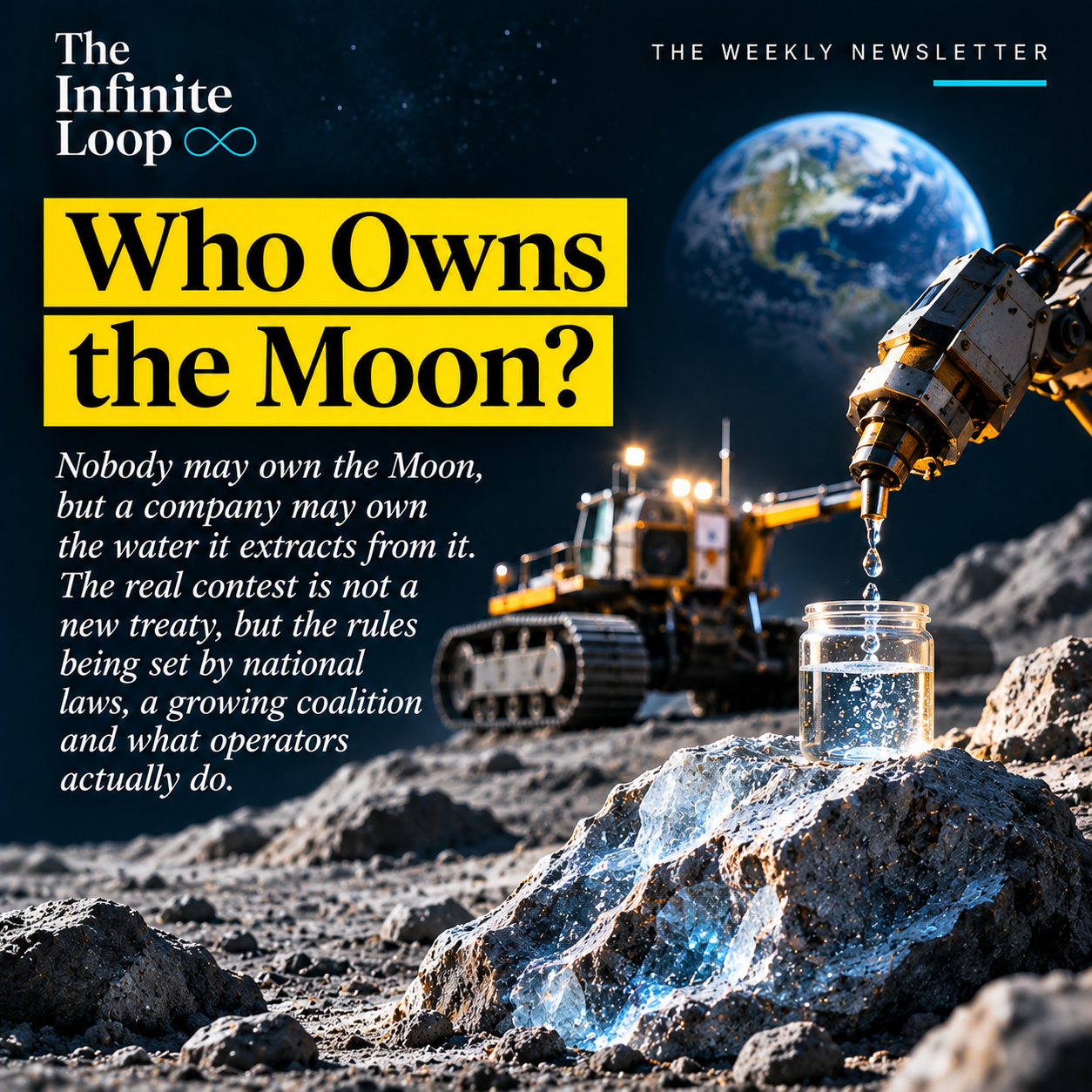
Nobody may own the Moon, but a company may own the water it extracts from it. The rules for space resources are being written not by a new treaty but by national laws, a fast-growing coalition and what operators actually do. For leaders, it is a lesson in shaping rules by showing up first.
Tags: Space, Law, Ethics, Sustainability, Leadership
Guess first
The Artemis Accords, a US-led set of principles for exploring the Moon, were signed by eight countries in October 2020. How many had signed by the end of October 2026?
78
Seventy-eight. Vietnam became the 78th signatory on 28 October 2026. The UN Moon Agreement, by comparison, has 17 parties after more than four decades.
Sources
This series has argued that space mining is less a technology story than an economics story: that the asteroid valuations are fantasy, that water is valuable only because of where it is, that helium-3's real market is refrigeration, and that the record so far is measured in grams. This final part asks the question that decides whether any of it can become a business: who is allowed to keep what they dig up?
The original version of this edition, in February 2025, called the law "ambiguous at best" and hoped for a new international agreement. Twenty months on, the ambiguity is being resolved, but not in the way the original anticipated. The rules are not being written in a new treaty. They are being written by national laws, by a growing coalition of signatories, and by what operators actually do.
No territory, but perhaps the ore
The foundation is the 1967 Outer Space Treaty, which forbids any nation from claiming the Moon or other celestial bodies as its territory. As of 1 January 2025 it had 116 parties. (UNOOSA, 2025) The treaty says nothing explicit about resources. A later instrument did: the 1979 Moon Agreement declares the Moon and its resources "the common heritage of mankind" and calls for an international regime to govern their use. (IISL submission to COPUOS) It has 17 parties, and none of the major spacefaring nations is among them. (UNOOSA, 2025)
Into that gap, states have legislated. The US Commercial Space Launch Competitiveness Act, signed on 25 November 2015, entitles a US citizen who recovers an asteroid or space resource to possess, own, transport, use and sell it. (51 U.S.C. § 51303) The same act adds that the United States "does not thereby assert sovereignty or sovereign or exclusive rights or jurisdiction over, or the ownership of, any celestial body". (Public Law 114-90, § 403) Luxembourg followed with a law of 20 July 2017 whose first article reads: "Space resources are capable of being owned." It requires written authorisation for any mission to explore or use them. (Luxembourg Space Agency)
The emerging position, in other words, separates the land from what is taken from it. Nobody may own the crater. A company may own the water it extracts from it.
What can you do on the Moon?
Five scenarios. Decide whether each is allowed today, not allowed, or still unsettled.
Verdict: not allowed. The Outer Space Treaty forbids national appropriation of the Moon, and its 116 parties include every major spacefaring nation.
Verdict: allowed, under US law. US law since 2015 entitles the company to own and sell what it recovers. Not every state accepts that national laws can settle the question, but no binding international rule forbids it.
Verdict: not allowed. The 2015 act expressly disclaims any US sovereignty or ownership over a celestial body. The resource can be owned; the ground cannot.
Verdict: unsettled. The Artemis Accords provide for safety zones, but for notification and coordination, and signatories must still respect free access. There is no exclusive right to a site.
Verdict: unsettled. The Moon Agreement envisaged an international sharing regime, but only 17 states have joined it. The UN's draft principles, still under negotiation, make benefit sharing voluntary and "as appropriate".
The sources for each answer follow below.
Two clubs and a committee
The most consequential development has been the Artemis Accords, a set of non-binding principles established by NASA, the US State Department and seven other countries in October 2020. They state that extracting and using space resources should comply with the Outer Space Treaty, and they introduce "safety zones" around operations, used for notification and coordination and ending when the operation ends, within which signatories must still respect free access. Vietnam became the 78th signatory on 28 October 2026. (NASA)
China and Russia lead a rival programme, the International Lunar Research Station, which counted 13 participating countries in September 2024, according to the Secure World Foundation's tracking. (Secure World Foundation) At the United Nations, a working group of the Committee on the Peaceful Uses of Outer Space has been drafting principles for space resource activities since 2025. (UNOOSA, 2025) Its consolidated draft of 24 September 2026 says that extraction compliant with the treaty "does not inherently constitute national appropriation", requires assessment of potentially significant adverse impacts, and makes benefit sharing voluntary. It remains a negotiating text, and is non-binding. (Opinio Juris, 2026)
Who has signed up to what
The rulebooks for the Moon
Parties or participating countries, at the latest date available for each.
The Accords went from 8 signatories to 78 in six years. The Moon Agreement, the only treaty to call lunar resources a common heritage, has 17 after more than four decades.
Sources: UNOOSA status of agreements (2025); NASA; Secure World Foundation. Counts are at different dates and are not strictly comparable.
Nobody may own the crater. A company may own the water it extracts from it.
Law by practice
What the original edition hoped for, a single multilateral agreement on resource rights and benefit sharing, is not what is happening. The binding treaties are old; the new rules are national laws, non-binding accords and draft principles. That leaves real questions open, including who adjudicates when two operators want the same ice-filled crater, and whether the environmental assessments in the UN draft will ever be more than voluntary.
It also means that the first operators to arrive will set precedents simply by acting. A safety zone declared, respected and repeated becomes a norm. That is why the slow progress described in Part 4 matters for the law as much as for the business: the countries whose landers work will have the most influence on what the rules become.
What this means for leaders
The first implication is that rules are often written by whoever shows up first. The Artemis Accords grew from 8 signatories to 78 not by negotiating a treaty but by offering a ready-made set of principles that others could join. In emerging markets on Earth, from data standards to AI governance, the organisations that publish workable rules early tend to shape the eventual settlement.
The second is that you do not need to own the asset to own the value. Space law is settling on a model in which the ground is common but the extracted resource is private. Many businesses already work this way, through licences, concessions and rights to a flow rather than title to the source. It is worth asking which of our strategies assume ownership where a right of use would do.
The third is to treat regulatory uncertainty as a design input rather than a reason to wait. The UN draft already points towards impact assessment and information sharing. Operators who build those in now will not have to retrofit them, and will have a stronger hand when the rules are finalised.
Three questions follow. In which of our markets are the rules still being written, and are we in the room? Where are we insisting on owning something when the right to use it would be enough? And which likely future obligation could we adopt now, at low cost, to strengthen our position when it arrives?
The series in one paragraph
Across five parts, the same lesson has recurred. Space resources have been valued by the size of the prize rather than the behaviour of the buyer; by what they are rather than where they are; by their famous use rather than their paying one; and by what could be built rather than what has worked. The law is now following the same path as the business, away from grand principles and towards the practical question of who is actually there. For anyone sizing a new market on Earth, that is a sequence worth remembering.
Your turn: who should set the rules?
Who should decide the rules for mining the Moon?
- A binding UN treaty
- Coalitions such as the Artemis Accords
- National laws, as now
- The operators, through practice
Vote and see current results on the website.
Thanks for reading,
Ideas for a Better World Editor, Simon Hill
About the Editor: Founder of Wazoku including Innocentive, author of the award winning Expected Value, Mapping Value, TEDx speaker and innovation thought leader.
Start the series
Part 1: The $10,000 Quadrillion Asteroid
Why a market sized by the prize is not a market.
Previously
Part 4: What It Actually Takes
One lander in seven, and a production record in grams.
Also in the archive
Space Junk
The other economics of orbit: who pays to clean it up.
How we checked this piece
This edition was first published on LinkedIn on 13 February 2025 as "Part 5: Ethics, Law, and Sustainability in the Final Frontier". It has been rewritten for 2026 around how the rules for space resources are actually being made. Every claim in the body is graded HIGH against a named primary source. This is not legal advice.
| Claim | Grade | Source |
|---|---|---|
| Outer Space Treaty 116 parties; Moon Agreement 17 parties, as at 1 January 2025 | HIGH | UNOOSA, Status of International Agreements, A/AC.105/C.2/2025/CRP.9/Corr.1 |
| Outer Space Treaty forbids national appropriation of celestial bodies | HIGH | Outer Space Treaty, Article II |
| Moon Agreement declares the Moon and its resources "the common heritage of mankind" and calls for an international regime | HIGH | IISL submission to the COPUOS working group; Moon Agreement, Article 11 |
| Major spacefaring nations are not parties to the Moon Agreement | HIGH | UNOOSA status table |
| US citizen recovering a space resource is entitled to possess, own, transport, use and sell it | HIGH | 51 U.S.C. § 51303 |
| Act approved 25 November 2015; Section 403 disclaimer quote | HIGH | Public Law 114-90 |
| Luxembourg law of 20 July 2017: "Space resources are capable of being owned"; written authorisation required | HIGH | Luxembourg Space Agency |
| Artemis Accords established 2020 by NASA, State Department and seven other countries; resources to comply with OST; safety zones for notification and coordination, free access; Vietnam 78th signatory 28 October 2026 | HIGH | NASA Artemis Accords page |
| ILRS: 13 participating countries as of September 2024 | HIGH | Secure World Foundation tracking (latest dated figure found) |
| COPUOS working group draft principles circulated March 2025 | HIGH | UNOOSA circular CU 2025/80 |
| 24 September 2026 consolidated draft: extraction not inherently appropriation; impact assessment; voluntary benefit sharing; non-binding, still under negotiation | HIGH | Opinio Juris, 25 September 2026 (analysis of the published draft) |
| First operators will set precedents by acting; landers' success shapes the rules | ANALYSIS | Interpretation |
| Ground common, extracted resource private, as the emerging model | ANALYSIS | Summary of the US and Luxembourg laws and the UN draft |
| Corrected from the original: "signed by over a hundred nations" | CUT | Replaced with the UNOOSA count of 116 parties |
| Removed from the original: asteroid redirection creating debris; Mars contamination; job displacement in terrestrial mining | CUT | Not supported by a primary source in the form given; debris covered in the Space Junk edition |
| Removed from the original: call for an international resource fund and licensing body | CUT | Author's 2025 proposal, superseded by the analysis of what is actually being agreed |
Simon Hill is the founder of Wazoku, which owns Innocentive, the open innovation platform.